
The ongoing offensive against Islamic State forces holding the Iraqi city of Tikrit in Salahuddin province is a crucial barometer for future operations. Instead of containing the city and then bypassing it to retake Mosul, military planners have decided to eliminate the Islamic State's presence there first. Aside from being known as the hometown of former Iraqi leader Saddam Hussein, Tikrit is an important Sunni Arab stronghold on the highway linking Baghdad with Mosul.
Critical to the conduct of the battle, which began March 1, is the fact that Iran has taken the lead in supporting Iraqi forces as they expand into Sunni territory. Tehran has so far supplied rockets, military advisers and tactical intelligence in an effort to assume responsibility for an area it considers part of its sphere of influence. The United States, while not being overt in its approval, has not vociferously objected either, focusing its own airpower for the time being on other areas held by the Islamic State.
The Iraqi army, recovering from its collapse last year, is making gains in rural areas east of Tikrit, having established a blocking position to the west. By capturing the suburbs of al-Dawr to the south and al-Alam to the north, Islamic State fighters have increasingly been forced to fall back to the city. In an attempt to slow advancing forces and disrupt airstrikes from Iraqi fixed-wing aircraft and attack helicopters, the militants set fire to the Ajil oil field, creating massive clouds of smoke.
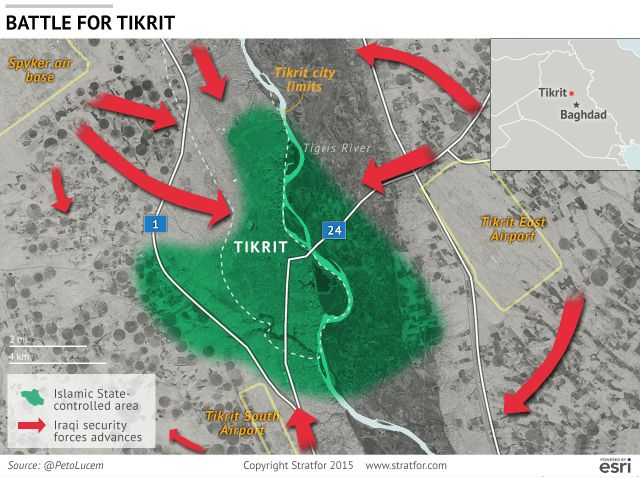
Reports indicate that Iraqi attempts to lock down Tikrit have not been successful, with Islamic State fighters still possessing limited freedom of movement. Sources on the ground claim that elements of the Islamic State leadership in Tikrit have already fled the city. Although it is unlikely that the Islamic State would relinquish its grip on Tikrit without extracting a cost on the attacking forces, the exodus of ground commanders could indicate an expectation that the city will fall. Additional reports, however, suggest that Islamic State forces have abandoned Qayyarah Air Base, south of Mosul, to free up reinforcements for Tikrit. This would indicate the militant group is prepared to stand its ground, or in the worst case, counter attack in force.
Battlefield Attrition
Improvised explosive devices and sniper fire are slowing Baghdad's forces as well as anti-Islamic State militias. A roadside bomb in the southern al-Dawr district killed the commander of the Shiite militia League of Righteousness on March 4, along with his bodyguard. Other pro-Iraqi government forces discovered a bomb-making factory in the Naoura district, recovering some 40 explosive devices ready for use.
After tightening the perimeter, about 30,000 Iraqi soldiers and Shiite militia fighters will attack the city with air cover from rotary and fixed-wing aircraft. Fighting in the urban environment will be costlier for the military because the built-up terrain gives the defending Islamic State forces a significant advantage. An estimated 28,000 civilians have already fled the city in anticipation of the coming assault.
A key thing to watch over the coming days and weeks is how the Iraqi military, their Iranian advisers, Shiite militias and Sunni Arabs share the same space. Sunni tribes have been reluctant to join the fight against the Islamic State, though some small elements are helping. The tribes are seen as crucial allies in the fight against the militants. However, perceived injustices by Shiite fighters could exacerbate the sectarian tensions that led to the Islamic State's rise, even pushing the broad Sunni community to overtly support or even join with the militants. The Iraqi air force has already begun dropping leaflets urging civilians to cooperate with Baghdad's forces.
The Tikrit offensive will serve as an indicator of how the Iraqi military will likely fare when it comes to retaking Mosul later in the year. An urban assault will expose any weaknesses in tactics, techniques and procedures, as well as overarching command and control in the urban battle space. The general principals to retake Tikrit are similar to what will be needed to retake Mosul. The two cities have similar combat environments, just on different scales. Suffering heavy casualties or running into problems could force the Iraqi military and its Iranian overseers to further delay any assault on Mosul, though support from the peshmerga and possibly even the United States adds further weight to the far-northern offensive to come.
