
Forecast
- Ecuador's right-wing opposition will continue street protests ahead of a key congressional vote that could remove presidential term limits.
- More protests will break out in the coming months as President Rafael Correa attempts to manage a slowing economy and declining public approval.
- Protests would have to expand significantly and protesters become more united to successfully challenge Correa's re-election initiative.
- Correa is unlikely to abandon his bid for re-election in 2017 unless the protests directly threaten his ability to rule.
For nearly a month, a patchwork group of dissatisfied citizens and political opposition parties have held small, sporadic protests across Ecuador. The demonstrations, which have at times involved thousands of protesters, began after President Rafael Correa proposed new taxes on capital gains and on inheritance. Correa's more recent initiative to eliminate presidential term limits so that he can seek re-election in 2017, however, added to discontent and brought more demonstrators into the streets. Protests have now occurred in all major cities, including Quito, Cuenca, Machala, Ambato and Guayaquil. They have disrupted movement in Ecuador's major cities but have not yet directly threatened the government.
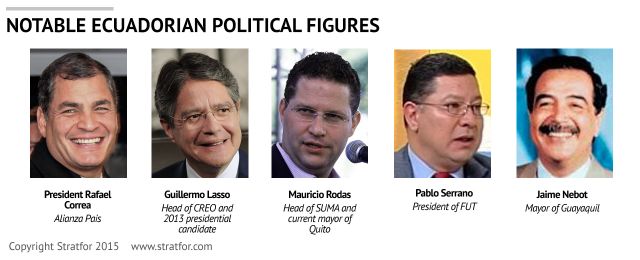
Protesters are roughly divided into three ideological camps, each with different backers: the conservative coalition Creando Oportunidades (CREO), the center-right Social Christian Party and a national union group, the Unitary Workers' Front (FUT). Protesters from each group are present at demonstrations across the country. CREO supports many of the protests in Quito. The coalition's leader, Guillermo Lasso, has attended some of these protests personally, and CREO politician Andres Paez, one of Lasso's political allies, has publicly expressed support for the demonstrations. In Guayaquil, Mayor Jaime Nebot of the Social Christian Party organized a demonstration June 25 involving a few thousand people. FUT involvement in protests centers on opposition to government cuts to pensions.
The demonstrations are the most significant recent challenge to Correa's policies. The country's conservative parties opposed previous presidential constitutional initiatives, such as the 2008 constitutional rewrite and the 2011 national referendum. But their opposition did not diminish Correa's approval ratings, which hung around 60 percent. However, his recent push to remove term limits — coinciding with spending cuts and additional taxes in response to low global oil prices — has cut into his popularity and swelled the protesters' ranks. For now, the divisions among the demonstrators will keep them from becoming a significant enough source of pressure to derail the constitutional amendment that would allow Correa to run for another term. However, additional disruptive protests are likely and could worsen if Correa presses forward with his attempt to remove term limits. The upcoming congressional vote will be crucial for Ecuador: If Correa loses and cannot run again, elections could yield a more business-friendly government. A new administration could reverse the current investment climate, which foreign investors consider risky because of past expropriations and abrupt regulatory changes under Correa.
The groups that have opposed Correa on several legislative topics in the past include traditional political parties and restive but divided indigenous organizations such as the Confederation of Indigenous Nationalities of Ecuador. So far, the government has weathered pressure from these groups because it enjoys strong public support during elections. Moreover, divisions within these opposition groups have kept them from gaining significant strength. For example, the Confederation of Indigenous Nationalities of Ecuador is divided between pro- and anti-government camps. Those divisions have prevented what could be the largest single opposition group in the country from actively threatening the passage of potentially unpopular legislation, such as a water management law passed in 2014.
The same disunity has plagued the country's formal political opposition. The opposition landscape is divided among Lasso's CREO coalition; the United Society Plus Action Party (SUMA), led by Quito Mayor Mauricio Rodas; and the Social Christian Party, whose public face is Nebot. However, the decline in oil prices has affected the Ecuadorian government's political agenda. In April, the government ended its direct funding to retirement pensions — 40 percent of all funding for pensions. Widespread tariff increases on 2,800 items, intended to alleviate the country's deepening trade deficit, raised the prices of imported goods. This has given Ecuador's marginalized opposition parties several social causes to rally around at a time when they can affect Correa's re-election bid.
Correa's reaction to the protests will influence their direction. The president has already shelved tax reform projects as a concession to the opposition. He has called for a public dialogue on the tax reforms, likely in an attempt to slow protests before July 5-8, when Pope Francis is scheduled to visit Ecuador. Both Lasso and FUT have rejected the president's call for a dialogue.
If Correa pushes ahead with his re-election bid, it could further inflame protests. The National Assembly, in which the ruling Alianza Pais coalition controls 100 of 137 seats, completed the first discussion of constitutional amendments to remove term limits in December 2014. The next debate will occur in the last quarter of this year, and Correa has not yet publicly backed down from continuing the discussions. However, a recent Gallup poll indicates that the removal of term limits by congressional vote is highly unpopular, with 80 percent of respondents rejecting it. The other option — one that Rodas openly backs — is a public referendum, which Correa could lose, given his dwindling popularity.
Protests will most likely continue across Ecuador in the coming months. If Correa continues with his plans for a second congressional debate on the elimination of term limits, the protests are likely to increase. However, the intent of these demonstrations does not seem to be to overthrow the government; rather, the groups involved in the protests seem focused on mobilizing their political supporters ahead of 2017, when they may be able to thwart Correa's re-election attempt.
Lead Analyst: Reggie Thompson
Production Editor: Robin Blackburn, Graphics: Robert Zavala
