
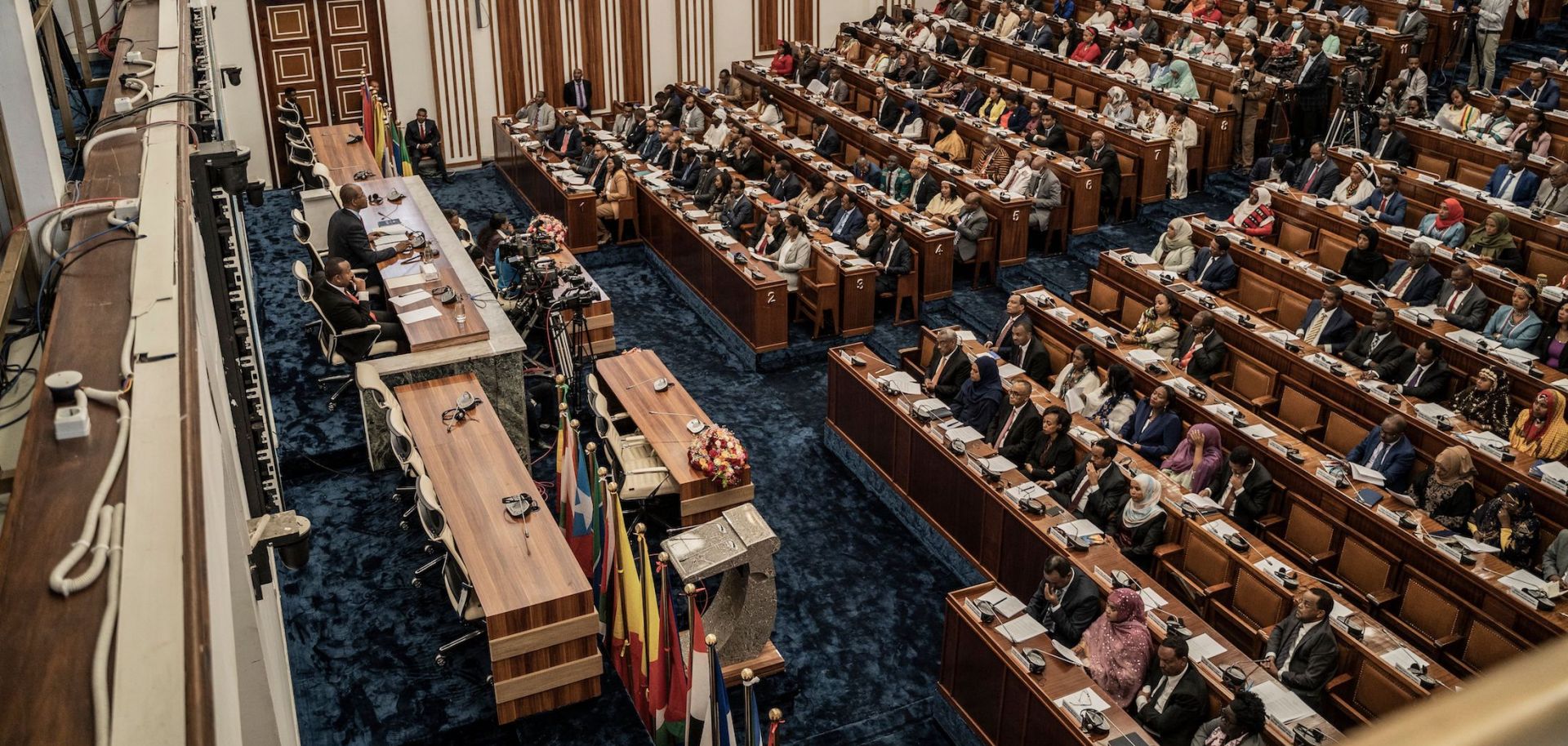
Ethiopia's failure to pay a Dec. 11 Eurobond coupon significantly raises the risk of an external debt default, but either way, the country will likely face an extended and painful economic recovery period as it seeks a relief deal with the International Monetary Fund and external debt restructuring under the Group of 20 (G-20) Common Framework, prolonging investor disinterest and socioeconomic hardship. Ethiopia missed a $33 million interest payment due Dec. 11 on its December 2024 Eurobond. If the country does not make the payment within the 14-day grace period, it will become the third sub-Saharan African nation to default on its external debt since the COVID-19 pandemic following Zambia and Ghana's defaults in 2020 and 2023, respectively. On Dec. 8, Ethiopia's finance ministry said it was ''not in a position to pay'' the interest payment due to the country's ''fragile external position'' and the fact that discussions held with a group of bondholders over restructuring the $1 billion Eurobond have stalled.
- Ethiopia reached a deal ''in principle'' in November with bilateral creditors (apart from China) to suspend debt payments until 2025. But Ethiopia's Paris Club creditors set a deadline of March 31 for the government to either agree on a relief program with the International Monetary Fund (IMF), or declare the November agreement null and void. China agreed separately to pause repayments.
- In early 2021, Ethiopia requested a debt deal under the G-20 Common Framework, the same mechanism that Zambia and Ghana have used to restructure their external debt. The major creditors on the committee include China, Denmark, France, Italy, Korea, Japan and the Saudi Fund, but progress has been extremely slow, due in part to delays caused by the ongoing war in Ethiopia's northern Tigray region.
- According to government data, Ethiopia's total external debt totaled $28.2 billion in March. About 81% of that debt is owed to official multilateral and bilateral creditors, with the remaining 19% owed to private creditors (mostly commercial banks). About 25% of Ethiopia's total external debt stock is owed to non-Paris Club creditors, mainly the Exim Bank of China. Multilateral debt far outstrips Chinese-owned debt, but interest rates on Chinese loans are usually between 5-6% compared with multilateral loan interest rates, which are typically less than 2%.
Ethiopia's war in Tigray and subsequent regional conflicts have drained state coffers, which, combined with high borrowing and low foreign exchange reserves, precipitated the government's elevated risk of default. The two-year-long war in Tigray that ended with a peace agreement in November 2022 and the ongoing conflicts in neighboring Amhara and Oromia regions have led to higher-than-usual military and humanitarian spending, along with international perceptions of elevated risk and underinvestment in unemployment and rural health and education services. During the war in Tigray, Ethiopia's economy demanded high imports but could only produce a fraction of its normal export volume, which forced the government to finance its budget through significant borrowing, with domestic and external credit now covering about 20% of the budget. At the end of September 2022, the ratio of external debt servicing to Ethiopia's exports reached 22% — well above the IMF's recommended 15%. But even before the outbreak of war in 2021, Ethiopia's Growth and Transformation Plan in the 2010s (which aimed to kick-start industrialization and invest in basic infrastructure and state-owned enterprises) relied heavily on external borrowing. Fitch Ratings estimates that Ethiopia's total debt-to-GDP ratio will stand at about 25.8% at the end of 2023 (well below the IMF's 55% recommended ceiling). However, the government's shrinking foreign exchange reserves cannot support the $2.1 billion of debt servicing payments that came due in 2023, let alone the next $2 billion coming due in 2024. In February, Ethiopia's foreign exchange reserves were worth less than one month of import cover, while every year from 2023 to 2027 Ethiopia is scheduled to make Chinese principal repayments of amounts ranging from 20% to 38% of its foreign exchange reserves at 2022 levels, according to Moody's Investors Service. Finally, Ethiopia's efforts to attract private investment and business have largely failed, as bureaucratic red tape and perceptions of elevated risk due to ongoing conflicts in the country have led to investor flight.
Even if Ethiopia avoids an official default, the missed payment reveals the immediacy of the country's debt qualms, which will likely lead to fiscal consolidation measures required by an IMF package and drawn-out external debt negotiations that will prolong Ethiopia's economic turnaround. Ethiopia may still avoid an official default if it pays the $33 million service payment within 14 days. However, the country's broader debt outlook — and specifically, its deal in principle with bilateral creditors that would suspend debt payments until 2025 — hinges on its ability to secure an IMF bailout by March 2024. If Ethiopia defaults on its debt, some creditors may prove less lenient in future negotiations. But official default status would not change the country's fundamental problem — namely, that it doesn't have enough foreign exchange reserves to meet its medium-term debt obligations. This means that even if it cannot reach a deal with the IMF by March 2024, Ethiopia will likely still seek a relief package to ensure it can pay external debt maturities coming due in the second half of the year. Similar to Ghana and Zambia's bailout agreements, an IMF relief deal would likely be contingent on the Ethiopian government enacting unpopular fiscal consolidation measures, like reducing subsidies, freezing government wages and/or reforming the country's currency. Such a deal might also include assurances from the government that it will not reengage in conflict in Tigray. On top of this, the Ghanaian and Zambian cases suggest that even after an IMF deal, the resumption of external debt negotiations under the G-20 Common Framework will still be an arduous and politically costly process, and protracted debt negotiations tend to delay the recovery of an economy. As such, Ethiopia will likely struggle with poor investor sentiment, insufficient access to capital markets, trade imbalances, high unemployment and high poverty rates for several years to come, even as Prime Minister Abiy Ahmed continues to herald Ethiopia as a post-conflict state ripe for investment, with the country's GDP growth rates expected to hover around 6% through 2028. Ethiopia's prolonged economic struggle will also probably further erode Abiy's popularity, which has taken a significant hit since his government launched its war in Tigray in November 2020; this will make for more difficult re-election prospects in 2025, as certain segments of the population, like ethnic Tigrayans and increasingly ethnic Amharas, grow more frustrated with Abiy's handling of their country's economic and security crises.
- Ethiopia's finance ministry will hold a call with bondholders on Dec. 14 to discuss the ministry's Dec. 11 proposal, which asks bondholders to extend the maturity on the $1 billion Eurobond from July 2028 to January 2032 and reduce the interest rate from 6.63% to 5.5%.
