
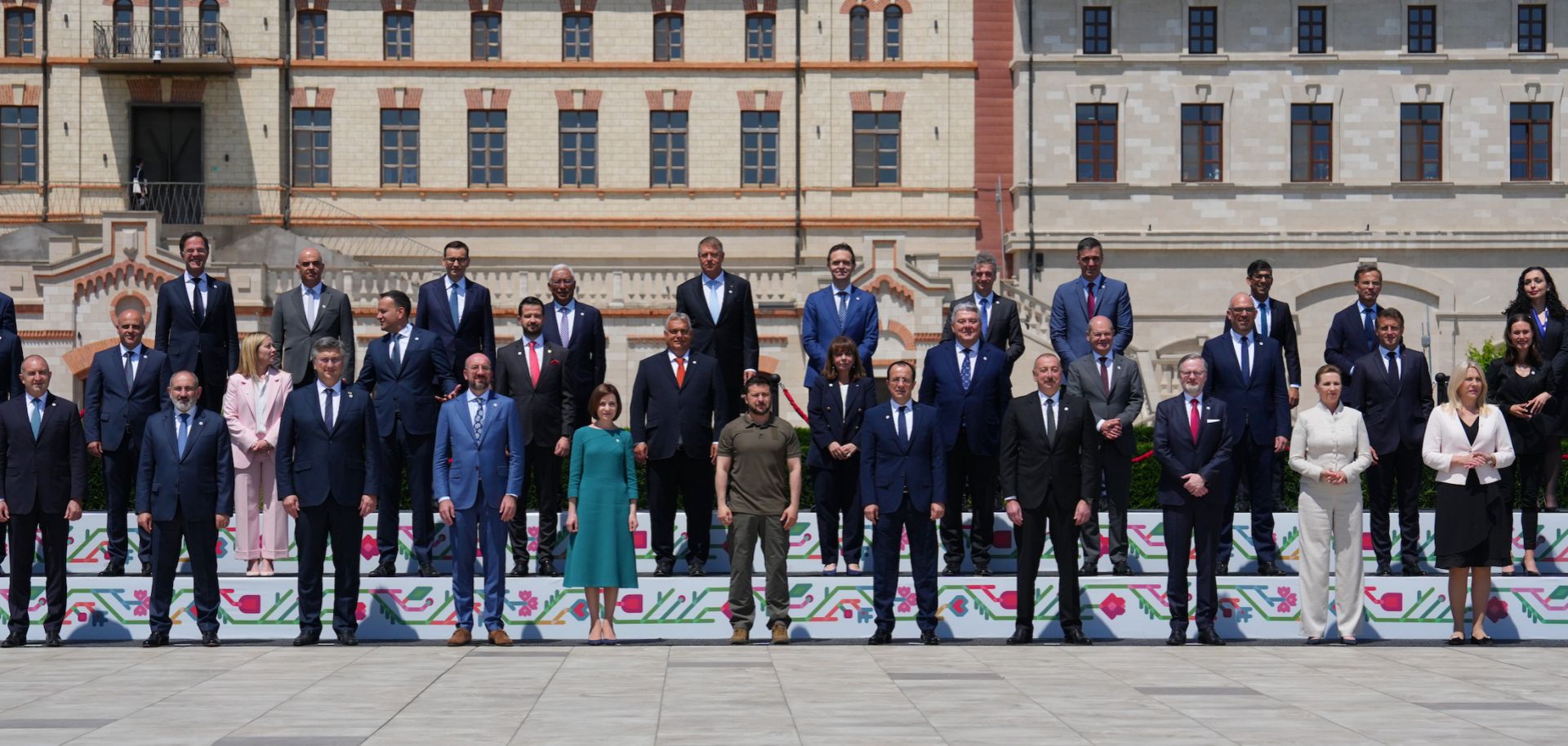
European leaders pose for a photo ahead of the European Political Community (EPC) summit in Bulboaca, Moldova, on June 1, 2023.
EU support and a series of domestic initiatives will give Moldova more tools to maintain its pro-Western course, but will not fully curtail pro-Russian political forces, which will continue to foment unrest leading up to next year's presidential election. On June 1, Moldova hosted the second summit of the European Political Community (EPC), which EU and non-member European countries launched last year as a forum to discuss issues affecting the Continent in the wake of Russia's Ukraine invasion. Nearly 50 European heads of state and government — including Ukrainian President Volodymyr Zelensky — attended the meeting, which was held just 20 kilometers (roughly 12 miles) from the Ukrainian border in what leaders said was a message to Moscow. The summit marked a return to the global spotlight for Moldova, which has battled months of social, economic and political volatility related to Russia's ongoing conflict in neighboring Ukraine. Over the past year, the small European country has faced a leaked Russian plot to overthrow its government, threats of energy cut-offs, ongoing protests staged by pro-Russian Moldovans, and destabilization efforts related to the breakaway region of Transdniestria. Against this backdrop, the European summit saw several announcements of political and economic support for Moldova and affirmations of its aspirations to join the European Union, in an effort to bolster the country's pro-Western president Maya Sandu. Combined with several developments before the summit, this aid is meant to keep living conditions in Moldova from further deteriorating in the coming months, which could have derailed the country's pro-European political course by further eroding support for the Sandu administration in favor of the pro-Russian opposition movement.
- Annual inflation in Moldova was around 28% in 2022, driven largely by high energy prices. In response to the cost-of-living crisis, pro-Russian political forces in the country have regularly staged protests since last summer against President Sandu and her ruling Party of Action and Solidarity. While inflation has eased and general economic conditions have improved in recent months, polling shows that support for Sandu's party has also fallen in favor of pro-Russian parties.
- At a press conference with Sandu on May 31, European Commission President Ursula von der Leyen justified a new support package for Moldova by emphasizing Chisinau has ''embod[ied] Europe's core values'' of unity, solidarity and resilience over the past year by ''linking its destiny to the European Union,'' receiving over 700,000 Ukrainian refugees, and maintaining support for Ukraine's war efforts despite Russian energy and political ''blackmail.''
- On Feb. 9, Ukrainian President Volodymyr Zelensky told EU leaders that his country had intercepted and shared with the Moldovan government Russian plans to ''destroy'' Moldova, which Moldovan intelligence services later confirmed. The following day, Sandu oversaw a government shakeup that saw her nominate her security and defense policy adviser and a former interior minister Dorin Recean as prime minister — a move observers perceived as a sign of pro-European forces' resolve to take a harder line against Russian influence.
New government initiatives and greater foreign support will bolster Moldova's ability to maintain domestic stability and its pro-European course. On May 29, Sandu announced the launch of new initiatives to combat Russian hybrid threats, including the creation of a national center for informational defense and combating propaganda, known as PATRIOT, with the mission of coordinating the state's policy in information security and combating disinformation at the national level. The new initiative, which Sandu said should be sent to parliament by the end of June, is particularly important because Moldova is considered one of the most vulnerable European countries to Russian disinformation and cyber operations. The initiative will also support an EU civilian mission unveiled on April 24 aimed at building capacity to handle hybrid attacks. The European Union further increased support for Moldova on May 30, announcing it was doubling its previously agreed macro-financial assistance to the country to 295 million euros. In addition, on May 31, von der Leyen announced a new five-part support package for Moldova to address the impact of the Ukraine war on its doorstep and speed its integration into the European Union. This will bring total EU support to Moldova to 1.6 billion euros, almost tripling the bloc's support goal compared to its initial goal set in October 2021.
- Moldova applied for EU membership in March 2022, immediately after Russia's invasion of Ukraine in February 2022. The European Union granted Moldova candidate status in June 2022 to send Chisinau (and Moscow) a message of political support for the country. While Moldova's status as an EU candidate means that the country qualifies for financial, political and institutional support from the bloc, Chisinau is unlikely to become an EU member anytime soon due to many current members' skepticism about expanding the bloc.
- The European Union's new support plan will lower the roaming charges between the bloc and Moldova, making it cheaper for people and companies in Moldova and EU member states to call, text and send data to each other. The plan will also provide more than 100 million euros to cover Chisinau's immediate needs in the energy sphere, along with an additional 40 million euros for Moldova's cash-strapped military.
- On Oct. 26, the U.S. Treasury Department sanctioned 12 entities and nine individuals (including the Moldovan oligarchs Vlad Plahotniuc and Ilan Shor) for capturing and corrupting Moldova's political and economic institutions and leading efforts to install pro-Russian leadership in the country. On May 30, the European Union imposed similar sanctions on Plahotniuc and Shor, among other pro-Russian politicians in Moldova. But unlike the U.S. sanctions, the new EU sanctions also targeted the leader behind the protest movement against Sandu's government, Marina Tauber, who was detained on May 1 at the Chisinau airport as she tried to flee to Israel to join Shor. The sanctions against Tauber will provide grounds for tougher action against other leaders of the pro-Russian movement still in Moldova.
While they're unlikely to depose the Moldovan government, pro-Russian forces in the country remain powerful and will continue to regularly stage protests prior to the 2024 presidential election. On May 21, President Sandu called for a pro-EU rally in the center of Chisinau. Her goal was to demonstrate continued public support for the government's pro-European integration course, despite the economic difficulties brought on by Russia's invasion of neighboring Ukraine. Police estimated at least 75,000 attended the rally, dwarfing more common pro-Russian rallies, which have rarely drawn more than 20,000 supporters. However, with inflation slated to remain high as Russia's war next door rages on, pro-Russian political forces will likely continue to try to exploit Moldovans' economic grievances and stage anti-government protests. Such efforts will intensify as the 2024 presidential election nears, where Sandu's rivals will be seeking to oust her in order to begin rolling back Moldova's EU integration progress.
- On May 15, 36-year-old Evghenia Gutul of the pro-Russian Shor party won an election to lead Moldova's semi-autonomous Gagauzia region. Pro-Russian forces have largely dominated Gagauzia's political scene since Moldova's independence in 1991.
- But Gutul's victory — and the fact that she prevailed in a runoff against another pro-Russian candidate — nonetheless underscores that levels of pro-Russian sentiment remain high in Moldova, despite generational changes and new geopolitical realities since 2022.
