
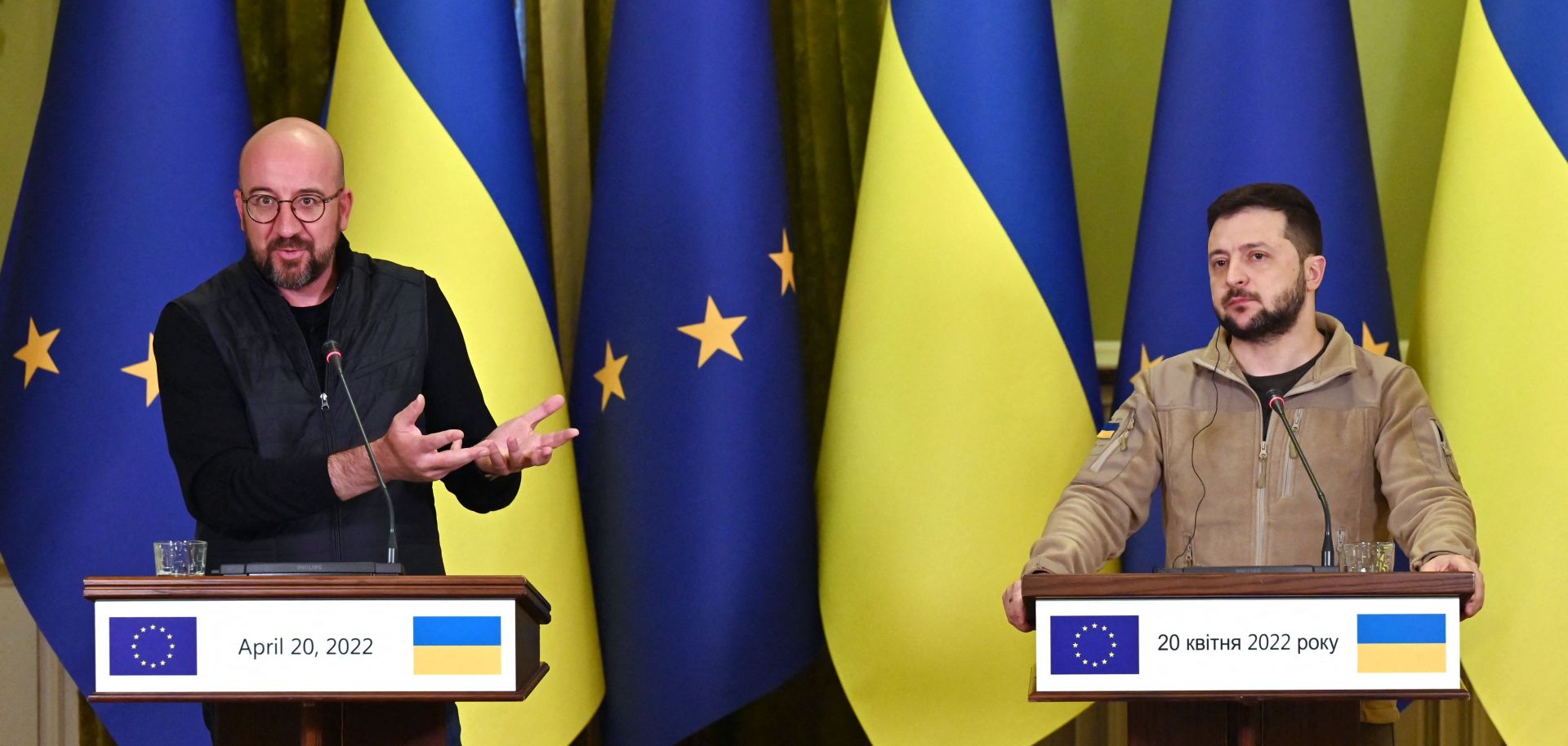
European Council President Charles Michel (left) and Ukrainian President Volodymyr Zelensky hold a joint press conference following their talks in Kyiv on April 20, 2022.
Ukraine will not join the European Union in the foreseeable future, though it may soon become an official candidate, which could ultimately prolong the war with Russia by adding yet another obstacle to peace talks. On April 18, the Ukrainian government announced it had fully responded to a set of questions from the European Union regarding its application to become a member of the bloc. Then on April 19, a spokesperson for the European Commission said that Brussels was working on a recommendation for the European Council on the issue. These events happened amid growing reports in European media that Brussels could suggest the heads of government and state of EU member countries consider formally granting Ukraine the official candidate status during a summit on June 23-24.
- According to the European Union's legal framework, the European Commission can only issue recommendations on whether a new country should join the bloc, but the ultimate decision is in the hands of the European Council, which represents the 27 governments of the bloc. The European Council makes enlargement decisions via unanimity.
- EU governments are internally divided over the issue of Ukraine's EU membership. While most governments in Central and Eastern Europe support the idea, many countries in Western Europe are skeptical of Ukraine's preparedness to join and because of misgivings about overall EU enlargement. Because of these internal disagreements, in recent statements, the European Council has stated that the European Union's preferred framework for cooperation with Ukraine is the Association Agreement that Brussels and Kyiv signed in 2014, which enhances economic cooperation (by, for example, establishing a Deep and Comprehensive Free Trade Area) without any promises of significant political or security integration (areas for which the deal only calls for ''gradual convergence'').
Even if the European Union officially labels Ukraine as a candidate country, Kyiv's membership in the bloc will remain elusive for years, if not decades. Becoming an official candidate is only the first step in a very lengthy and heavily bureaucratic accession process. Once a country becomes an official candidate, it is expected to introduce a series of political and economic reforms to meet the European Union's accession criteria. The process could take many years. Russia's invasion has increased EU solidarity vis-a-vis Ukraine, which could see the bloc accelerate this timeline to grant Kyiv the candidate status. But Ukraine is still very far from meeting many of the European Union's membership criteria. In the past, Brussels has expressed concerns about issues, such as Ukraine's weak rule of law, insufficient economic and financial reforms, corruption and protectionist trade policies. This means that even if the European Union decides to make Ukraine an official candidate to send a message of support for Kyiv, the country still will not join the European Union for the foreseeable future.
- Croatia, the last country that joined the European Union, received candidate status in 2004 but only entered the bloc in 2013. Serbia became an official candidate in 2012 but is not expected to join the bloc for several more years due to the slow progress of Belgrade's ongoing accession talks with Brussels. Albania and North Macedonia are official candidates but formal accession negotiations have yet to take place.
- In a December 2020 review of Ukraine's reform agenda, the European Union noted that ''further concerted efforts will be required in sectors such as energy, corporate governance of state-owned enterprises, along with further critical reforms in the area of judiciary reform and the rule of law more broadly.''
Labeling Ukraine as an EU candidate could complicate peace negotiations with Russia and ultimately prolong the war because Moscow could see it as contradictory to its demand of Kyiv's full neutrality. For the European Union, such a move would primarily have financial implications because candidate countries receive pre-accession EU funds. Ukraine's candidate status would not legally commit the European Union to provide any kind of military or political assistance to Ukraine (though the bloc as a whole and individual member countries may continue or expand existing support for their own reasons). Still, the declaration could impact negotiations with Russia, which had demanded Ukraine's total neutrality in exchange for a peace agreement. Moscow's primary concern is Ukraine's potential membership in NATO (the Western security alliance that includes the United States and has a collective military defense clause). But Russia could also see EU candidacy as a threat to Ukraine's future neutrality by further cementing Kyiv's Western aspirations. Moscow may be more willing to tolerate Ukraine's EU accession as a part of a broader deal that includes Kyiv making significant territorial concessions, which could result in a much smaller Ukrainian state. But Kyiv is unlikely to accept such territorial losses, especially at a time when the war is not progressing as quickly as Russia originally anticipated.
- The European Union includes several frameworks for military cooperation, such as the Permanent Structured Cooperation (PESCO), which harmonizes requirements and pools resources related to military equipment acquisition, research and funding, and also involves the participation in multinational force groups (EU Battlegroups). Although EU countries can opt out of these structures (Denmark and Malta, for example, are not involved in PESCO), Kyiv is unlikely to agree to Moscow's probable insistence that it oversees Ukraine's EU-related decisions and opt-outs if it joins the bloc.
- The European Union's treaty includes a mutual defense clause that says EU countries have an obligation to assist a fellow member state that ''is the victim of armed aggression on its territory.'' The nature of this assistance, however, is not as clearly established as in NATO's Article V mutual defense clause. Moreover, the EU clause claims this obligation should not affect the neutrality of some of its member states, making its interpretation ambiguous. This means that Ukraine could argue that joining the European Union would not interfere with its promise of neutrality, but it's not a given Russia would accept it.
