
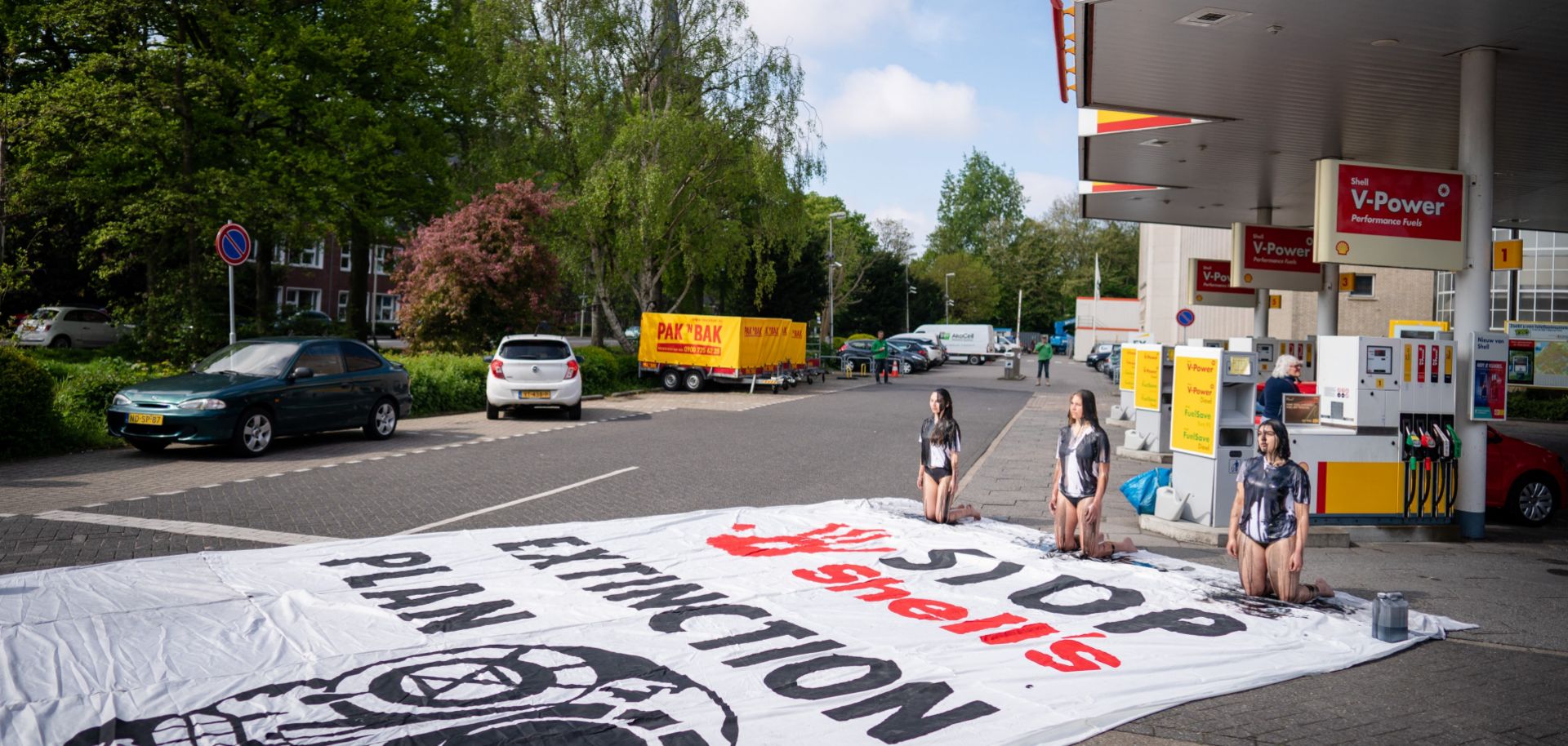
Climate activists take part in a demonstration at a Shell gas station in The Hague, Netherlands, on May 18, 2021.
Legal and investor pressure on Western oil companies will force them to take more concrete and proactive steps to cut emissions, even if it reduces business profitability in the short term. This trend will solidify the transition to renewable energy, boosting investments in carbon-neutral technologies while accelerating the creation of financial tools to help companies offset emissions. On May 26, ExxonMobil, Chevron and Royal Dutch Shell — the three largest Western oil and gas companies — all lost legal cases or shareholder votes that will force them to take a more aggressive approach to cutting emissions.
- A lower Dutch court ruled that Shell was partially responsible for climate change and ordered the Shell group, along with its suppliers and customers, to reduce carbon emissions by 45% by 2030 from 2019 levels through the corporate policy of the group. The ruling is only legally enforceable in the Netherlands and Shell plans to appeal it, but it could be used as a precedent in Western countries in similar cases.
- ExxonMobil’s shareholders voted to appoint at least two new dissident board members to the company’s 12-member board of directors. This was a huge blow to the company’s current leadership after it intensely lobbied investors to vote against the proposal made by a small activist investor, Engine No. 1, that has criticized ExxonMobil’s business strategy related to climate change.
- Chevron’s shareholders voted to “substantially” cut back on so-called “Scope 3” carbon emissions produced throughout the company's entire value chain, including those emitted by its suppliers and customers.
The Dutch court ruling will put oil and gas companies on notice that they may be legally forced to take more stringent measures on climate change if they do not do so themselves. The court order marks the first to force a major oil and gas company to shift its operations in a preventative fashion to combat future climate risks. Beyond just the potential impact on Shell, the Dutch ruling reflects a shift in climate change litigation strategies in recent years where human rights- and consumer protection-based arguments that focus on companies’ fraudulent or misleading statements about climate change impacts are having now success. Lawyers for the environmental group suing Shell argued that the company was violating human rights through its oil, gas and refining operations, undermining the 2015 Paris Agreement goals of reducing the growth rate in global temperatures. The Dutch court largely sided with the argument, saying that Shell had a duty of care to reduce its emissions and that its current plan did not go far enough. Requiring Shell to take preventative measures contrasts with historical climate and environmental litigation, which has largely focused on punitive damages resulting from the impact of oil and gas production (such as on oil spills).
- In a landmark April 2021 ruling, Germany’s Supreme Constitutional Court took a similar position to the Dutch court when it ruled that the country’s Climate Protection Act acted too slow in addressing climate change arguing that it threatened younger people’s “fundamental rights to a human future.”
- Although the human rights angle is now seeing some success, such arguments have failed to win other cases. In January 2021, for example, the Norwegian Supreme Court threw out a case where environmental groups argued that Arctic oil and gas exploration violated a constitutional right to a healthy environment.
Alongside social pressures, shareholders and financial institutions are taking note of the legal risks and the onslaught of more stringent government commitments to push oil companies to take a more proactive approach to climate change. European governments' stronger positions on climate change have pressured European oil companies to make more aggressive commitments compared with their U.S. counterparts. Unlike Europe’s BP, Eni, Equinor, Repsol, Shell and Total, neither Chevron nor ExxonMobil has set Scope 3 emissions targets. Though it appears that may soon change, as the May 26 shareholder votes signal that the two U.S. oil giants are now facing pressure from investors and financial institutions to close the gap, even if the regulatory environment and government commitments in North America remain more accommodative to the oil and gas industry than those in Europe. ExxonMobil CEO Darren Woods has been particularly vocal in opposing calls for the company to take a strong stance on climate change. The shareholder rebellion, however, will lead ExxonMobil to take more action on reducing the environmental impact of its operations regardless — and may even force Woods out of his position.
- Engine No. 1, the investor that initially proposed appointing new climate-conscious members to ExxonMobil’s board of directors, holds just $54 million shares in the approximately $250 billion company. But Engine No. 1’s motion nonetheless passed, thanks to support from some of ExxonMobil’s largest shareholders, reportedly including BlackRock.
In taking a more proactive stance on climate change, oil and gas companies will lay out more concrete plans on how to significantly cut emissions by 2030, among other intermediate pledges. In August, BP announced that it would reduce its oil and gas production by 40% by 2030 and stop exploration activities in countries where it's not currently active. While it may be too ambitious for other majors to mirror, BP’s plan to quickly reduce production could be a harbinger for what oil and gas companies will have to do to meet new climate targets. Indeed, if the recent Dutch court ruling isn’t appealed, Shell will need to follow BP’s footsteps of heavily shedding production and assets in order to cut its emissions by 45% by 2030. And if shareholders also force ExxonMobil and Chevron to take steps toward reducing emissions, both companies will likely have to increase their asset sales and reduce capital expenditure on new projects in order to reduce overall production as well.
- The International Energy Agency (IEA)’s sobering new climate change report outlines particularly extreme commitments for oil and gas producers in order to reach global net-zero carbon emissions by 2050, including the immediate cessation of investment into any new projects. The IEA’s ambitious requirements, however, are not politically palatable for most governments and would require significant shifts in policy around approving new oil and gas projects.
In order to meet new carbon reduction targets, oil and gas companies will shift more investments toward natural gas and less emissions-intensive resources. This will leave some undeveloped oil and gas investments at risk of not being developed, and force firms to divest their involvement from other projects. Large Western oil companies will increasingly be concerned about how new projects will affect their long-term emissions outlook, given that oil and gas projects tend to last for several decades, which will likely translate to slowing down their capital expenditures on projects with either high carbon costs or high overall risk. This could, in turn, prompt an exodus in investment for carbon-intensive projects, such as Canada’s oil sands production. Assets in frontier producing areas, like Tanzania’s proposed liquified natural gas (LNG) project, could also become stranded.
This shift will be financially painful for oil and gas companies, which will be forced to shift toward green technologies and reducing carbon emissions while still maintaining spending on fossil fuel projects in order to sufficiently maintain production. U.S. majors have weathered the global COVID-19 crisis far better than their European peers, perhaps in part because of their focus on oil and gas. Since the onset of the pandemic in early 2020, ExxonMobil and Chevron’s stock prices have risen by nearly 60% and 50%, respectively. Eni, Total, Shell and BP’s stock prices, meanwhile, have all risen by less than 25% over the same period. There are various reasons why European oil companies have fared worse than their American counterparts over the past year, including the differing level of lockdowns in their primary markets. But compared with its European peers, BP is the only one whose stock price is still below pre-pandemic levels, which is partially due to backlash from investors over the climate-focused business overhaul the British company announced in August 2020.
State-owned oil and gas companies in non-Western countries are in the best position to capitalize on the coming sell-off of U.S. and European assets. But even they will not be immune to risks as their customers become increasingly conscious about products’ carbon footprint. Divestments by Western companies will merely shift carbon production from one company to another. In addition to acquiring the assets that are being sold, Saudi Arabian Oil Company (Saudi Aramco), India’s Oil and Natural Gas Corporation (ONGC) and Petroleos Mexicanos (Pemex), along with China’s Sinopec and the China National Offshore Oil Corporation (CNOOC), will all benefit from the windfall associated with lower global oil production and thus high prices. Nonetheless, the carbon intensity of their products will still make it increasingly difficult to sell to markets where companies are increasingly concerned about their own emissions and impact on climate change. The growing momentum behind carbon tariffs, taxes and other forms of carbon pricing in North America and Europe will also increase pressure on products made elsewhere.
- In March, the European Parliament backed a Carbon Border Adjustment Mechanism from 2023 that will place tariffs on carbon-intensive imports.
Growing concerns about emissions will result in oil and gas companies increasing their support for carbon-neutral oil and LNG products, as well as exchanges designed to support offsetting emissions. Oil and gas firms have already begun ramping up investments into carbon capture and storage programs. But companies in overall carbon-intensive industries will also increasingly start looking into ways to offset their emissions in order to hit net-zero goals and potentially avoid carbon taxes in certain jurisdictions. Oil and gas companies are beginning to offer “carbon-neutral” oil and LNG cargoes where the emissions are offset by purchases of nature-based solutions, such as investments into reforestation projects. Financial markets to trade products that offset emissions are also starting to pop up, which will enable stakeholders in green projects like reforestation to find more sources of investment and financial windfalls.
- In April, ExxonMobil proposed a $100 billion carbon capture program in Houston that would store carbon dioxide in offshore saline reservoirs in the Gulf of Mexico.
- Climate Impact X — a new Singapore-based global exchange that will initially focus on monetizing nature-based solutions and the creation of carbon credits from them — is set to launch by the end of 2021.
- Since the world’s first carbon-neutral LNG cargo was sold in 2019, a number of companies have started to publicize the sale of such shipments. In March, Shell announced it had taken the delivery of Europe’s first carbon-neutral LNG cargo. In January, the Texas-based firm Occidental Petroleum Corporation also announced that it had delivered the world’s first carbon-neutral oil cargo to India’s Reliance Industries.
