
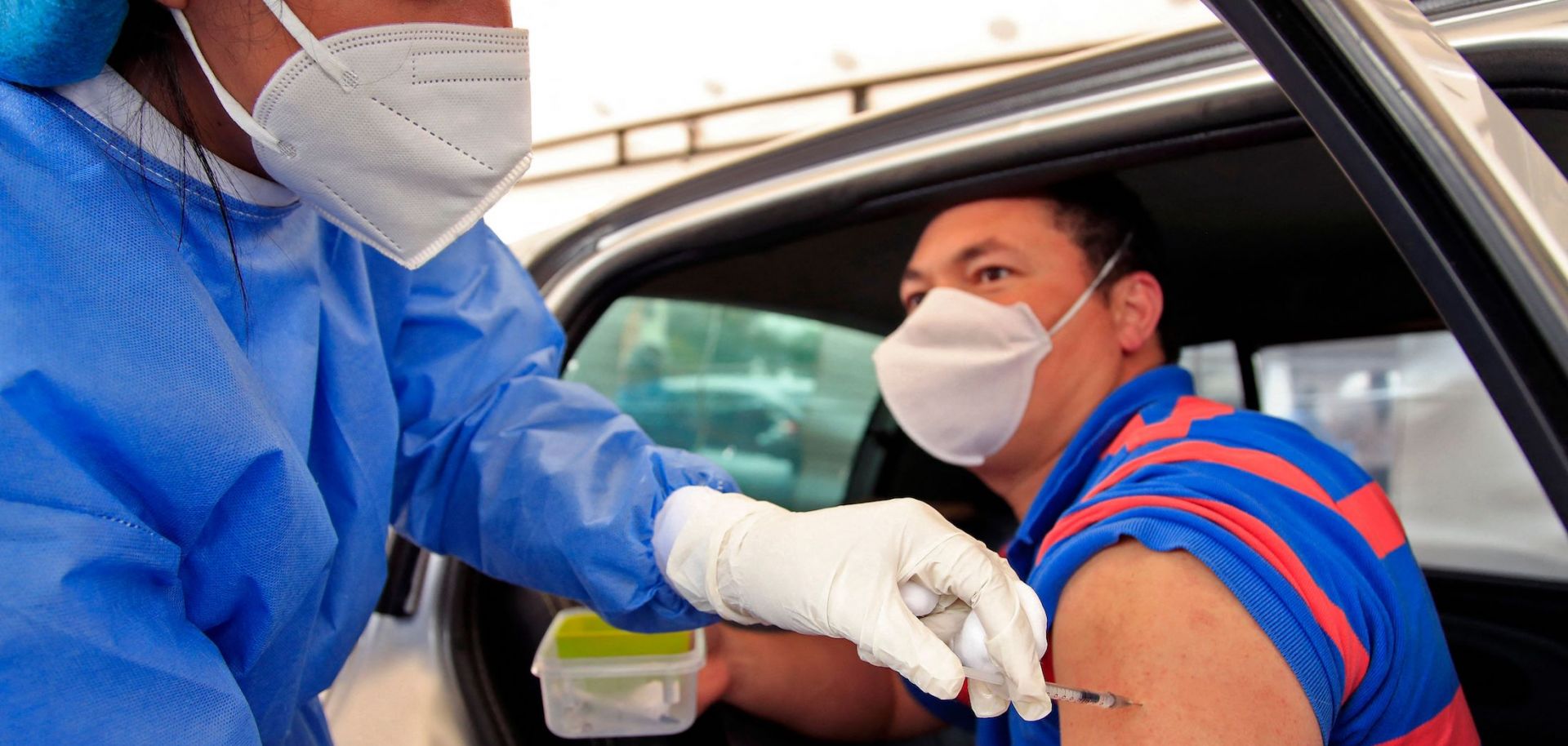
A man receives a dose of a COVID-19 vaccine at a drive-through distribution site in Bogota, Colombia, on April 11, 2021.
To contain the fast-spreading P1 variant of COVID-19, South American countries with politically secure governments like Chile and Uruguay will likely impose stricter lockdowns but experience faster economic rebounds, while countries with upcoming elections like Brazil and Argentina enforce softer restrictions but struggle to fully restart their economies amid ongoing outbreaks. In December 2020, the P1 variant was detected in the Brazilian city of Manaus and eventually spread across the country. The variant now accounts for half of new COVID-19 cases in Brazil. Brazil has subsequently experienced over 3,000 deaths a day for several weeks and is on track to see 100,000 deaths from COVID-19 in April. While the variant has primarily affected Brazil, it has been detected in 15 countries across Latin America, including Argentina, Chile, Colombia, Ecuador, Peru and Uruguay.
- Scientists suspect the P1 variant could be 50% more transmissible than the original COVID-19 strain first detected in Wuhan, China. There are also signs that the P1 variant may be able to evade natural antibodies, allowing for reinfection.
- China’s Butantan Biomedical institute announced on April 11 that its SinoVac vaccine (which is being distributed in several Latin American countries, including Brazil, Chile and Uruguay) is only 50.7% effective against the P1 variant, which could explain the high number of infections in the region despite ongoing vaccination campaigns.
Countries that do not face immediate electoral pressure will be able to impose unpopular lockdown measures, but many other governments will opt for softer measures, which will make it hard for them to contain COVID-19 infections. Several South American countries, including Argentina, Peru, Colombia and Brazil, will hold elections in 2021 and 2022, which means that governments will seek to avoid the introduction of tight lockdown measures, which are unpopular and have a negative impact on economic activity. Softer lockdowns in these countries will allow for some degree of economic activity to continue in the short term, but they could also result in pervasively high infection rates that would delay full economic recoveries.
- Chile implemented a strict lockdown on 80% of its population, including the entire capital city of Santiago. President Sebastian Pinera is not running for another term in the presidential election in November, which gives him more freedom to make unpopular decisions, especially because he is an independent and does not depend on a political party that will nominate a candidate.
- Uruguay, which won’t hold another national election until 2024, closed schools and nonessential businesses for two weeks to avoid an increased spread of the variant during Easter, extending the restrictions through May 3. Uruguay will hold its next presidential and parliamentary elections in 2024, which means that the government is not under immediate electoral pressure.
- Argentina, Colombia, Ecuador and Peru have introduced measures, such as night curfews and border closures. But commercial activities — such as indoor gyms, restaurants, places of worship and, in some cases, nightclubs — are open at limited capacity. Argentina will hold legislative elections in October 2021, Peru will hold runoff presidential elections in June 2021, and Colombia will hold presidential and legislative elections in May 2022. While Ecuador held a presidential election on April 11, a fragmented Congress will make it hard for the government to impose strict lockdowns at the national level.
- In Brazil, where infections are surging, several provinces have implemented social distancing measures in recent weeks. The federal government, however, continues to oppose nationwide social distancing measures, with President Jair Bolsonaro promising to defend the economy and avoid strict lockdowns ahead of presidential and legislative elections in October 2022.
Strict lockdown measures could allow for faster economic rebounds in the medium-to-long term, especially if they are accompanied by fast vaccination campaigns. On the contrary, countries that refuse to implement strict social distancing and have slow vaccination campaigns will struggle to sustain strong economic growth due to the greater possibility of subsequent COVID-19 waves. Household consumption is a significant driver of economic growth in Argentina, Chile, Colombia, Ecuador, Peru and Uruguay, representing over 60% of GDP in these countries in 2019. Extended partial restrictions that stall economic recovery but do not fully halt outbreaks, combined with slow vaccination rollouts, will undermine economic activity throughout 2022.
- Chile has vaccinated 40% of its population and Uruguay has vaccinated over 30%. Both countries have relatively small populations and have bought large quantities of vaccines, meaning that they are both on track to reach the 70% vaccination rate needed to achieve herd immunity by the third quarter of 2021. This should allow Uruguay and Chile to lift the economically damaging restrictions relatively fast. According to International Monetary Fund (IMF) calculations, Chile and Uruguay’s economies should grow by 5.3% and 5.0% in 2021, respectively.
- Argentina has vaccinated 12% of its population and Brazil has vaccinated 11%. However, the large populations and the slow shipment of vaccines to both countries indicate that they will not reach herd immunity until at least the end of 2021. According to the IMF, Brazil’s economy should grow by 2.9% in 2021, while Argentina’s economy should grow by 4.4%.
- Colombia has vaccinated 5% of its population while Peru and Ecuador have each inoculated only 2%. The IMF expects Colombia’s economy to grow by 3.7% and Ecuador’s economy by 3.9% in 2021. The IMF expects Peru’s economy to grow by 5.2% in 2021, one of the fastest rates in the region — but only after contracting by 11.1% in 2020, the second deepest in South America after Venezuela.
