
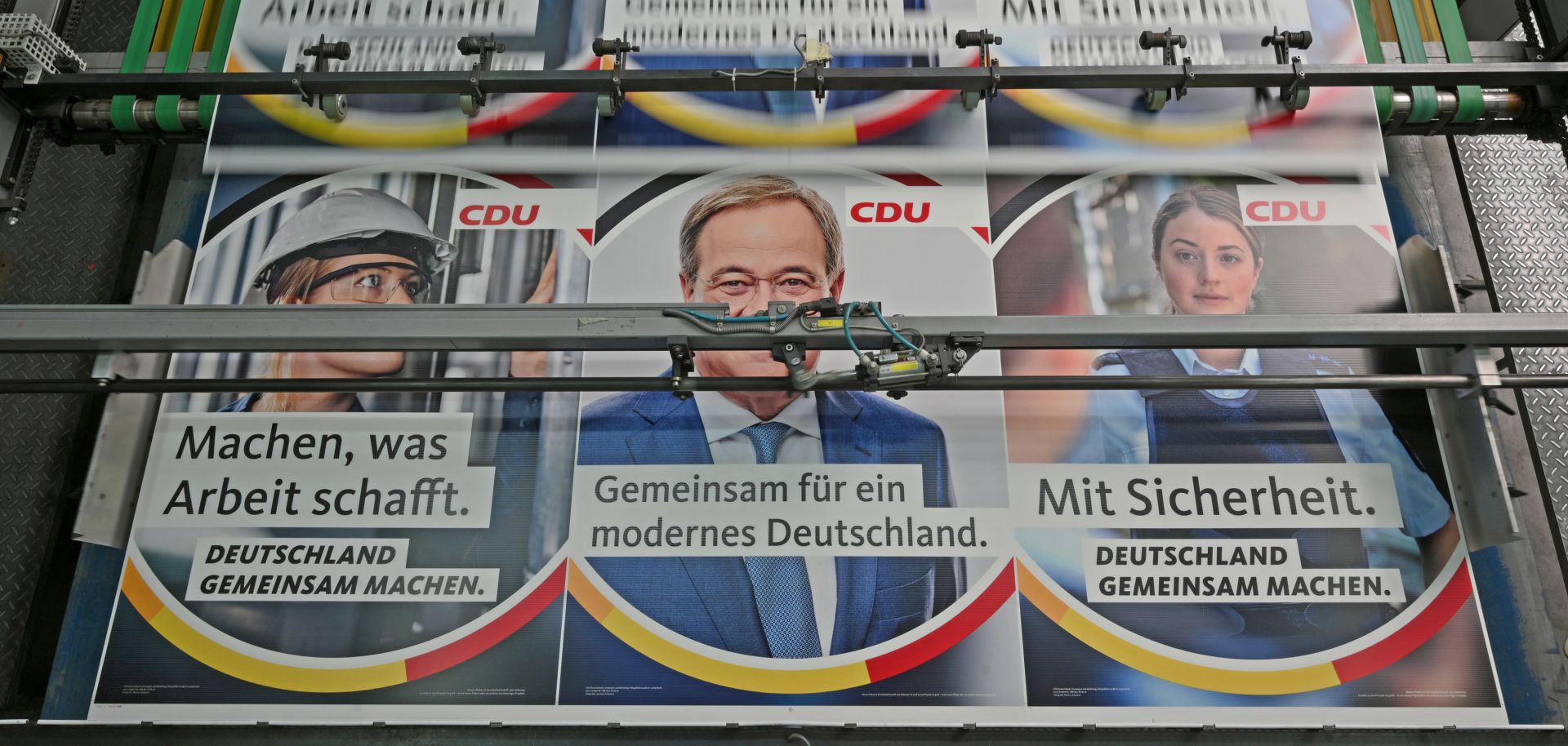
Campaign billboards are printed for the Christian Democratic Union (CDU) candidates running in Germany's upcoming federal election on June 29, 2021.
Opinion polls suggest that the September federal election in Germany will result in a fragmented parliament and long negotiations to form a government. While a centrist coalition is the most likely outcome, the process could paralyze German and EU policymaking for months. Germany will hold a federal election on Sept. 26, the first in two decades where Chancellor Angela Merkel will not be a candidate. Recent surveys show that the popularity of Merkel’s conservative Christian Democratic Union (CDU) and its Bavarian sister party, the Christian Social Union (CSU), is on the rise, while the popularity of the environmentalist Greens is in decline. In the meantime, the rest of the parties are relatively stable.
- The CDU/CSU and the center-left Social Democratic Party (SPD) have governed together for the most part of the last two decades. This has eroded their popularity and contributed to the rise of other parties, most notably the Greens. But in recent weeks, a series of political mistakes and attacks from other parties has dented the Greens’ popularity.
- The latest INSA/YouGov poll, carried out between July 2-5, has the CDU/CSU at 29%, up from 26% in early June, and the Greens at 18%, down from 21% in the previous month. The center-left SPD is at 16.5%, the pro-business FDP is at 12.5%, the right-wing Alternative for Germany (AfD) is at 10% and the left-wing Die Linke is at 7%.
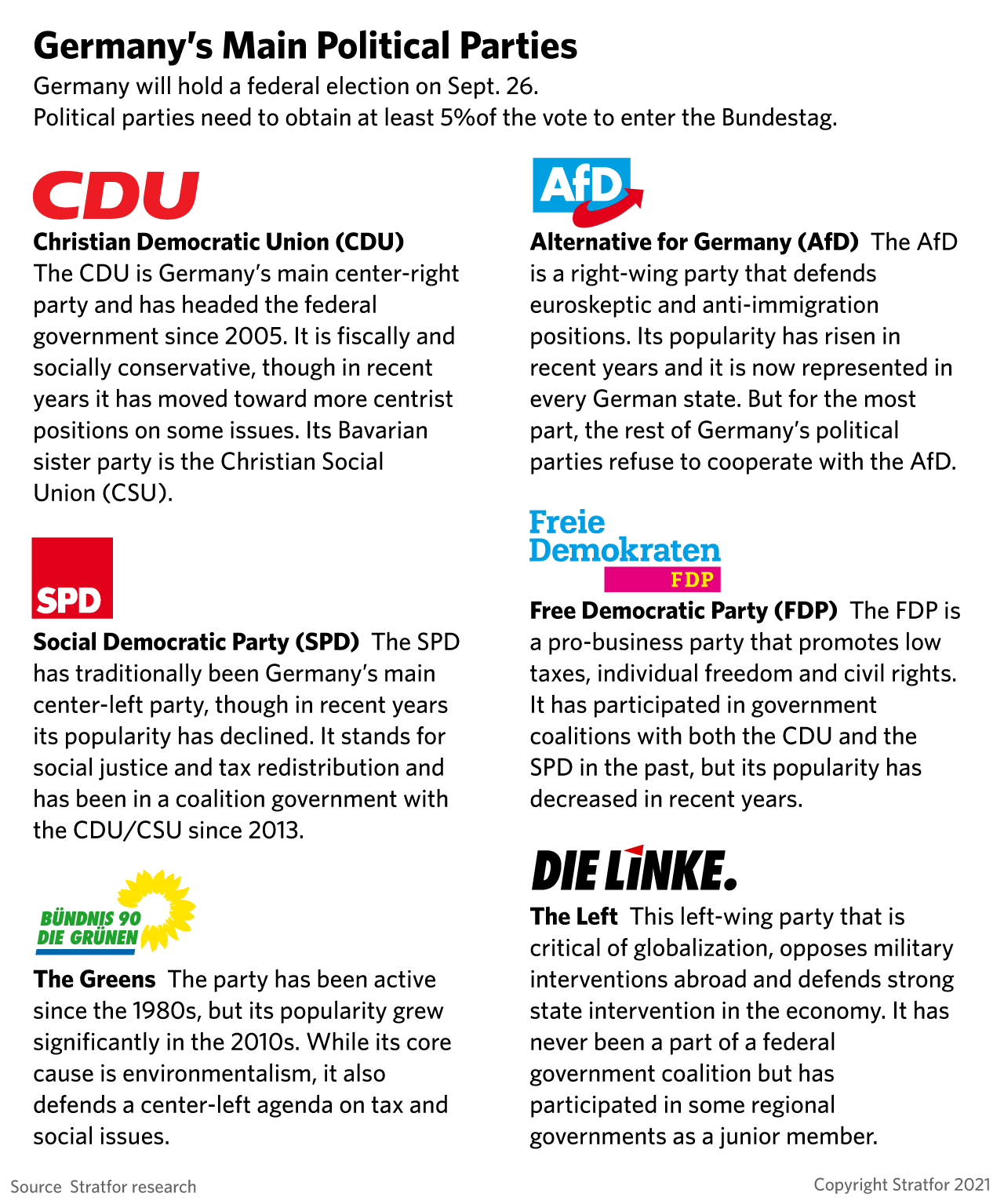
A centrist coalition would seek a balance between fiscal discipline, stimulus measures and the energy transition, though the pace and intensity of these policies will depend on the final composition of the government. Current polls suggest that two centrist coalitions are mathematically possible: 1) a so-called “Jamaica” coalition (because of the colors that identify the parties involved) between the CDU/CSU, the Greens and the FDP; and 2) a so-called “Kenya” coalition between the CDU/CSU, the Greens and the SPD. Because of the presence of two conservative parties, a “Jamaica” coalition would push for a faster reduction of Germany’s fiscal deficit and sovereign debt through spending cuts, while a center-left-dominated “Kenya” coalition would push to keep high levels of public spending, potentially including higher taxes. In the meantime, a faster energy transition would be a bigger priority under a “Kenya” coalition.
- Polls suggest that a center-right coalition including only the CDU/CSU and the FDP, and a center-left coalition including the Greens, the SPD and Die Linke are both improbable.
- A “black-green” coalition including the CDU/CSU and the Greens is possible if these parties perform better than what polls are currently showing. The smaller number of participants could result in faster and less complicated negotiations to form a government.
The polls also suggest that the election will produce a fragmented Bundestag. This would result in months of coalition talks that would slow down the policy-making process in Germany and in the European Union. Polls indicate that the coalition negotiations after the election could involve three or more parties. As a result, the process to form a government may only end in late 2021 or early 2022. While the outgoing German government would stay in place in a caretaker facility, it is unlikely to make any major policy decisions until the next government is appointed. This, in turn, would slow down the decision-making process in the European Union as the bloc’s institutions are likely to wait for a new German government to be appointed before making substantial decisions on issues such as the financial integration of the eurozone.
- The process to appoint a government after the German federal election of 2017 took around six months. The CDU/CSU, the Greens and the FDP tried to form a coalition, but the negotiations collapsed over ideological disagreements between them. This forced the CDU/CSU to form a “grand coalition” with the SPD.
