
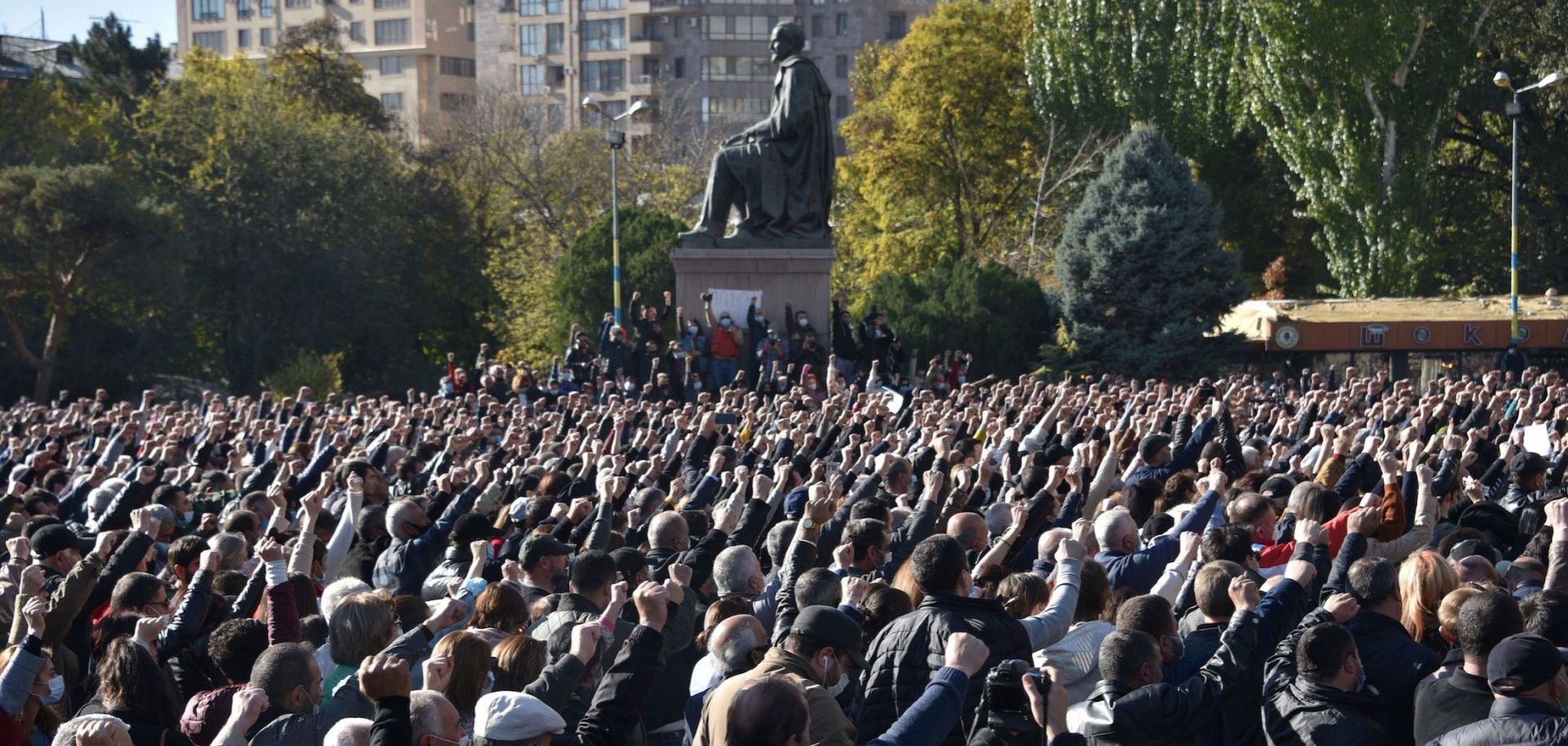
Armenians gather in Yerevan on Nov. 11, 2020, to protest against their country’s agreement to end fighting with Azerbaijan over the disputed Nagorno-Karabakh region. More than 2,000 demonstrators protested in the Armenian capital as anger mounted over Prime Minister Nikol Pashinian’s decision to cede swathes of the disputed territory to Azerbaijan under a controversial cease-fire.
Armenia’s political crisis is intensifying amid growing calls for the government’s resignation over a controversial cease-fire agreement with Azerbaijan in Nagorno-Karabakh. The volatile situation in both Armenia and the disputed region makes episodes of ethnically-motivated violence and future violations of the cease-fire possible. On Nov. 9, Armenia and Azerbaijan reached a Russia-brokered deal that put an end to six weeks of fighting. The cease-fire involves Armenia giving up on some areas of the Nagorno-Karabakh region and three regions surrounding it. As a part of the deal, roughly 2,000 Russian peacekeeping troops will also be present in the region for a five-year period. The cease-fire has been received as a victory in Azerbaijan and as a capitulation in Armenia, as the former won many of the territories it has long sought after in negotiations with the latter over their decades-old dispute. Armenian Prime Minister Nikol Pashinian has nonetheless defended the deal, arguing that the country’s military resources were near exhaustion. Pashinian has so far refused to resign and the opposition parties currently lack the parliamentary seats needed to overthrow him. But this could change if the protests escalate and the members of Pashinian’s coalition government desert him.
- Armenian Foreign Minister Zohrab Mnatsakanyan resigned on Nov. 16 amid a public confrontation with Pashinian over the terms of the cease-fire.
- Since the cease-fire was announced, 17 Armenian opposition parties and their supporters have been taking to the streets of Yerevan demanding Pashinian’s resignation and early parliamentary elections.
- Armenian President Armen Sarkissian (whose role is largely ceremonial) has also called for Pashinian’s resignation and for the formation of a national unity government.
- Armenian security forces arrested an opposition leader on Nov. 14 over an alleged assassination plot against Pashinian.
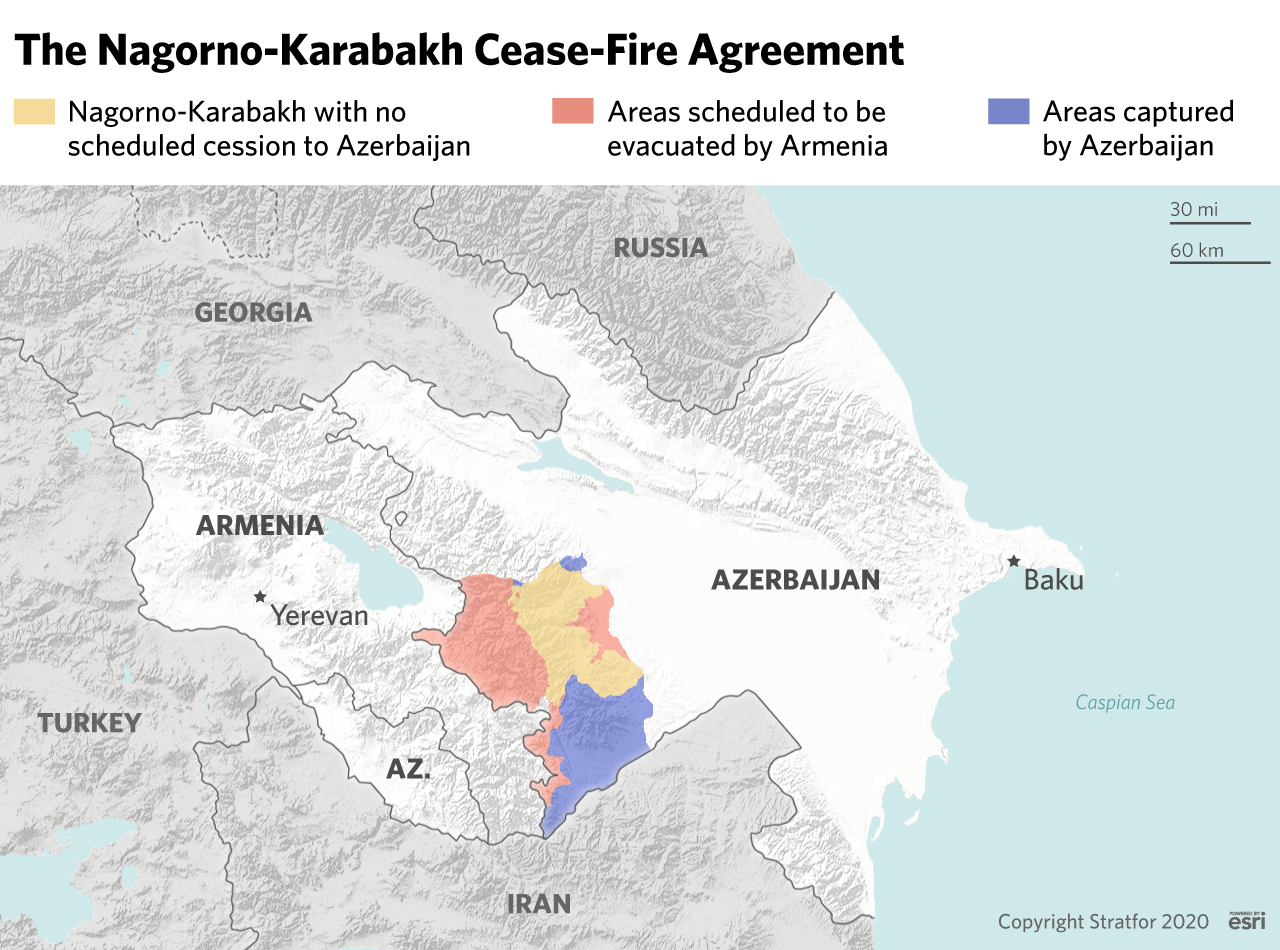
The cease-fire has consolidated Russian and Turkish influence in the region, and sidelined outside powers such as the United States and France, which were not involved in the agreement. For Russia, it involves a continued military presence in one of its spheres of influence and opens the door for the Kremlin to preserve its ties with Armenia without neglecting its links to Azerbaijan. When Pashinian was in the opposition, he was critical of Armenia’s close ties with Russia. But since taking over the Armenian government in 2018, he sought a pragmatic relationship with Moscow. Armenia’s now fragile position after the cease-fire could force Yerevan to seek even closer economic, political and security cooperation with Moscow to prevent any attempts by Azerbaijan to make new territorial gains. For Turkey, the cease-fire consolidates its backing of Azerbaijan and opens the door to a greater military presence in the region.
- Turkey has close political, military and energy ties with Azerbaijan, which it has backed since the latest bout of fighting in Nagorno-Karabakh began in September.
- On Nov. 12, Kremlin spokesman Dmitry Peskov said the cease-fire that Moscow promoted prevented “a military operation” to solve the dispute “with the use of force,” which is what Turkey allegedly wanted.
- Turkey and Russia will spend the coming weeks discussing the implementation on the ground of the cease-fire deal between Armenia and Azerbaijan.
- The Turkish government submitted a motion to the parliament on Nov. 16 to deploy troops in Azerbaijan. Turkey has said it will have the same role in the peacekeeping efforts as Russia, which Russia has denied.
- Pashinyan said on Nov. 12 that the Russian peacekeepers will ensure the safety of Armenian residents in the disputed areas.
The complex implementation of the cease-fire and historical tensions between Azeris and Armenians means that sporadic episodes of violence are probable. Armenia’s turbulent political position suggests that the country will spend weeks, if not months, under political instability, which would reduce its interest in resuming a direct fight with Azerbaijan. Many Armenians have already left the areas that will be handed over to Azerbaijan, and Baku will probably push to repopulate those territories with Azeris, making it harder for Armenia to try to retake them. For its part, Azerbaijan has little interest in breaking the cease-fire, considering the territorial gains it secured in the agreement. The presence of Russian troops in the region will also reduce the probability of Armenia or Azerbaijan seeking to restart the war in the short term. But this will only freeze (and not resolve) the conflict, leaving open the door for new fighting in the future.
- Thousands have been killed and more than 100,000 have been displaced in the latest round of fighting began in Nagorno-Karabakh, marking the worst period of conflict in the disputed area since the 1990s.
- Many Armenians have set their homes and other infrastructure on fire as they left the areas that will be transferred to Azeri control to prevent Azerbaijan from using them.
- On Nov. 16, Russia moved rocket launchers into a land corridor between Armenia and Armenian-controlled sectors of Nagorno-Karabakh.
- While Pashinyan defends the peace deal, he acknowledged on Nov. 12 that it "does not provide a substantive solution to the issue.”
