
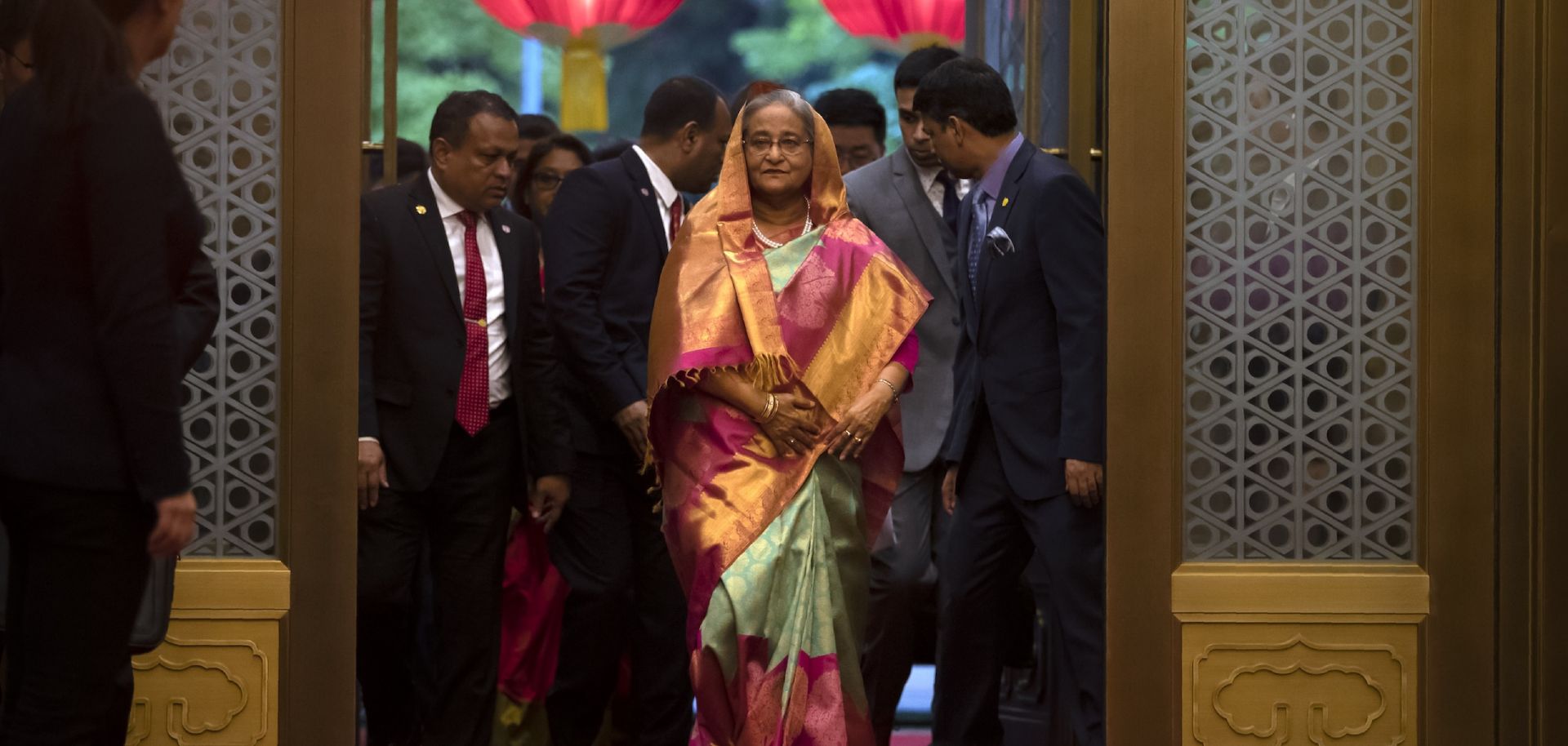
In Bangladesh, former Prime Minister Sheikh Hasina's pledged return from exile would risk triggering violent unrest and probably do little to facilitate her party's near-term political revival, but it could eventually help ease India-Bangladesh tensions. On July 13, Bangladesh's state minister for foreign affairs said the country's authorities would arrest ousted Prime Minister Sheikh Hasina should she return from her self-imposed exile in India. The official added that Hasina was a "convicted criminal" after Bangladesh's war crimes court sentenced her in November 2025 to death in absentia for her role in authorities' deadly crackdown on student-led anti-government protests in 2024, which ultimately ousted her from office in August of that year. The comments came days after Hasina, on July 10, 2026, told Reuters she plans to return to Bangladesh alongside other senior party leaders, including the former home minister, around December to surrender. While Hasina has acknowledged that she may be arrested or killed upon arrival, she claims she still feels compelled to return due to the "tremendous repression" her Awami League party is currently facing, and because she would prefer to die in her native country. Hasina has yet to confirm whether her potential homecoming would be part of a larger effort to revive her party, which has remained politically defunct since her 2024 ouster.

Hasina's return to Bangladesh would be symbolically significant for her party and supporters, whose activities have been heavily repressed since the 2024 ouster. The interim authority formed after Hasina fled the country, which governed Bangladesh from August 2024 until general elections in February 2026, excluded the Awami League. Days after Hasina's ouster, student-led protests at the Supreme Court also forced the resignation of the chief justice and five other top judges accused of favoring Hasina's government. In May 2025, interim authorities then invoked Bangladesh's Anti-Terrorism Act to formally ban all activities of Hasina's party and any related organizations until Bangladesh's war crimes court could try the Awami League and its leaders for their role in the 2024 crackdowns. The restrictions prevented the Awami League from contesting the February 2026 elections, which brought the current government to power, led by the Awami League's historical rival, the Bangladesh Nationalist Party (BNP). This government has also restricted the Awami League's operations, including by upholding the interim authorities' prior ban. Furthermore, unchecked popular anger at Hasina has deterred her supporters from staging large-scale protests or unrest due to concerns for their safety. This was evidenced in February 2025, when thousands of rioters torched Hasina's familial home in Dhaka and attacked other properties allegedly linked to the Awami League after she delivered an online speech urging supporters to resist the interim government.
- Hasina's loyalists have occasionally engaged in unrest since her ouster; in July 2025, a group of her supporters attacked a student-led political rally and clashed with security forces in the southern city of Gopalganj. However, such activity has often attracted only a few dozen participants before quickly dissolving, often under pressure from authorities and opponents.
Hasina's return to Bangladesh would risk galvanizing her supporters and likely trigger unrest, which could prolong or worsen if she challenges her legal charges or is put to death by authorities. While the Awami League's activity has been muted since Hasina's ouster, her prospective homecoming may reinvigorate her supporters, who would likely see the move as a courageous act of self-sacrifice for the party she has long led and the principles it represents. Additionally, the event would offer her loyalists a rare opportunity to publicize their support and vent long-suppressed grievances with their mistreatment, both real and perceived, over the past two years. Bangladeshis opposed to Hasina would also likely protest her return and, emboldened by authorities' shared opposition, could more violently confront her supporters. Risks of violent unrest may increase if Hasina or the Awami League challenge her death sentence or other legal decisions regarding the party. Protests would also risk intensifying if authorities follow through on executing Hasina, which her supporters would view as especially inflammatory.
- The Awami League has repeatedly accused Bangladeshi security forces of responding slowly and ineffectively to violence targeting Hasina's supporters in recent years.
Even if Hasina returns, the Awami League would still face a range of legal and practical challenges in reviving its political prospects, though it will likely have years before the next general election is due to attempt a comeback or create a new party. Authorities' prosecution of Awami League leadership in recent years has deprived the party of the individuals historically tasked with organizing and mobilizing supporters. The government's recently renewed restrictions on the Awami League's operations also impose legally enforceable constraints on nearly every activity required to quickly rebuild its political influence, from holding rallies to organizing online. And since the party remains excluded from, or bereft of, meaningful influence within the Bangladeshi government, it will have little direct ability to ease these challenges. This may, in turn, increasingly drive Awami League supporters to commit to other parties they perceive to have a more viable political future; indeed, polls conducted before the February 2026 election indicated that most Awami League supporters intended to vote for either the BNP or the Islamist Jamaat-e-Islami. Meanwhile, those who remain loyal to the Awami League will very likely continue to face popular vitriol, further stemming any effort by the party to regain political momentum for the foreseeable future. That said, given Bangladesh's next general election is not due until around 2031, the Awami League will likely have years to capitalize on any potential surges in anti-government sentiment against the ruling BNP, particularly regarding enduring economic challenges. This could also give the Awami League time to rebuild its membership and leadership, reshape its platform, or even ensure its survival in spirit by creating a new party ahead of the next ballot.
- After the Awami League was barred from contesting in the February 2026 ballot, both the BNP and the Islamist Jamaat-e-Islami attempted to win over the party's base, and pre-election polling suggests these efforts had some success. Specifically, one poll revealed that 48.2% of the surveyed Awami League supporters intended to vote for the party's historical rival, the BNP, while 29.9% intended to back Jamaat-e-Islami. Support for the activist-led National Citizens Party came in at a distant third, at 6.5%. Only 8% of Awami League supporters surveyed in the poll remained undecided or were considering abstaining.
- While the BNP's actions and public statements have suggested it remains opposed to the Awami League and Hasina, it may ultimately prefer to have the Awami League as its primary political rival and ideological competitor, rather than the rising and historically Islamist Jamaat-e-Islami party. Jamaat-e-Islami has sought to soften its reputation as an Islamist party, including by establishing ties to young activists who led the 2024 uprising, which likely facilitated its garnering enough votes in the February election to lead the current opposition. But lingering ambiguity over the extent to which Jamaat-e-Islami has actually abandoned its Islamist policy priorities has made many uneasy. Against this backdrop, the BNP could be incentivized to modestly ease restrictions on the Awami League and/or reduce Hasina's sentence to divert support from Jamaat-e-Islami and curb its longer-term growth. The BNP could perceive such a move as limited in risk, given that it maintains strong control over the government, and the fact that the Awami League remains a long way from rebuilding enough influence to threaten the BNP.
Although punitive measures against Hasina upon her arrival could initially exacerbate tensions with India, her return to Bangladesh might ultimately pave the way for improved relations by removing a major source of recent diplomatic friction. Beyond the domestic implications, Hasina's return would also end her exile in India, which has hosted her in part because of the close ties she had with Indian Prime Minister Narendra Modi during her tenure. The arrangement has frustrated Dhaka, as New Delhi has rebuffed its repeated extradition requests. This, combined with increased anti-Hindu violence in Bangladesh and nationalist unrest in both countries following Hasina's ouster, has strained bilateral relations over the past two years. While Indian officials have been fairly ambiguous about their views on Hasina's potential homecoming, their historical support for the former prime minister suggests that any punitive measures Dhaka takes against Hasina upon her return would likely prolong or potentially worsen tensions. Even with Hasina explicitly acknowledging and "accepting" the possibility of her execution, such a development would likely be especially inflammatory and threaten a more substantial chill in India-Bangladesh relations, potentially including punitive but probably largely symbolic diplomatic measures. Additionally, Dhaka's accusations that Indian authorities are forcing alleged undocumented migrants over the Bangladeshi border, as well as Indian concerns about anti-Hindu violence and the Islamist Jamaat-e-Islami party's growing influence in Bangladesh, could also sustain mistrust between the two neighboring countries. That said, both governments have in recent years expressed a willingness and taken steps to repair their relationship. Bangladesh and India's long-standing pragmatism will also incentivize them to continue pursuing mutually beneficial cooperation, particularly to foster economic growth. Against this backdrop, Hasina's return home may offer closure on one substantial bilateral dispute and eventually facilitate improvements in the countries' ties.
- Despite their differences following Hasina's 2024 ouster, both Indian and Bangladeshi authorities have repeatedly expressed openness to "constructive" dialogue and mutually beneficial cooperation. In the months since the BNP's February 2026 election victory, the two countries have withdrawn the visa restrictions they imposed at the height of recent bilateral tensions. In addition, the countries have sustained high-level dialogues — such as that between the leaders of their border security forces, even amid disputes over cross-border activity — as well as their years-long commercial and energy ties, with the latter becoming especially valuable amid energy shocks from the Iran conflict.