
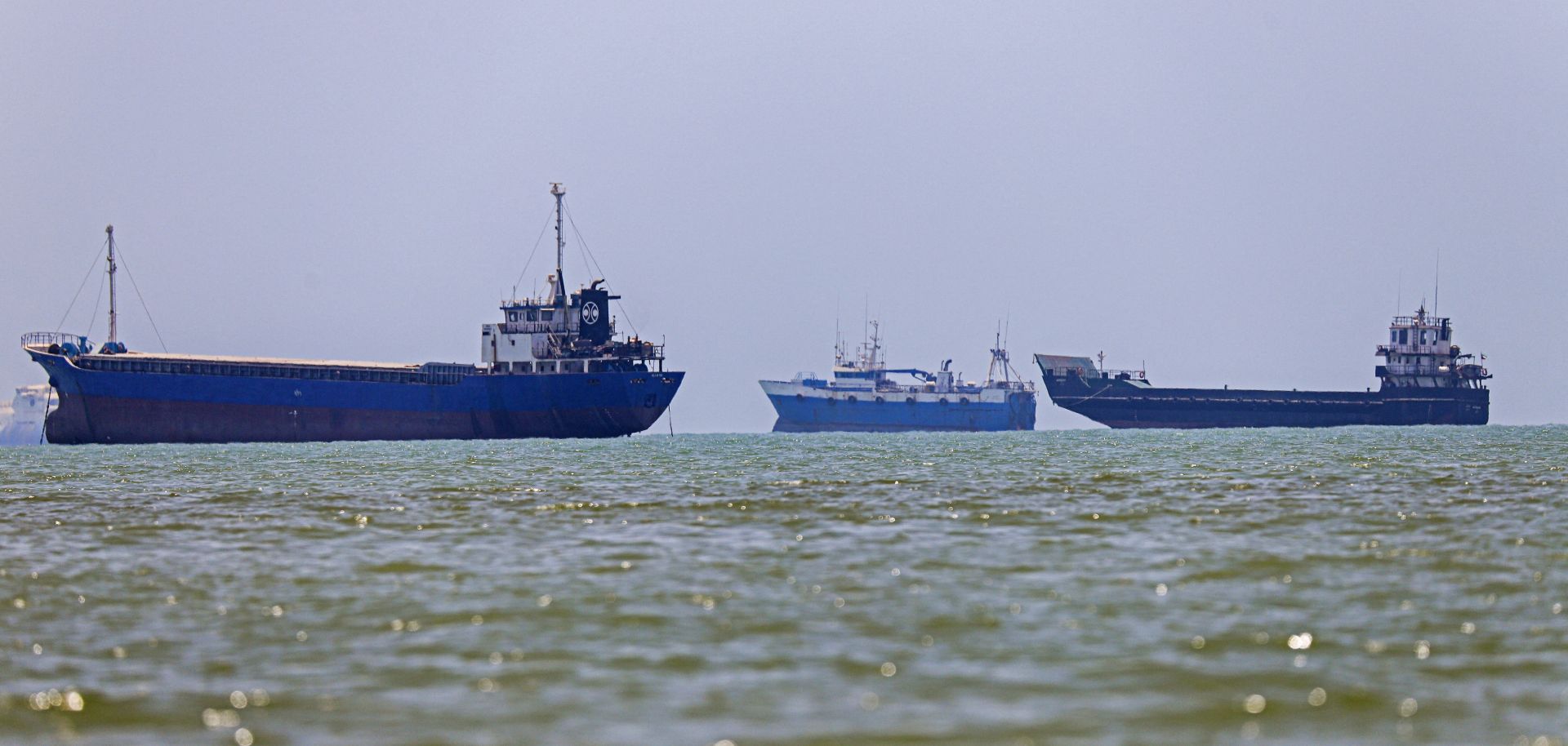
The United States' transactional security demands in the Strait of Hormuz will further alienate Gulf partners and harden Iran's attitude toward controlling the waterway, and could also encourage Yemen's Houthis to impose tolls on ships transiting the nearby Bab el-Mandeb Strait. In a rapid back and forth on July 13-14, U.S. President Donald Trump announced — and then reversed — a pledge to place a 20% toll on all cargoes passing through the Strait of Hormuz, which he initially characterized as a levy to compensate for American protection for transiting the contested waterway. However, after intense regional and international lobbying, Trump said that the United States would instead negotiate massive trade and investment commitments with Gulf Arab states in exchange for continued protection, without providing further details. The transactional offer came amid a weeklong uptick in regional hostilities, marked by Iranian attacks on Jordan, Kuwait and Bahrain, and U.S. attacks on targets across southern Iran, near Tehran and on islands in the Persian Gulf. Meanwhile, both the United States and Iran reimposed their mutual maritime blockades in the Strait of Hormuz, with Washington's going back into effect on July 14.

- On June 17, the United States and Iran reached a memorandum of understanding aimed at ending the war. But just over a week later, Iran resumed attacks on civilian shipping in the Strait of Hormuz, ultimately triggering the latest round of escalation, with Trump saying the ceasefire was "over" on July 10. The primary point of contention was Article V of the MoU, which stipulated that Iran would take steps to end its blockade and initiate discussions with Oman to define the future administration of Hormuz. The United States interpreted this as a commitment to permanently end Iran's closure of the strait. Conversely, Iran viewed it as a step toward negotiating a new regulatory framework that would allow it to directly administer the strait and potentially impose tolls in exchange for such services.
- Gulf states have already pledged to invest trillions into the United States, including $1.4 trillion over ten years from the United Arab Emirates, $1.2 trillion from Qatar, and $1 trillion from Saudi Arabia. Few of these pledges, however, are directly connected to specific deals and, as seen during Trump's first term, are likely aspirational rather than concrete dollar amounts.
The U.S.'s Long Defense of Open Sea Lanes
For over 200 years, the United States has prioritized maintaining freedom of navigation, starting with its first overseas war against the Barbary pirates in North Africa in the early 1800s. Later, in 1857, the United States was part of the international process to secure the opening of the Straits of Copenhagen from Danish tolls. Canals were treated differently. In the 20th century, the United States extracted tolls from ships passing the Panama Canal under the 1903 Hay-Bunau Varilla Treaty, but this came after Britain did the same with the Suez Canal, and was widely seen as acceptable because of the costs of constructing the Panama Canal and the fact that it is inside a single country's territory. Over time, however, the expansion of U.S. global power led Washington to embrace freedom of the seas and, in the wake of World War II, to take on the mantle of defending open sea lanes. Although sovereignty concerns have kept the United States from signing the 1982 U.N. Convention on the Law of the Sea, which formalized freedom of navigation, it has generally abided by the treaty's rules, including the prohibition on monetizing straits like Hormuz.
The United States' suggestion that its protection of Hormuz will become transactional will further undermine Gulf Arab states' trust, accelerating efforts to reduce their strategic reliance on both Washington and the Strait of Hormuz. By threatening a highly disruptive maritime toll only to swap it for domestic investment demands, the Trump administration has signaled that its defense of the global trade routes is a transactional service rather than a core strategic commitment. Gulf states like Saudi Arabia, the United Arab Emirates and Oman may offer superficial investment packages to placate the White House, with some pledges likely never followed through on, or merely repackaged versions of existing commitments. However, Trump's suggestion will feed into their underlying perception of Washington's weakening role in the region and growing disinterest in providing open-ended security. Consequently, this transactionalism will further drive Gulf monarchies to safeguard their interests, both in Hormuz and throughout the region, through alternative means. In particular, they will likely accelerate efforts to cultivate new security partnerships, bolster their domestic defense capabilities and diversify their export routes away from Hormuz via pipelines, railways and other infrastructure.
- During Trump's first term, Gulf states made significant pledges to invest and buy weapons from the United States, including a $110 billion Saudi arms deal in 2017. But actual Saudi purchases amounted only to $34.6 billion as the kingdom reduced its military intervention in Yemen.
- Pakistani jets helped secure Saudi skies during the most intense phase of the Iran war in the spring of 2026, after Riyadh and Islamabad signed a defense pact in September 2025. The United Arab Emirates also brought in Israeli troops during the conflict after normalizing ties with Israel in 2020. Qatar's long-standing defense partnership with Turkey similarly resulted in the deployment of Turkish troops to Doha during the 2017-21 Saudi-Emirati-led blockade.
The Trump administration's new Hormuz strategy will embolden Iran to maintain military pressure on the United States and exploit Gulf states' growing skepticism about U.S. reliability by positioning itself as a more pragmatic security partner. Seeing the United States more closely align with Iran's own transactional view of the Strait of Hormuz will deepen Tehran's political resolve to establish long-term control over the waterway. Iranian hard-liners will argue that Washington is also undermining freedom of navigation, and that Iran should gain what it can from a similar arrangement. Moreover, Tehran will see Trump's proposition of a 20% toll as another sign of his weakening political capacity to sustain an open-ended conflict over international norms, with him now apparently being forced to justify the war to a skeptical American public on economic grounds rather than strategic ones. This will, in turn, embolden Iran to maintain its campaign of asymmetric shipping disruptions and strikes on U.S. regional assets, as it tries to further erode Washington's political will. Simultaneously, Iran will exploit Gulf states' disquiet over shifting U.S. regional policy by directly offering localized security arrangements to Oman and potentially other countries, portraying itself as a pragmatic partner that is embracing the more mercantilist norms now being set by the United States.
- Iranian Foreign Minister Abbas Araghchi said he agreed with Trump's sentiments around a 20% toll, noting whoever "provides secure and safe passage of commercial vessels…should be compensated."
- U.S. political support for the war has been wavering in Congress as well, with Democrats on July 14 blocking the must-pass National Defense Authorization Act (NDAA) out of opposition to the current Iran policy.
The normalization of transactional approaches to maritime security could incentivize Yemen's Iran-backed Houthis to impose their own tolling system in the Red Sea, and may also encourage other actors to weaponize tolls in future conflicts, increasing shipping risks worldwide. According to a July 16 Reuters report, Iran has asked its Yemeni ally to close the Red Sea if the United States attacks Iranian power infrastructure. If the Houthis do re-enter the regional conflict, they may demand their own tolling or fees in places like the Bab al-Mandeb Strait, another critical maritime chokepoint, as part of a final settlement, similar to Iran's current push to exert greater influence over the Strait of Hormuz. Regardless, over time, a weakening of norms regarding freedom of the seas may lead both state and non-state actors to view strategic trade routes as potential revenue generators, while those who currently hold strategic locations, such as Turkey, could also be emboldened to impose higher fees for the usage of its waters. Such a development, or even, to some extent, merely future uncertainty about the norms governing freedom of navigation, may lead to higher risk premiums being imposed on shipping as companies assume the possibility of tolls being levied in the course of new wars.
- The Houthis have already talked about imposing their own tolling system in the Bab al-Mandeb, supported by Iran, though so far they have not implemented such a system.
- In April, Indonesia's finance minister suggested that the Strait of Malacca be tolled beyond its current Voluntary Fund. While both Indonesia and Singapore have since reiterated their commitment to free passage, the statement nonetheless reflects growing sentiment that favors debate over the potential tolling of waterways globally.
- Turkey has also been steadily raising fees on ships transiting the Bosphorus and Dardanelles straits in recent years, ending decades of stability dating back to 1983. Turkey's transit fees stood at $6.70 per net tonne in July 2026, up from $4.08 per net tonne in July 2022.