
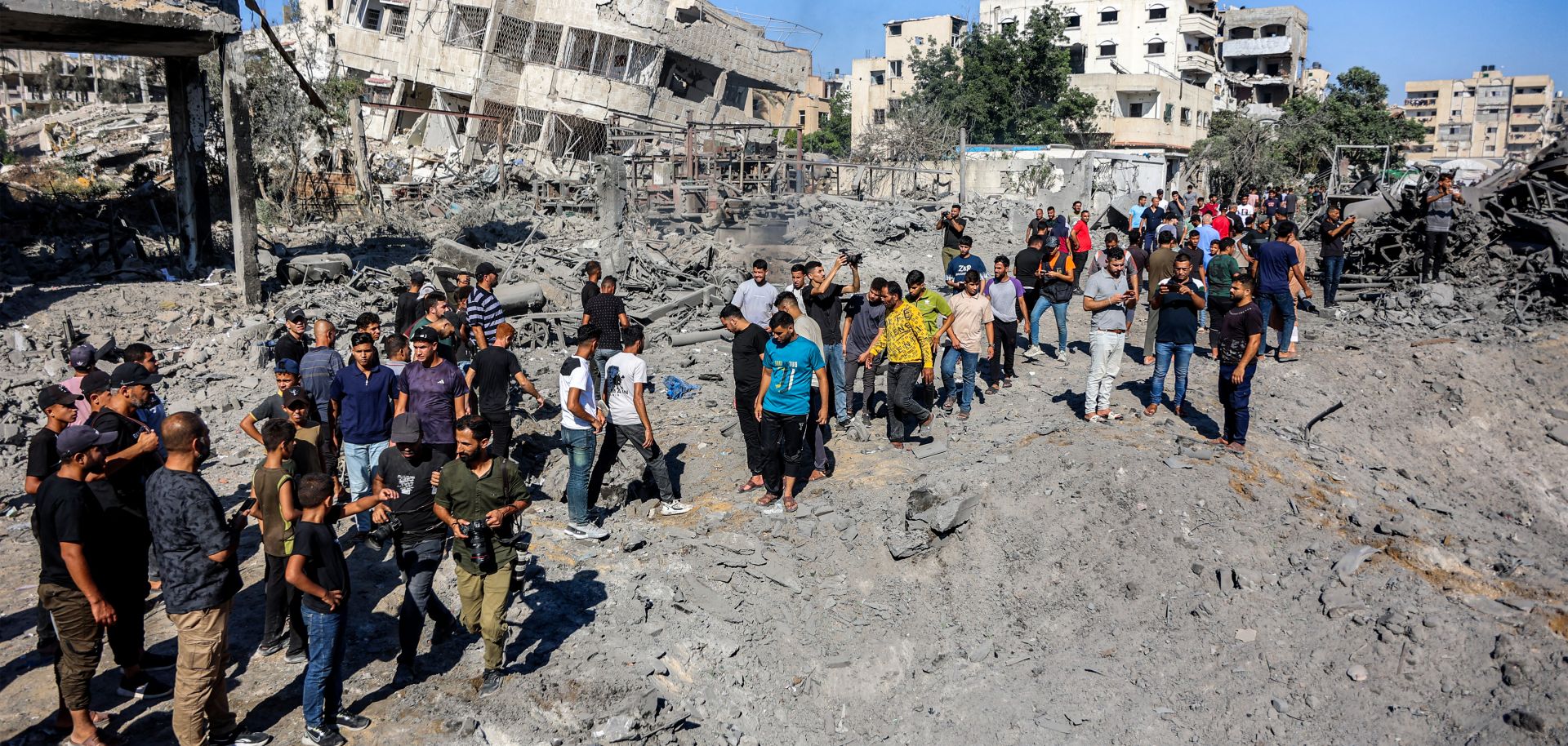
People gather by the rubble of destroyed buildings following an Israeli strike on an industrial area in Gaza City on July 12.
(Omar AL-QATTAA / AFP via Getty Images)
People gather by the rubble of destroyed buildings following an Israeli strike on an industrial area in Gaza City on July 12.

An impasse over governance in the Gaza Strip will embolden Israel to conduct additional low-intensity military operations and gradually expand its control in the strip, keeping the door open for a larger offensive ahead of Israeli elections in the fall. On July 8, an unnamed U.S.-led Board of Peace official said the organization was planning a pilot humanitarian zone that could host tens of thousands of Gazans in southern Gaza in order to increase deliveries of humanitarian aid. Gazans would enter voluntarily and be vetted by a U.S.-backed Palestinian technocratic committee, the National Committee for the Administration of Gaza (NCAG), which would also be responsible for governing the zone. Security would be provided by a trained police force in conjunction with the multinational, U.N.-backed International Stabilization Forces (ISF). The official's statement came after Hamas on July 6 announced the dissolution of the Gaza Emergency Committee — the administrative body tasked with overseeing daily operations in the Gaza Strip — to enable NCAG to assume control over daily operations in the Gaza Strip. However, both Israeli officials and the Board of Peace were skeptical of Hamas' decision, as Hamas did not indicate any moves toward disarmament nor to permit the ISF to take over security in the strip. 

  • On July 6, Israeli Foreign Minister Gideon Sa'ar wrote on social media: "Hamas' apparent willingness to 'make room' for a technocratic government is designed to prevent its own disarmament." The Board of Peace posted the same day, "We have taken note of the announcement today regarding the dissolution of the 'Emergency Committee' in Gaza. Ultimately, our assessment will be guided by actions, not promises, to meet the critical needs of the people of Gaza."
  • Although the Board of Peace had aspirations for a sizable ISF force of tens of thousands of foreign military personnel to deploy to the Gaza Strip, any initial deployment is only expected to be in the dozens. The peacekeeping force has struggled to secure commitments from countries due to the poor security conditions in the strip. 
  • Many of the NCAG's members previously held positions in the Palestinian Authority, but Israeli Prime Minister Benjamin Netanyahu has rejected any Palestinian Authority involvement in governing the strip. Israel, which controls entry into the strip, has refused the NCAG permission to enter over its links to the Palestinian Authority. NCAG officials remain stranded in Cairo. 

The Board of Peace's proposal and Hamas' dissolution of the Gaza Emergency Committee are small efforts to advance the stalled ceasefire agreement, though neither addresses core impasses between Hamas and Israel that have obstructed the agreement. The Board of Peace's pilot humanitarian zone proposal is a token effort to advance the phased Israel-Hamas ceasefire, which was signed in October but has stalled since U.S. officials announced the start of the second phase in January. Hamas' mostly symbolic decision to dissolve the governing body is an effort to portray Israel as the side obstructing the ceasefire's progress, pressure Israel to halt military operations and withdraw its troops to the "Yellow Line," which divides the strip roughly in half and was the boundary to which Israel was supposed to withdraw its forces during the first phase of the ceasefire. But even so, the core disputes remain. According to the terms of the ceasefire, Hamas is expected to disarm and Israel fully withdraw from the strip during the second phase, though neither of these developments is likely and the two sides have struggled to move past the initial phase. For one, Hamas has resisted full disarmament, though it has indicated willingness to consider freezing or storing its weapons for a fixed period of time — both non-starters for Israel. Meanwhile, since the start of the ceasefire, the Israel Defense Forces (IDF) have expanded their control beyond the yellow line. By late June, Israel controlled nearly 70% of the Gaza Strip. In short, the two sides are caught in a catch-22 in which, under intense mutual distrust and respective security imperatives, neither can meet the other's key demand to enable the ceasefire to advance without the other first making a major concession it is unprepared to do.

Without a viable governing plan, Hamas will very likely keep resisting disarmament in hopes that the election of a new Israeli government later this fall would change Israeli policy. Until then, further low-intensity Israeli military operations in Gaza will continue, though a larger offensive remains possible. The Board of Peace's latest proposal is highly unfeasible. Gazans are unlikely to willingly enter the humanitarian zone. More broadly, this plan and others previously floated by the Board of Peace indicate that there is no real viable option being discussed for the governance of Gaza. Thus, over the next several months, Hamas will very likely maintain its political resolve to resist disarmament until at least the next Israeli elections, which will likely be held in October, hoping a more moderate government assumes power that may be more flexible in negotiations. Until then, Hamas' resistance to disarmament and the absence of a solution to govern the strip that would appease the Netanyahu government will embolden Israel to continue to keep up pressure on Hamas. With Israel continuing to focus on its northern front in Lebanon and hesitant to appear to be the one decisively breaking the ceasefire in Gaza amid recent frictions with the United States, the most likely scenario is that Israel continues low-intensity operations by targeting Hamas leadership and slowly expanding the territory it controls. Over time, however, if Israel assesses that there is a growing Hamas security threat and/or perceives implicit or explicit U.S. approval for further military action, Israel may conduct a bigger offensive to weaken the Palestinian militant group. A larger offensive could also help Netanyahu shore up flagging poll numbers ahead of the vote, especially if he can portray it as a defensive action against ostensible Hamas provocations. Israel intensifies military operations in the strip would increase the likelihood of Houthi attacks against Israel and attacks on commercial vessels transiting the Red Sea in solidarity with Gaza. For its part, Iran would likely rhetorically reject Israeli military actions against Hamas but would be unlikely to further imperil the already fragile ceasefire with the United States by joining military action against Israel. Iran has demonstrated limited willingness to intervene on behalf of Hamas.

  • In late June, the IDF warned that Hamas was preparing for a renewed war by stepping up efforts to boost recruitment, create bombs and anti-tank missiles and train its elite Nukhba force. 
  • Far-right Israeli Finance Minister Bezalel Smotrich has called for the re-establishment of Israeli settlements in Gaza. On June 29, he stated that Israel had created plans for three settlements in Gaza which require Netanyahu's approval. Netanyahu has neither outright rejected nor backed the plans. He is likely using them as a point of leverage over his far-right coalition partners ahead of elections.
RANE
SUBSCRIBERS ONLY

Expert analysis when it matters most.

Get access to RANE's decision-grade geopolitical intelligence.