
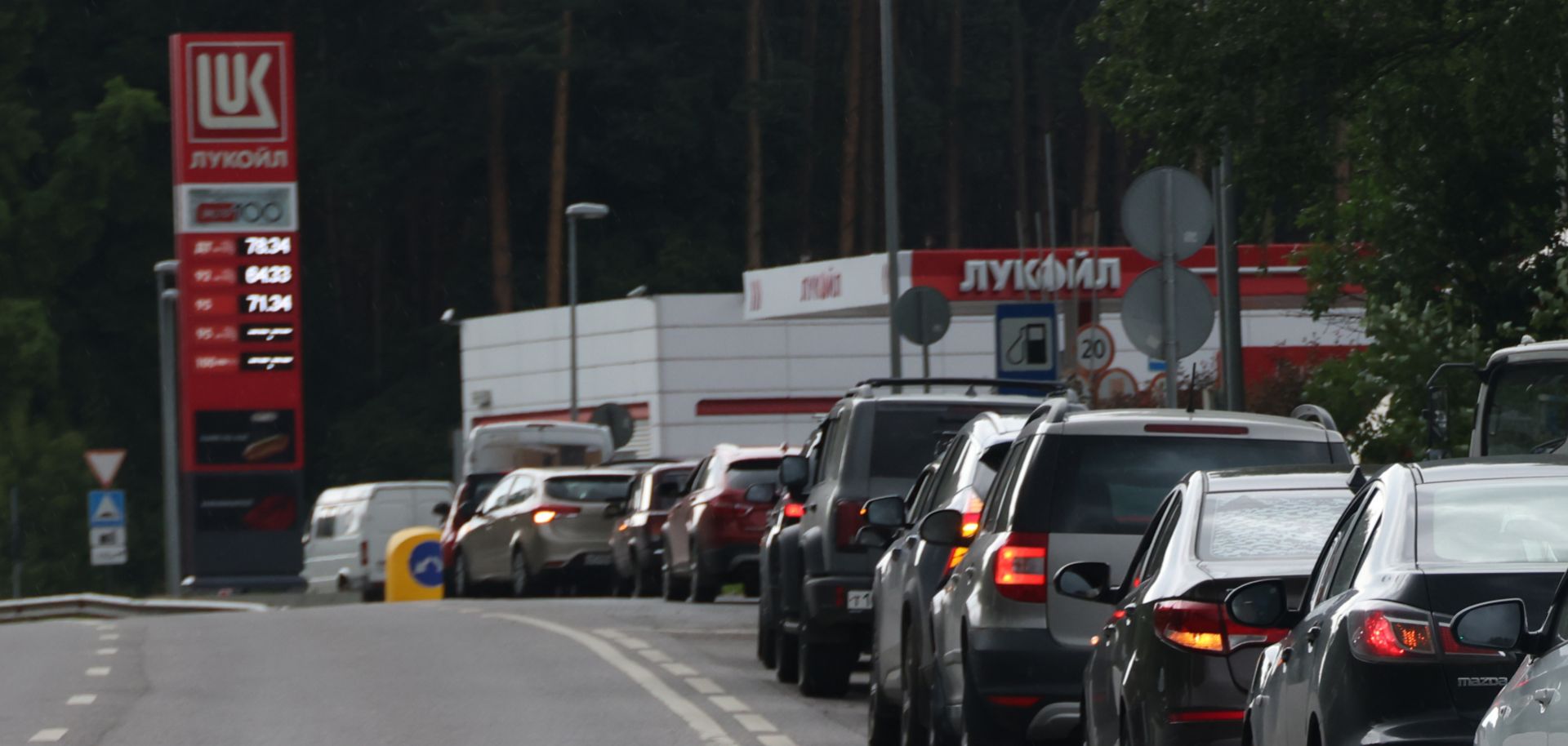
Cars stand in line for gasoline at a Lukoil gas station on July 8, 2026, outside of Moscow, Russia.
(Contributor/Getty Images)
Cars stand in line for gasoline at a Lukoil gas station on July 8, 2026, outside of Moscow, Russia.

Russia will retain the ability to produce and export most of its oil, but sustained Ukrainian strikes will erode its refining capacity, exacerbate domestic fuel shortages and increase the risk of deeper production cuts, leaving Moscow with less fiscal room, but these disruptions are unlikely to force the Kremlin to scale down its war effort in the short term. On July 10, the International Energy Agency (IEA) lowered its forecast for Russian oil production in 2026 and 2027, citing continued Ukrainian strikes against Russian energy infrastructure. The agency now expects Russian oil production to average 8.9 million barrels per day (bpd) in 2026 and 8.8 million bpd in 2027, down from 9.2 million bpd in 2025, representing reductions of 85,000 bpd and 150,000 bpd, respectively, relative to its previous forecasts. The downgrade follows months of Ukrainian drone and missile strikes targeting refineries, storage facilities, pumping stations and export infrastructure across Russia. Russian crude production nevertheless increased by 1.4% month on month in June, although this remained around 9% below Russia's OPEC+ quota, while total crude exports rose by 12%, as reduced domestic refining left more unprocessed oil available for overseas shipment. Refined product exports, by contrast, fell by 11%, and on July 8, Russia introduced a diesel export ban through July 31, alongside earlier restrictions on gasoline and aviation fuel sales as the government sought to address worsening domestic fuel availability. The International Energy Agency warned that reduced Russian refining capacity was contributing to tighter global product markets amid continued high seasonal demand and supply disruptions in the Middle East.

  • On July 8, Russia imposed a ban on diesel exports through July 31, including shipments by domestic producers, while exempting supplies under existing government agreements. The measure is intended to redirect fuel to the domestic market but will likely further reduce Russian diesel availability abroad, particularly for major buyers such as Turkey and Brazil, and could tighten European and Mediterranean fuel markets, pushing prices up.

The growing pace and precision of Ukrainian strikes are increasingly outstripping Russia's ability to repair damaged refineries and maintain domestic fuel supplies. Russia's refinery runs have reportedly fallen by roughly 26%, from normal operating levels of around 5.3 million bpd to approximately 3.9 million bpd, leaving throughput near levels last recorded over two decades ago and pushing gasoline production well below seasonal demand during the peak summer driving season. This has exhausted the sector's pre-crisis gasoline surplus of about 15% and transformed disruptions that remained manageable only a month ago into widespread shortages, queues and regional sales restrictions. The impact has been amplified by the concentration of Ukrainian attacks against refineries serving Moscow, central Russia and the Volga region, disrupting a distribution system built around nearby refinery supply and poorly equipped to replace large volumes over long distances by rail. Although fuel is being redirected from Siberia and other operating plants, doing so is creating shortages elsewhere while overloading rail terminals, storage facilities and regional distribution networks. Belarus can provide only limited additional volumes, while imports from India or East Asia may supplement supplies but are unlikely to replace lost Russian refining capacity at scale. Continued administrative pressure from the Kremlin to contain retail prices also impedes adjustment by weakening incentives to redirect costly replacement supplies to the worst-affected regions. The government's July 2 decision to permit lower fuel quality standards and the blending of partially processed gasoline may increase available volumes at the margins, but it will worsen pollution and could damage vehicle components if sustained over an extended period. Because these measures can offset only a fraction of lost refining output, Russia's fuel crisis will likely deepen as long as Ukrainian strikes continue to outpace repairs.

  • According to Financial Times analysis using data from Poland's Rochan Consulting, Ukrainian forces struck Russian oil refineries at least 194 times between Jan. 1 and early July 2026, 11 times more than during the same period of 2025. May recorded a monthly high of 16 successful refinery strikes.

Ukraine's drone strike campaign will degrade the resilience of Russia's refining system and could eventually force deeper cuts to its oil production, intensifying pressure on already strained public finances, but it is unlikely to alone compel the Kremlin to curtail the war in the short term. Absent successful Ukrainian attacks against major export terminals, pipeline systems or upstream production hubs in western Siberia, Ukraine is unlikely to deprive Russia of the physical ability to continue producing and exporting oil. At the same time, Moscow will struggle to restore a significant portion of damaged refining capacity, unless it successfully overhauls its domestic air defenses to protect these facilities (which appears highly unlikely, given the sheer number and geographic spread of vulnerable facilities), or the intensity of Ukrainian attacks declines. Yet completely and durably disabling Russian large refineries will also remain difficult with long-range drones alone, which generally carry much smaller warheads than the ballistic and cruise missiles Russia has used to inflict prolonged damage on Ukrainian refining facilities. Even without heavier weapons, however, repeated strikes on already damaged plants could outpace repairs, exhaust stocks of specialized replacement of Western-made equipment, increase metal fatigue and force irreparably damaged processing units to be rebuilt. Russia's lack of spare storage and shrinking refining capacity would also leave the entire system vulnerable to recurring and cascading disruptions, as refinery, rail or storage failures would have fewer alternative routes or supply buffers available. As refining capacity deficits deepen, production losses could become more pronounced where oil companies cannot rapidly redirect crude that would otherwise be processed domestically. The diesel export ban, if sustained, could also compound this pressure because Russia still produces more diesel than it consumes domestically, potentially leaving refineries with excess product and forcing them to reduce overall throughput. The IEA's latest forecast, which puts Russian output about 4.3% below its 2025 level by 2027, may therefore prove conservative if Ukraine's sustained strikes on ports and refineries — magnified by Moscow's ad hoc administrative interventions and rigid, centrally directed crisis management — force producers unable to process, export or sell surplus crude to curtail extraction.

  • Following the full-scale invasion, Russia first struck Ukraine's Kremenchuk refinery in the Poltava region on April 2, 2022, and repeatedly attacked the facility thereafter, with some estimates putting the cumulative number of weapons used at more than 60 missiles and 260 drones. Although industrial-scale refining had largely ceased by June 2022, parts of the refinery and its associated storage and logistics infrastructure continued to be repaired, reused and targeted through mid-2025.
  • Some Russian oil companies, such as Gazprom Neft, have historically processed most of their crude domestically and maintained a relatively limited customer base for crude exports. With its three main refineries in Omsk (about 460,000 bpd), Moscow (about 300,000 bpd) and Yaroslavl (about 300,000 bpd) now halted or materially disrupted, the company may struggle to place an additional 600,000-700,000 bpd of unprocessed crude on foreign markets.
RANE
SUBSCRIBERS ONLY

Expert analysis when it matters most.

Get access to RANE's decision-grade geopolitical intelligence.