
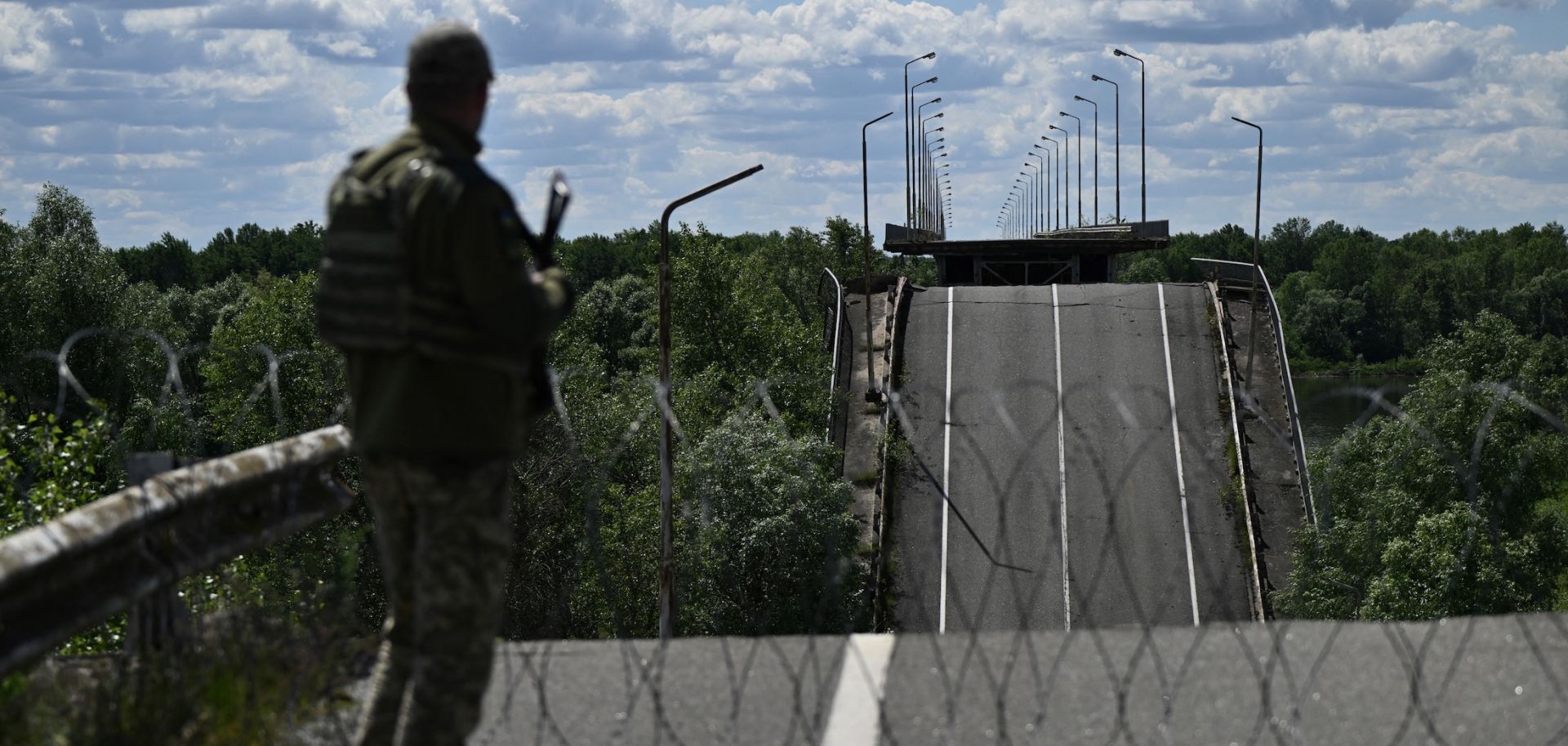
Despite Russia's renewed pressure on Belarus to deepen its role in the war in Ukraine, the threat of Ukrainian retaliatory strikes and the Belarusian military's limited independent offensive capacity will likely keep Minsk from entering the conflict directly, but Belarus will remain a critical base of Russian military pressure against Ukraine and NATO's eastern flank. On June 25, during a meeting televised on a state TV channel, Belarusian President Alexander Lukashenko told Russia's ambassador to Belarus, Boris Gryzlov, that Minsk did not want to be drawn into the war against Ukraine, saying he had repeatedly discussed this with Russian President Vladimir Putin. The comments followed increased Ukrainian pressure on Belarus over relay stations that Kyiv said were helping Russia guide drone attacks against Ukraine. On June 19, Ukrainian President Volodymyr Zelensky said Lukashenko had one week to remove the equipment and warned that Ukraine would act if Belarus did not. The warning came after weeks of Ukrainian statements that Russia was seeking to draw Belarus deeper into the war, including by expanding military infrastructure near the Belarusian-Ukrainian border, as well as media reports that Russia had intensified pressure on Belarus since early 2026 to deepen Minsk's role in the conflict. Against this backdrop, Belarus conducted mobilization drills in the Grodno region, which borders Poland and Lithuania, from June 17 to June 26 for local military recruitment offices to practice mobilization procedures, including registering military-liable citizens and vehicles for potential call-up. Belarusian authorities also said reservists in Grodno's Ashmyany district would report for verification musters through July 2, with about 2,000 people expected to be notified.

- According to Zelensky, the relay stations in Belarus support two-way video links for Russian long-range drones (including Shahed/Geran-type attack drones and Gerbera-type systems used in Russia's drone campaign), and were used in recent Russian strikes on the Ukrainian regions of Rivne, Zhytomyr and Volyn.
- Citing reports from Ukrainian intelligence, Zelensky said the relay stations stopped operating on June 22, but noted it remained unclear whether the equipment had been dismantled. Ukrainian forces had reportedly already targeted similar relay infrastructure along the Belarus-Ukraine border in 2025 after Ukrainian forces publicly identified the sites.
- Lukashenko also publicly acknowledged that French President Emmanuel Macron had warned him in a May phone call against deeper Belarusian involvement, with a French presidential aide confirming that Macron had raised the risks of escalation.
- In a June 12 interview with Al Arabiya, Lukashenko also said Ukrainian forces could strike Belarusian critical infrastructure if Minsk entered the conflict.
- On June 29, Lukashenko met Chinese President Xi Jinping in Beijing following two days of talks with Putin at Valdai on June 26-27, which produced no public readout. Xi said China supports Belarus's sovereignty, independence, territorial integrity and development path, and pledged continued support for the country's development.
Belarus has so far avoided sending its own troops into Ukraine, but its political and military relationship with Russia has made Minsk an increasingly active enabler of Moscow's war effort. Belarusian territory, airspace, logistics networks and military facilities have supported Russian activity since the start of the war in February 2022, without a Belarusian troop deployment. The so-called Regional Grouping of Forces, a joint military structure whose operations fall under the Union State framework, also enables Russia to operate within Belarusian military infrastructure or expand its presence in Belarus if both countries claim a deteriorating security environment. In 2026, Russia and Belarus moved from hosting Russian tactical nuclear weapons to conducting nuclear drills, in which Moscow said it delivered nuclear munitions to field storage facilities in Belarus. After agreeing to host Russian tactical nuclear weapons in 2023, Belarus held previously unannounced nuclear drills with Russia in May 2026, which involved command-and-control coordination for strategic and tactical nuclear scenarios, including the deployment of nuclear weapons from Belarusian territory. The drills were notable not only because they were out of cycle, but also because they suggested deeper command-and-control integration between the two militaries, with Belarus serving less as a separate partner than as part of a combined military system. Although the drills did not, by themselves, indicate imminent Belarusian entry into the war in Ukraine, they showed that Russia and Belarus could quickly elevate their military coordination and signaling.
- The Regional Grouping of Forces is based on a 1997 Russia-Belarus military security agreement and operates within the broader defense framework established by the 1999 Treaty on the Establishment of the Union State between Russia and Belarus. A 2022 protocol to the 1997 agreement added provisions on Russian forces and military infrastructure connected to it. Together, these documents give Moscow an extensive framework to increase military activity in Belarus should it decide to build up forces under the cover of existing bilateral military arrangements.
- Belarus has structured its forces around western, northwestern and southern operational directions, allowing it to concentrate on the borders with Poland, the Baltic states and Ukraine simultaneously. The ongoing development of a dedicated southern command further reflects Minsk's growing military focus on the Ukrainian border. Belarus also maintains major air and air defense bases nationwide.

A full Belarusian entry into the war is highly unlikely without major Russian support, but should it occur, it would further stretch already strained Ukrainian forces. Russia has been struggling to achieve its goals on the battlefield in Ukraine, with limited prospects for a decisive breakthrough along the current front line. Against this backdrop, Russia appears to be pressuring Belarus to deepen its role in the war, from hosting infrastructure supporting long-range drone strikes to increasing military activity near Ukraine's northern border, in order to stretch Ukrainian defenses and force Kyiv to pull troops away from higher priority fronts in Donbas. However, although Belarus remains heavily dependent on Russia economically, militarily and diplomatically, Moscow has limited ability to force Lukashenko into a direct ground intervention that could threaten his regime's stability, as Belarusians strongly oppose sending troops to Ukraine. Moreover, even if Belarusian ground forces are sizable by regional standards, they are constrained by limited combat experience, shallow strategic depth, weak sustainment for extended operations and independent offensive capacity. Without support from Russian forces, the Belarusian army would likely struggle to achieve significant tactical, let alone strategic, objectives against prepared Ukrainian defenses, especially across the forests, rivers and marshes along the Belarusian-Ukrainian border. A larger campaign would require Russia to provide manpower, logistics, ammunition, fuel, command support and possibly combat formations while Russian forces are already heavily committed elsewhere. Ukraine would likely detect such a buildup early through satellite imagery, signals intelligence and border surveillance, giving Kyiv time to reinforce the northern border and expand strikes against Belarusian military, logistics and economic infrastructure, though doing so would further stretch an already thinned Ukrainian force.
- Open-source estimates put the Belarusian armed forces at roughly 48,000 active military personnel, with total strength sometimes estimated at 63,000-65,000 when additional deployed components are included. Belarus's first-stage mobilization capacity could reportedly raise the force to about 80,000-90,000 personnel, while broader reserve estimates range from roughly 150,000 to nearly 290,000.
- Current Belarusian military activity near Ukraine appears more consistent with border reinforcement, readiness checks and coercive signaling than preparation for an operational-scale attack, and available reporting does not indicate the concentration of a large offensive grouping along the Ukrainian frontier.
- Independent polling has consistently shown that Belarusians overwhelmingly oppose direct participation in Russia's war against Ukraine, making a Belarusian troop deployment a likely trigger for renewed domestic unrest. Such protests would directly test the loyalty and capacity of the security forces on which Lukashenko's regime depends, especially if Belarusian casualties mounted or Ukrainian strikes brought the war onto Belarusian territory. Putin would also likely have less bandwidth than in 2020 to rescue Lukashenko from a major domestic crisis, given Russia's military and economic overextension in Ukraine.
The high costs of joining the war will likely keep Minsk from sending troops into Ukraine, but Belarus will remain useful to Russia as a base for pressure against Ukraine and NATO. A Belarusian attack or direct entry into the war would almost certainly trigger Ukrainian retaliatory strikes. Kyiv would target Belarusian military infrastructure as well as oil refineries, potash production sites, and logistics hubs — all of which are economically important, geographically reachable by Ukrainian drones and difficult to fully protect. Such a move would also trigger a strong European response, the reimposition of U.S. sanctions and more military support for Ukraine, while undermining Lukashenko's efforts to preserve limited diplomatic room with Washington created by recent U.S. outreach, sanctions relief and prisoner releases. Additionally, Belarusian forces would suffer significant losses in a war for which they have not been tested, creating new risks for regime stability at home. For the foreseeable future, Belarus will likely continue allowing Moscow to use its territory to stage coercive, gray zone operations along the border with Ukraine and NATO's eastern flank. These operations will likely remain below the threshold of direct Belarusian entry, but could include continued drone support activity, GPS jamming and periodic airspace incidents aimed at testing NATO responses and diverting allied attention and resources to eastern flank defense.
- On May 26, Robert Brovdi, commander of Ukraine's Unmanned Systems Forces, said Ukrainian forces had identified the first 500 targets on Belarusian territory if Belarus entered the war or allowed hostile action against Ukraine from its territory.
- Belarus has only two major oil refineries: Mozyr in southern Belarus, roughly 19 miles from the Ukrainian border, and Naftan in Novopolotsk, roughly 270 miles from the border, placing both within range of Ukrainian drones. These refineries have become more important to Russia as Ukrainian strikes have curbed Russian refining capacity. According to Reuters, in January-May, Belarusian rail shipments of gasoline to Russia rose nearly 13-fold year over year. Strikes on either facility would threaten Belarus's small refining base and could further complicate Russia's effort to offset refinery outages with Belarusian fuel supplies.
- Ukrainian retaliatory strikes against Belarus could give a pretext to invoke the Collective Security Treaty Organization's (CSTO) mutual defense clause, putting pressure on Russia's junior partners to back Belarus militarily. Even under pressure from Moscow, however, Kazakhstan, Kyrgyzstan and Tajikistan would be highly unlikely to commit forces or materially enter the war. This would further risk exposing the CSTO's limited utility as a collective defense bloc and irrelevance.