
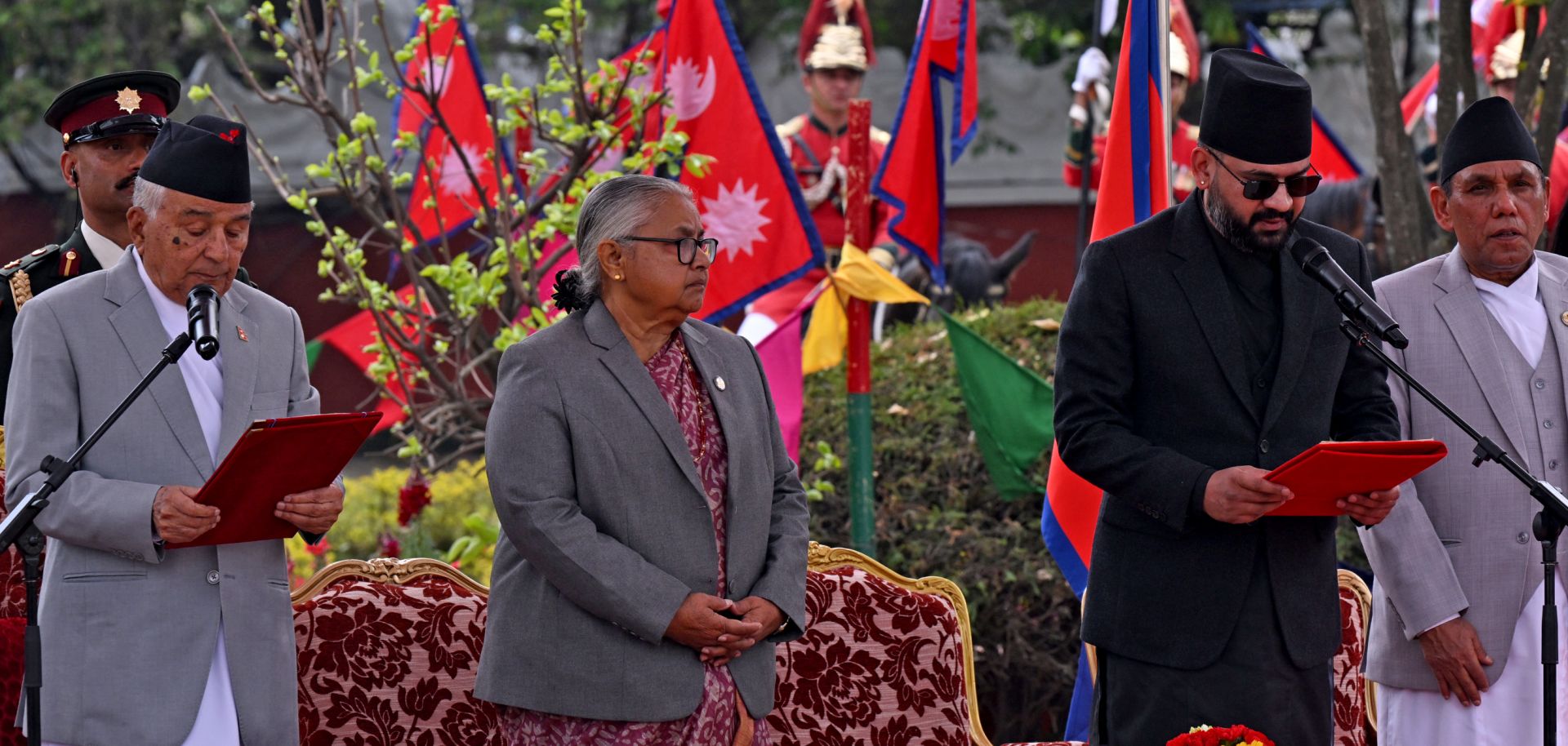
Nepal's newly elected government faces the immediate challenge of managing energy and economic shocks from the ongoing Iran war. In the longer term, it will face enduring popular pressure to improve living conditions and reform the unstable political system. On March 27, Nepal's president swore in former Kathmandu Mayor Balendra Shah as the country's new prime minister, a day after the president swore in lawmakers elected in the country's March 5 general elections. Citizens voted overwhelmingly for the four-year-old Rastriya Swatantra Party, or RSP, in the country's March 5 polls — Nepal's first since September 2025 anti-government protests helped oust then-Prime Minister K.P. Sharma Oli and his government. The RSP won 182 of 275 parliamentary seats, the largest single-party majority since the country abolished its monarchy in 2008, allowing it to govern without additional partners. The party's unprecedented victory and rebuke of the political establishment underscored the severity of popular grievances — particularly regarding the Nepalese political system's instability and enduring corruption — that had animated unrest months earlier. Many Nepalese citizens blame these grievances for enduring daily hardships and believe they warrant deep reforms.
- Youth-led anti-government protests centered in Kathmandu erupted on Sept. 8, 2025, triggered by a government ban on social media but fueled by broader, long-simmering grievances over political instability, corruption and high youth unemployment. The demonstrations quickly devolved into violent unrest that prompted Nepalese lawmakers to go into hiding and ultimately killed some 76 people. Oli and other officials subsequently resigned on Sept. 9, 2025, paving the way for Nepal's president to formally dissolve Parliament on Sept. 12 and appoint former Chief Justice Sushila Karki as interim prime minister.
- Nepal's political system has long been notoriously unstable, in part due to its mixed electoral system, which allocates 165 parliamentary seats via first-past-the-post voting and the remaining 110 seats via proportional representation. While the latter was meant to offer minority communities greater representation, it has also for years prevented any party from securing a clear parliamentary majority. Resulting coalitions have typically been fragile, often marred by ideological diversity and member parties switching sides opportunistically for near-term political gain. This has prevented all prior governments from completing their terms and resulted in 15 changes in government since the country's transition to a republic in 2008.
The new government will prioritize managing the fallout of the Iran war, which includes energy shocks as well as risks to remittances and tourism that are threatening to worsen Nepalese citizens' living standards. The eruption of the war with Iran in late February has presented an immediate challenge for Shah's government. Nepal imports nearly all of its petroleum products from India, itself heavily reliant on Gulf imports disrupted by the ongoing war. The most immediate impacts Nepal consequently faces are shortages of liquefied petroleum gas, or LPG, which nearly half of the country's households rely on to fuel gas cooktops. The Iran war has already prompted panic-buying and stockpiling, particularly by commercial users, until the state-owned Nepal Oil Corporation began rationing LPG in mid-March. Media reports since have suggested the move, alongside users seeking out electric cooktops, has helped ease pressures on and improve access to LPG supplies. But a prolonged war will continue to stress India and, consequently, Nepal's LPG supplies, which will present a worsening challenge for Shah. Beyond LPG shortages, Nepalese citizens are also broadly enduring higher inflationary pressures from the war, not only from increased fuel prices but also from traders hiking prices on imported goods like edible oils — already prompting accusations of price-gouging. Meanwhile, enduring conflict in the Gulf and challenges to regional air travel are increasingly threatening remittances and tourism across South Asia, presenting particular challenges for the Nepalese economy, which remains heavily reliant on both. Against this backdrop, authorities will likely prioritize limiting citizens' daily hardships by continuing to ration LPG, as well as by combating stockpiling and alleged price-gouging of essential goods. Nepalese authorities will also remain in close contact with New Delhi on renewing their memorandum of understanding on urea and DAP fertilizer supplies — which formally guarantees India's provision of at least 30% of Nepal's annual fertilizer requirements and ostensibly lapsed in March. An official at Nepal's agricultural ministry claims it sent a draft renewal of the memorandum to India around January. A renewal would support Nepalese farmers as they prepare for the rice paddy planting season around June. Communicating with India on its energy supply levels and on ensuring Nepal continues to receive sufficient LPG will also help Kathmandu adjust its domestic policies to better prepare for potential impending downstream shocks.
- The RSP's landslide victory suggests many Nepalese people will initially be more patient and forgiving with the new government, which should support its ability to implement unpopular austerity measures to manage the Iran war's consequences. That said, citizens' daily hardships will almost certainly worsen the longer the war continues, increasingly sapping citizens' patience and heightening risks of protests and violent unrest.
- Among other things, a protracted war in the Middle East may depress remittances to Nepal if intensified violence were to sustainably disrupt business operations and threaten personal safety across the Gulf, where around 40% of Nepal's remittances originate. It may also lead to more persistent declines in tourism to Nepal as logistics challenges and input costs for air travel mount. In addition, such a conflict may threaten inflows of petroleum products and chemical fertilizers, of which Nepal imports its entire supply.
Over the longer term, Nepal's government will face sustained popular pressure and risks of renewed unrest as it seeks to address domestic grievances by bolstering the country's economic growth — in part by fostering ties with regional rivals India and China — as well as by pursuing anticorruption efforts and potentially deep reforms to the country's political system. Among the most prominent popular demands during the September 2025 unrest were increased economic growth and expanded employment opportunities, for which the RSP set ambitious goals during its election campaign. However, the RSP's ability to realize meaningful economic gains in the short term will be significantly constrained by the ongoing Iran war and its highly likely lingering impacts even when it eventually ends. Much will also depend on the party's ability to foster relations with both India and China, for which the party previously pledged Nepal could serve as a "vibrant bridge" for economic ties rather than retaining its historical position as a mere "buffer state." But it remains unclear exactly how the RSP will pursue these policy objectives and the extent to which it will be able to secure bilateral agreements or infrastructure projects to support them. This is especially the case given India and China are enduring their own economic challenges linked to the Iran war and that the two countries remain regional rivals, which has often complicated prior Nepalese efforts to bolster bilateral ties. The RSP will also face challenges addressing popular grievances with the country's political system, particularly its historical instability and perceived irresponsiveness to popular concerns. While the RSP's substantial parliamentary majority reduces the risk of instability and fragmentation at least in the short term, many Nepalese people will likely pressure authorities to undertake political reforms to ensure less frequent governmental turnover and reduce public-sector corruption. Even so, citizens will differ on which measures they support and how patient they will be with authorities' implementation of them, which will likely sustain risks of unrest. Additionally, any structural reforms the RSP succeeds in passing may take years to bear fruit, further sustaining a lingering risk of social unrest or political instability.
- The RSP's substantial parliamentary majority — merely two seats shy of the supermajority required to enact constitutional amendments — should help the party pursue reforms it believes will improve political stability and representation. That said, the party is young and largely united by antiestablishment sentiment, risking internal differences the longer it governs nationally, including on which policies to pursue. Reforms could also lead to unintended consequences. For example, the RSP has floated direct elections for prime minister and electing Parliament solely through proportional representation. However, these proposals could worsen Nepal's political fragmentation and gridlock, the very challenges to which voters are demanding solutions.
- Popular demands for authorities to hold establishment politicians and political parties accountable — both for their actions during the September 2025 unrest and alleged historical corruption — will likely remain among authorities' most contentious considerations. Even with the RSP's landslide victory, Nepal's establishment parties retain a base of support that could be alienated by prosecutions of their political leaders. This was already seen following authorities' March 28-29 arrests of Oli and other former officials for their alleged role in the September 2025 unrest, with hundreds of protesters and isolated violence subsequently reported in several cities. Political polarization and risks of unrest would only worsen if the RSP undertook reforms perceived to sideline certain parties or otherwise disenfranchise a portion of the electorate.
