
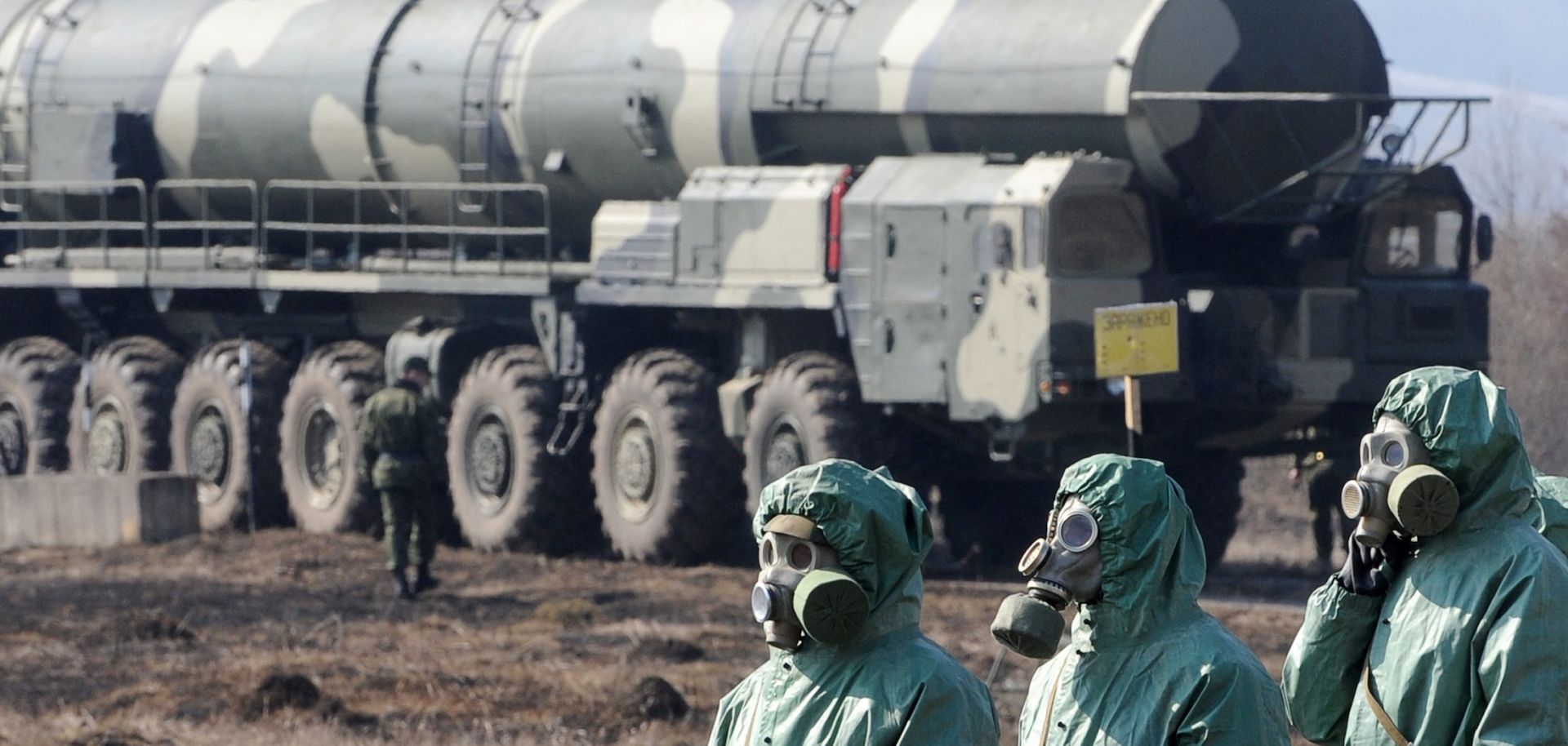
The expiration of the last major U.S.-Russian nuclear arms control agreement will, over time, intensify an ongoing buildup of nuclear capabilities across the globe and, amid a broader weakening of the global nonproliferation regime, make crises involving nuclear powers more unpredictable and prone to miscalculations. On Feb. 5, New START, the only remaining nuclear arms limitation agreement between Russia and the United States, officially lapsed. The 2010 deal, which entered force in 2011 and was extended in 2021, limited both countries to 1,550 deployed strategic nuclear warheads and 700 deployed strategic nuclear delivery systems — comprising intercontinental ballistic missiles, submarine-launched ballistic missiles and heavy bombers capable of carrying nuclear payloads. The treaty also gave both countries the opportunity to conduct 18 on-site inspections each year, though these have not occurred in years due to the COVID-19 pandemic and the Russian invasion of Ukraine. In September 2025, Russian President Vladimir Putin said his government was ready to abide by the treaty's numerical limits, though not to grant U.S. inspections, for an additional year, if the United States agreed to do the same. Despite initially reacting positively to the suggestion, U.S. President Donald Trump ultimately did not take Putin up on the offer, saying in an interview with The New York Times published Jan. 8, "If it expires, it expires."
- The treaty's terms enabled a one-time extension of up to five years, which already took place.
- The United States and Russia together possess approximately 90% of all nuclear weapons, with the total U.S. inventory in 2025 reaching 5,177 weapons and the total Russian one reaching 5,459. In addition to the amount each side was allowed to deploy under New START, each has many more in a larger inventory that includes weapons in storage (e.g., which could be deployed following some preparation) or retirement (e.g., awaiting dismantling but in theory still functional).
- Like many U.S. presidents before him, Trump has said he wants to bring China into any future nuclear arms control deal, but Beijing has shown no appetite to set limits on its nuclear capabilities. Moscow meanwhile has demanded that France and the United Kingdom join a future agreement because they are U.S. allies, but both sides have demurred.
The formal expiration of New START is the culmination of a yearslong weakening of the global arms control regime. New START had been under strain for years, with Russia suspending its participation in 2023, shortly after the United States formally accused Russia of failing to comply with its requirements. The deal also never set limits on tactical nuclear weapons — e.g., those with shorter to medium ranges and lower yields — and had not been updated since it was signed to cover key technological and military advancements like the development of hypersonic missiles, which can maneuver significantly in flight and thus are much harder to defend against compared to traditional ICBMs. New START's flaws were part of a broader enfeeblement of the global arms control in recent years, including the collapse of the Intermediate-Range Nuclear Forces Treaty (which effectively banned both the United States and Russia from deploying ground-launched ballistic and cruise missiles with a certain range) and the U.S. and Russian withdrawals from the Open Skies Treaty (a key confidence-building measure that allowed participating countries to carry out unarmed, short-notice surveillance flights over each other's territory to verify military activity). In parallel with the weakening of arms control agreements, many nuclear-armed states have been building out and/or modernizing their arsenals. Aside from both the United States and Russia, which are in the middle of a yearslong modernization program of their entire nuclear triads (e.g., land-, air- and sea-based systems), China has taken by far the largest steps to expand its arsenal, which has doubled in size from approximately 300 weapons in 2020 to an estimated more than 600 last year.
- The other nuclear powers — France, India, North Korea, Pakistan, the United Kingdom and Israel (which does not officially acknowledge that it possesses nuclear weapons) — have all taken steps in recent years to expand their arsenals, develop new delivery systems and/or improve the capabilities of nuclear-capable missiles.
- The Trump administration has also proposed an expansive Golden Dome missile defense shield — the centerpiece of which is an ambitious network of space-based interceptors — to protect the U.S. homeland from missile threats. Although the initiative faces significant financial, technical and other constraints, the effort is one of the many developments in recent years that have dented the global arms control regime. This is because any progress the United States makes in better defending against incoming missiles incentivizes adversaries like China and Russia — which in a joint statement called the initial announcement of Golden Dome "deeply destabilizing" — not only to invest even more in missiles capable of overcoming them, but also to intensify their own development of space-based weapons.
Despite the chance of a narrower nuclear arms control arrangement in the future, the end of New START will, over time, accelerate other drivers for nuclear proliferation and make crises involving nuclear-armed states more volatile and prone to miscalculation. The expiration of New START could push the United States and Russia to reengage in talks. Russia has already proposed this, and both sides want to revive ties in areas of mutual interest deeply strained in recent years over the war in Ukraine. It is also possible that the United States or Russia will say it will independently follow some of the terms of New START. But either of these developments would be weaker than New START in terms of its scope and timeframe, and would still not cover China, France, the United Kingdom and other nuclear powers. These options also would not address nuclear-armed countries' broader buildouts of their stockpiles, delivery systems and other capabilities that are set to intensify. While the end of New START on its own will not provoke an arms race, given that the deal was already fairly limited, it will put further pressure on the tenuous Non-Proliferation Treaty — which effectively bans countries other than China, France, Russia, the United Kingdom and the United States from possessing nuclear weapons — and the broader global nonproliferation regime. Amid an uncertain transition to a more unstable multipolar world, this will, over time, make it more likely that new countries will seek to acquire nuclear weapons or, at the very least, obtain extended nuclear umbrellas. Already, fearing Russian aggression and U.S. abandonment (or even outright U.S. military pressure), multiple European leaders and top officials in nonnuclear states have floated ideas about indigenously developing weapons, engaging in nuclear-sharing programs or extending nuclear umbrellas in which France (which has already floated the idea) or the United Kingdom provide nuclear guarantees. And even if road to building nuclear weapons and delivery systems is politically fraught, technically challenging, financially costly and organizationally complex, over time the erosion of nuclear arms control, fears of U.S. retrenchment amid rising threats and the broader breakdown in the post-World War II global order will make it more likely that near-nuclear states like some European countries, Japan or South Korea move in this direction. Finally, the demise of New START will also further weaken both explicit rules and implicit norms about nuclear weapons transparency, resulting in greater unpredictability during periods of high tension. Without verification protocols and confidence-building measures that were prior hallmarks of New START and other nuclear arms control deals, the status of U.S. and Russian nuclear weapons will become even more opaque — and the incentives for other countries to increase transparency will further erode. Thus, during future crises, such as a confrontation between NATO and Russia or a Chinese military move against Taiwan, there will be even more potential for misunderstanding and miscalculation. Even if this does not result in an actual nuclear exchange, it will make for more unpredictability, volatility and a higher likelihood of at least conventional kinetic exchanges.
- Other nuclear arms control deals are possible in the future, but they would still be narrow in scope. For instance, nuclear powers could agree to limits on the use of artificial intelligence in nuclear command-and-control, or to limits on what is permissible in outer space. But these are far from certain, would not necessarily be agreed to by all nuclear-armed states and would still leave the bulk of nuclear proliferation unaddressed.
