
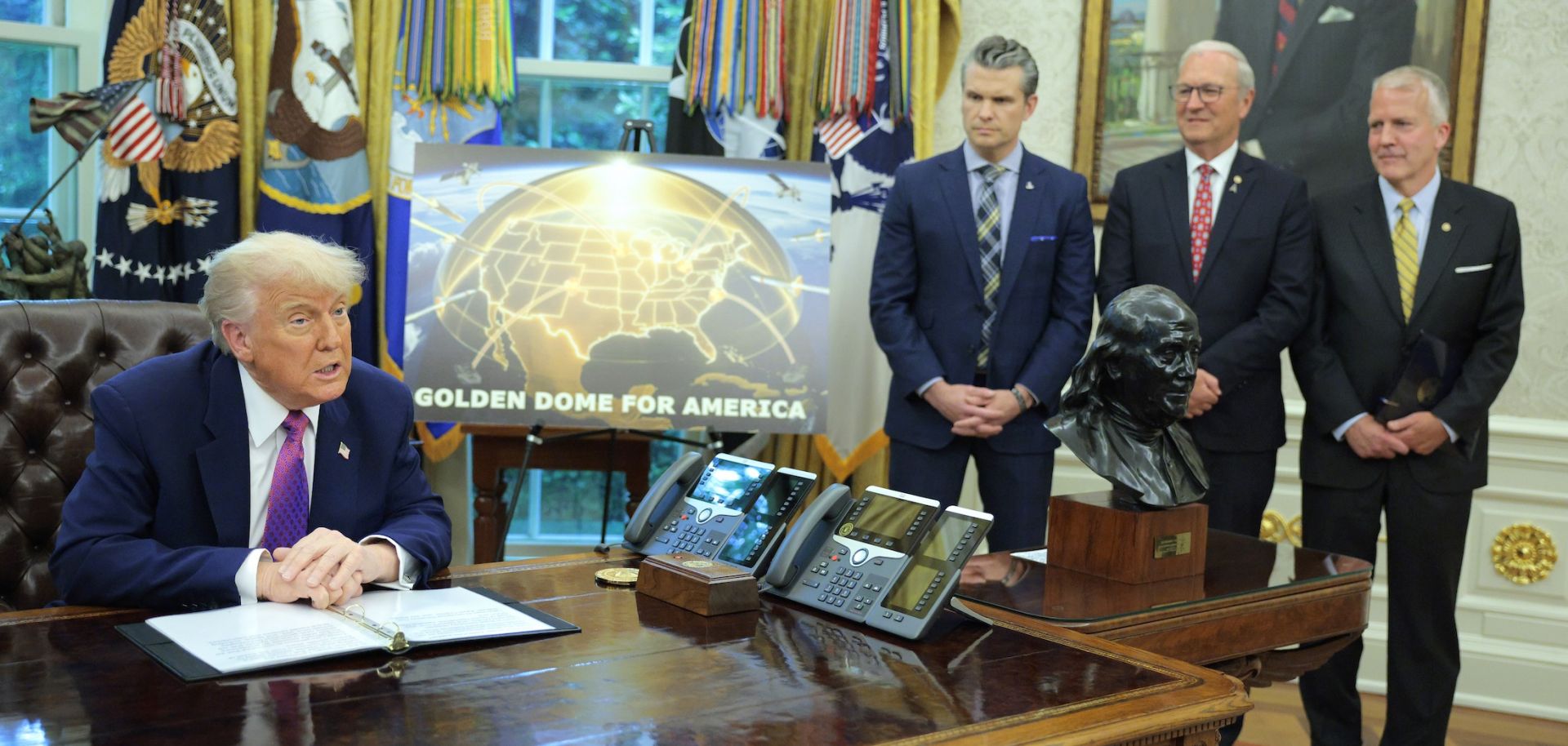
The White House's plan for a U.S. missile defense shield will likely face large technical hurdles, cost overruns and delays, but even a system that falls short of its expansive aims would threaten to accelerate the militarization of space and an arms race, as well as add momentum behind the commercialization of space. On June 10, two Republican members of the House of Representatives announced the formation of a Golden Dome Caucus, which will collaborate with one launched in the Senate last month, to provide legislative backing for U.S. President Donald Trump's expansive vision for an antimissile defense system to cover the United States. In remarks made on May 20, Trump estimated that the initiative would cost about $175 billion and would be operational before he leaves office in January 2029. The specifics of the effort are still being developed and many details will remain classified, but Trump said that the program would involve a multilayered system using "next-generation technologies across the land, sea and space, including space-based sensors and interceptors." According to Trump, once completed, the system "will be capable of intercepting missiles even if they are launched from other sides of the world, and even if they are launched from space." Trump's comments outlining his vision for the Golden Dome were the most detailed public statements about the program since he signed an executive order on Jan. 27 directing the Department of Defense to present a plan for the creation of a "next-generation missile defense shield."
- In the same public remarks on May 20, Trump also said that Canada had expressed interest in being part of the Golden Dome effort, something Canadian Prime Minister Mark Carney has confirmed. Canada and the United States already jointly run the North American Aerospace Defense Command, a military initiative launched in the 1950s to protect North American aerospace.
- Trump announced on May 20 that U.S. Space Force Gen. Michael Guetlein would oversee the Golden Dome project. In congressional testimony in March, Guetlein compared the effort to the World War II-era Manhattan Project to develop the first atomic bomb, saying that the Golden Dome program would necessitate huge cross-government coordination.
- In his address to Congress in March, Trump announced that he would ask lawmakers "to fund a state-of-the-art Golden Dome missile shield to protect our homeland." Approximately $25 billion is included in the budget reconciliation bill passed by the House of Representatives on May 22 and now awaiting a vote in the Senate.
The Golden Dome effort reflects growing U.S. concern about the missile capabilities of various adversaries, especially China, to evade existing air defenses. Protected by two vast oceans and having no nearby countries that present a serious threat, the United States has long benefited from its geographic location. Moreover, the country already has a diverse system of air defenses involving ground- and sea-based interceptors, supplemented by space-based tracking and warning capabilities. In recent years, however, U.S. officials have grown wary of advancements other countries have made in the size and sophistication of their missile arsenals that can reach the U.S. homeland, carry nuclear payloads and overwhelm existing air defenses that were designed to protect against less advanced capabilities. Already, China and Russia each have hundreds of ground-based intercontinental ballistic missiles (ICBMs) and submarine-launched ballistic missiles, along with land attack cruise missiles that can be fired from the ground, sea or air. And both countries' stockpiles are only expected to only grow in number and capability in the coming years. Of particular concern, however, is that Russia and especially China are investing heavily in so-called "hypersonic" weapons that can achieve hypersonic speeds (i.e., more than five times the speed of sound) and, more importantly, unlike more traditional missiles, can maneuver significantly in flight at that velocity — characteristics that would likely significantly challenge existing U.S. air defenses. Against the backdrop, Trump has taken a strong personal interest in missile defense, having repeatedly praised Israel's multilayered system; one component of that, Iron Dome, inspired his idea for Golden Dome, despite significant differences between the two.
- Although of lesser concern than Russia and especially China (which U.S. military strategy documents assess to be the most significant threat in the coming years), North Korea has already successfully tested ICBMs that can reach the U.S. homeland. U.S. intelligence assesses that Iran will also have the capability to do so in the next decade, if it chooses.
- Trump's Jan. 27 executive order was titled "Iron Dome for America" — a reference to Israel's air defense system that protects the country from short-range rockets and artillery, and which Trump has repeatedly praised for its effectiveness. Israel also maintains other air defense systems designed to protect against longer-range threats that are more akin to Trump's Golden Dome concept, but even those are currently not able to defeat hypersonic missiles.
The Pentagon will make progress on developing Trump's Golden Dome in the coming years, but the process will likely be riddled with delays and cost overruns that could cannibalize funding for other priorities; major technological hurdles also mean the defense system will likely will fall short of Trump's pledged expansive capabilities, at least before he leaves office. With Trump personally championing the project, his allies leading the Department of Defense and significant Republican (and some Democratic) support in Congress, the stage is set for progress to be made on Golden Dome in the coming years, such as to upgrade and better integrate existing land- and sea-based air defenses, as well as to develop some of the space-based components integral to Golden Dome. Moreover, U.S. Space Force Gen. Michael Guetlein, who is the project manager, is widely respected at the Pentagon and has extensive experience in acquisition and missile defense — qualities that will be necessary to keep momentum behind such a complex initiative. Still, major Pentagon development processes are notorious for running behind schedule and over budget, especially for projects as complex as Golden Dome. Already, many independent assessments place the costs and time needed to develop Golden Dome far beyond Trump's estimates. Assuming the Golden Dome project takes longer and costs more than currently estimated, the program could crowd out other high-priority Pentagon initiatives, including the modernization of all three legs of the United States' nuclear triad. Meanwhile, there will likely be significant technical challenges to achieving anything close to Trump's goals before he leaves office. Defending against long-range missiles is already incredibly difficult because it requires a complex set of sensors, interceptors and command-and-control infrastructure to identify, track and destroy an incoming missile traveling at incredibly fast speeds, changing trajectories and often while facing decoys, electronic jamming and other countermeasures. Advances in U.S. adversaries' long-range missiles will only make this more difficult in the future, meaning that Trump's vision to effectively make the United States impenetrable to incoming missiles is unrealistic in the coming years and will likely face significant hurdles even in the coming decades. However, incremental improvements in U.S. air defenses — especially against smaller threats from countries like Iran and North Korea — are more likely in the shorter term.
- Long-range ballistic missiles broadly travel in three phases: the initial boost phase, when engines fire the missile into its trajectory; a midcourse phase, when the booster rockets stop firing and the missile travels through space; and a terminal phase, when the missile reenters the atmosphere on the way to its target. Most missile defense systems aim to destroy an incoming threat in the midcourse phase because it is the longest and technically least challenging to do, but even the main U.S. missile defense system that targets the midcourse phase has only been effective approximately 50%-60% of the time in highly controlled tests designed to combat a smaller-scale threat from a country like North Korea. By contrast, Trump's executive order explicitly tasks Golden Dome to be able to defeat missiles in the boost and terminal phases, which would be necessary to defeat hypersonic missiles whose maneuverability essentially rules out an intercept in the midcourse phase. However, doing so in the much shorter boost or terminal phases is much more difficult, in large part because interceptors need to be near the launch or target sites, especially against much larger barrages of more advanced missiles fired by a country like China.
- According to a report published in February 2025 by the American Physical Society, a nonprofit group composed of professionals in physics and related disciplines, merely defending against a small attack from North Korea remains a "daunting challenge" for the United States — and thwarting a much larger attack from a country like China, let alone while its missiles were in the boost (or terminal) phase, would require massive and currently unproven leaps in U.S. missile defense capabilities.
- The nonpartisan Congressional Budget Office, or CBO, stated in May that, while the costs to launch a constellation of space-based interceptors are continuing to decline, the costs for just the space-based components of Golden Dome (i.e., stripping out other costs to upgrade and synchronize existing land- and sea-based missile defenses) could reach as high as $542 billion over 20 years. The CBO also said that costs could rise even higher given U.S. adversaries' growing missile capabilities, as well as Trump's envisioned goal for the Golden Dome to protect not merely against attacks from regional adversaries like North Korea but also against much larger peer ones like China.
- In a May 30 report published by The Guardian, two unnamed sources familiar with the Pentagon's implementation plan said that, by the time Trump leaves office, the department only plans to have a basic version of the Golden Dome ready for a demonstration under ideal conditions. In particular, the central part of Trump's vision — namely, space-based interceptors capable of destroying missile threats in their boost phase — is not expected and may not be ready, even in a limited way, for many more years.
Even if the Golden Dome's capabilities remain limited, the effort threatens to accelerate an arms race on Earth and in space, though the program could revive counter-proliferation talks that go beyond Russia and the United States to include China. China, Russia and North Korea have already harshly criticized the Golden Dome, with Beijing and Moscow issuing a joint statement calling it "deeply destabilizing." This is because nuclear deterrence rests on a fragile calculus that it does not make sense for any nuclear power to use its capability against another one because the attacked country would automatically respond with its own nuclear weapons, resulting in massive and possibly existential mutual destruction. However, if the United States is more secure in its assessment that it can withstand an adversary's missile barrage, it undermines the adversary's nuclear threat and weakens constraints on the United States using its own nuclear arms. Thus, even if the Golden Dome never reaches the sweeping protection envisioned by Trump, mere progress on hardening U.S. missile defenses threatens to incentivize U.S. adversaries like China and Russia to invest even more in developing more numerous and technically advanced missiles capable of overwhelming U.S. defenses (not to mention improving their own air defenses). It would also motivate U.S. adversaries to intensify their efforts to develop space-based capabilities that move beyond more traditional systems that support communications or imagery to encompass actual space-based weapons, particularly those that could neutralize the Golden Dome's reliance on space-based sensors and interceptor constellations. As more objects enter into already crowded orbits, and with few norms — let alone formal rules — governing space-based assets, the risk of accidents or miscalculation will rise. Due to these threats, as well as the fact that a new arms race would be extremely expensive and potentially a death knell for an arms control regime that has been rapidly weakening, it is possible that progress on the Golden Dome opens the door for the United States to pressure not just Russia but also China into new counter-proliferation talks. But even if this were to occur, any new deals would likely be fairly narrow and/or temporary, as no great power would want to significantly curtail its future ability to develop new weapons.
- China, Russia and the United States will, alongside Europe, remain the top space powers. However, a host of emerging powers like India, Japan and South Korea have both the incentives and capabilities to develop space-based weapons capabilities in the future. And an even longer list of countries with existing missile programs — including Iran, North Korea and Pakistan – would also have reasons to prioritize further development in response to any progress on the U.S. Golden Dome, especially in competition with their respective regional rivals.
- The last major nuclear arms control agreement between the United States and Russia, the New Strategic Arms Reduction Treaty, expires in February 2026. China, meanwhile, halted nuclear arms control talks with the United States in July 2024 in response to U.S. military sales to Taiwan. Trump has said that he wants to launch new talks with not only Russia but also China — a longstanding desire of successive U.S. presidents who have sought, so far unsuccessfully, to bring Beijing into a new arms control regime with Moscow.
The Golden Dome program will also likely accelerate the commercialization of space that, over time, will yield both benefits and risks for private firms. The project's complexity means that the contract opportunities will be vast enough to benefit numerous defense companies. These include established so-called "primes" that dominate the U.S. defense industry (like Lockheed Martin and RTX), as well as tech firms and defense startups that provide both hardware and software, but which have historically not played as large of a role in the Pentagon's acquisition process. The fact that the most crucial part of Golden Dome initiative will focus on space — combined with the Trump administration's broader desire to move away from the traditional acquisition process, which is widely critiqued as being slow and inefficient, in favor of using commercial technologies and alternative acquisition methods — indicates that the Golden Dome project likely will only add momentum to the accelerating commercialization of space. In the coming years, as the number of private space-focused companies grows, their capabilities increase and launches both become more frequent and cost-effective, this commercialization trend will enable private companies to take advantage of new satellite constellations that provide better communications and imagery on Earth, among other opportunities. In future decades, private firms will also be able to capitalize on space-based opportunities, like resource development, that are becoming more realistic with new technologies. Even so, and especially in the absence of clear rules governing the commercialization of space, a greater reliance on space-based assets will also open the door to disruptions, both due to accidents (such as a growing threat of space debris) and deliberate sabotage, which increasingly make space a contested domain.
- Elon Musk's SpaceX, which dominates the private space launch industry and is a crucial Pentagon partner, had been expected to play a large role in the Golden Dome initiative by providing launch services. However, this is now in jeopardy after Musk's falling out with Trump. But even if SpaceX is no longer as well-positioned to win large contracts, media reports indicate that many other tech firms, defense startups and other non-traditional defense contractors are expected to bid on parts of the Golden Dome project. The U.S. Missile Defense Agency is currently planning to award a series of 10-year contracts totalling up to $151 billion, and has reportedly already received more than 500 responses to its request for information from industry.
- U.S. efforts to build a missile defense shield and the broader commercialization of space will increase the strategic importance of areas on Earth that are optimal for space launches and land- and sea-interceptors. In the context of the Golden Dome, Canada's geographic location north of the United States and abutting the Arctic Circle is significant because Chinese or Russian missiles traveling over the Arctic would cross Canadian territory before reaching a target in the continental United States. On May 27, Trump published a post on Truth Social in which he said that Canada would need to pay $61 billion to join the Golden Dome but could do so for free if the country becomes the 51st state.
