
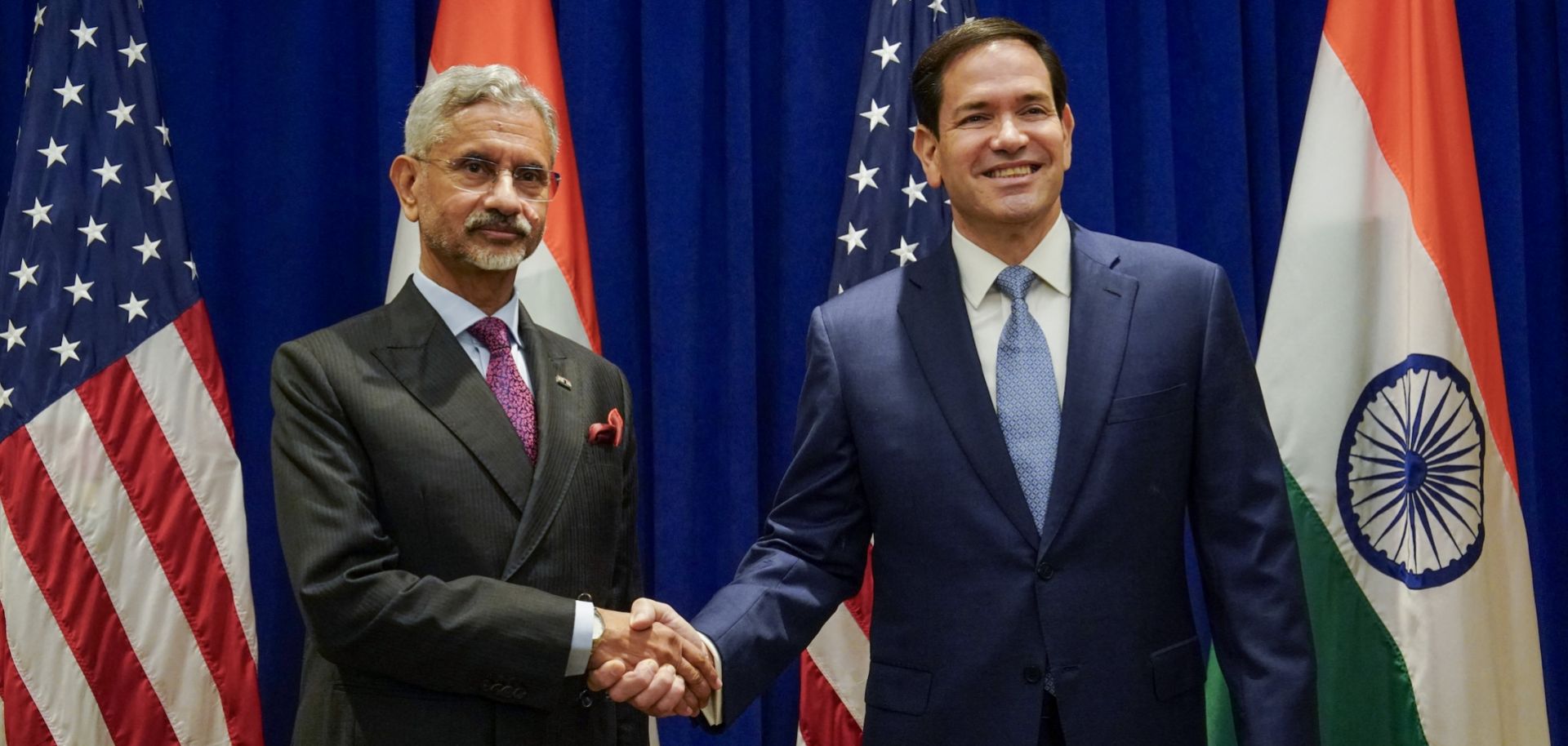
A U.S.-India trade agreement could gradually ease tariffs and regulatory barriers, particularly in tech, industrial and energy sectors, but progress will likely remain constrained by India's domestic priorities in agriculture and manufacturing, as well as U.S. legal and political uncertainties. On Jan. 20, U.S. Treasury Secretary Scott Bessent stated that Indian companies had "stopped" buying Russian oil after the United States further increased tariffs on India to deter such purchases — a move that has since fueled tensions between the two countries. Bessent's comments followed a Jan. 13 meeting between U.S. Secretary of State Marco Rubio and Indian External Affairs Minister Subrahmanyam Jaishankar, where they discussed ongoing bilateral trade negotiations, as well as cooperation on energy security and critical minerals. Since taking office in January, the administration of U.S. President Donald Trump has levied some of the world's highest tariffs on India, totaling 50%. Despite months of talks and multiple calls between Trump and Indian Prime Minister Narendra Modi, India remains one of the largest major economies that has not reached a trade agreement with the United States.
Progress on a U.S.-India trade deal has been held up by disputes over U.S. market access for agricultural and dairy products, as well as India's continued energy ties with Russia. U.S. officials say New Delhi has been unwilling to make deeper concessions, especially in agriculture, where the Modi government maintains strong safeguards to protect millions of farmers. Indian leaders have made it clear that they are willing to absorb economic fallout rather than compromise protections for farmers, who have threatened to stage more protests if the government fully opens the Indian market to U.S. agricultural products. Meanwhile, in late August, the White House imposed an additional 25% tariff on Indian goods (on top of the 25% one it imposed in April 2025 as part of Trump's sweeping "reciprocal" tariffs), arguing that India's imports of Russian oil were helping fund the war in Ukraine. Washington has also pushed New Delhi to reduce those oil imports during trade talks, but India has insisted that it needs cheap Russian crude to meet growing domestic demand. This dispute has further impeded efforts to finalize a trade deal, even as India's Russian oil imports recently fell to a two-year low amid Western pressure.
- India imports over 80% of the crude oil it needs to serve its 1.4 billion people. Traditionally, the Middle East was India's primary oil supplier, but this changed after Russia's 2022 invasion of Ukraine and the subsequent wave of Western sanctions, which forced Moscow to sell its oil at steep discounts. Seeking a cheaper alternative to meet growing domestic needs, India sharply increased its Russian oil purchases, which now account for roughly 35% of its total oil imports — up from just 1% before the Ukraine war.
- In December 2025, however, India's Russian oil imports dropped to a two-year low, averaging around 1.2 million barrels per day, down from 1.78 million barrels per day in November. Privately-owned Reliance Industries, India's largest buyer of Russian crude, halted shipments from Russia's Rosneft, while state-owned refiners limited purchases to non-sanctioned Russian suppliers. The decline reflects growing pressure from Western sanctions and a broader push by Indian refiners to diversify their sources.
To secure tariff relief, India will likely continue trade talks with the United States, though ongoing legal challenges to the Trump administration's trade policy could slow progress. India may delay offering major concessions in negotiations until the U.S. Supreme Court rules on the Trump administration's use of the 1977 International Emergency Economic Powers Act (IEEPA) to implement most of its tariffs, including those on India. A ruling is expected in early 2026, potentially even in the coming days. If the Supreme Court strikes down the tariffs, India could ease off urgent efforts to secure tariff relief and pivot to longer-term trade discussions, rather than making costly market-opening moves. But if the tariffs are upheld, New Delhi would face stronger incentives to accelerate talks and offer Washington concessions to limit the economic impact. Regardless, the Supreme Court's decision will not affect Trump's threatened 100% tariff on India's branded and patented pharmaceutical products, which is based on a Section 232 investigation by the U.S. Commerce Department and would be imposed using the 1962 U.S. Trade Expansion Act, not the IEEPA. If implemented, these tariffs could severely impact India's pharmaceutical sector, which heavily relies on the U.S. market (accounting for about one-third of its exports) and contributes about 1.7% to India's GDP. To ease tensions, India may consider reducing tariffs on U.S. electronics, industrial goods and medical equipment, while also increasing imports of American defense and energy products. However, these measures may not be enough to convince the White House, as the U.S. position is primarily driven by domestic supply chain and political considerations.
- The so-called "reciprocal tariffs" that the Trump administration imposed on numerous countries in April 2025 were implemented under the IEEPA, which grants the president authority to regulate commerce and impose sanctions during a declared national emergency. The U.S. Supreme Court is currently assessing whether the president can use this law to impose broad global tariffs without Congress's approval. As of Jan. 22, 2026, the court had not issued a decision, leaving the tariffs in place. Even if the U.S. Supreme Court deems the IEEPA tariffs illegal, the White House will likely seek to reimpose many of them through alternative legal frameworks, though this process could take several months.
- The United States accounts for roughly 18% of India's exports, and is the primary buyer for key Indian products such as pharmaceuticals, electronics and engineering goods. In 2024-25, India had a $46 billion trade surplus with the United States.
- In return for potential tariff relief, New Delhi initially offered to increase U.S. energy imports from $15 billion to $25 billion and signaled interest in deeper defense cooperation, including the possible acquisition of F-35 fighter jets. India also proposed eliminating its 6% digital services tax and reducing tariffs on American bourbon, luxury vehicles and solar products, though it is unclear whether these proposals remain under discussion.
If finalized, a trade deal could gradually ease barriers for U.S. exports to India, reduce some operational frictions and improve market access for key sectors like tech, fintech and industrial goods, though India's domestic and digital policy priorities will limit full liberalization. While the details of the trade agreement that U.S. and Indian negotiators have been working on have not been released, such an agreement could broadly benefit U.S. businesses by lowering trade barriers to enter the Indian market, improving regulatory transparency and providing more predictable market access. However, progress would likely be gradual and uneven across sectors due to differing domestic regulations and political considerations. Less sensitive sectors (e.g., textiles or IT services) will advance more quickly than sensitive ones (e.g., agriculture and dairy), which will need longer negotiation and implementation. A trade agreement could be particularly advantageous in sectors where India already has relatively open policies, including technology services, software, fintech, medical devices, industrial machinery and energy equipment, while also creating opportunities in aerospace. However, India's continued emphasis on domestic manufacturing, localization and strategic autonomy will likely constrain full market liberalization. A key area of potential improvement would be non-tariff barriers, as U.S. exporters currently face complex certification processes, local content requirements and inconsistent technical standards that can delay shipments, increase compliance costs and create uncertainty. While a bilateral trade deal could help simplify customs procedures, enhance transparency and promote greater regulatory alignment, India is unlikely to fully dismantle local content rules or sector-specific protections because they support domestic industry and job creation, carry political sensitivity, advance long-term industrial policy goals and protect regulatory sovereignty. But even incremental reductions in these frictions, alongside tariff cuts, would still improve predictability and cost efficiency, enabling U.S. firms to scale operations, strengthen supply chains and compete more effectively in the Indian market. A U.S.-India trade deal would likely also cover digital trade rules, cross-border data flows and access to services, particularly for U.S. tech companies. Given India's concerns with data sovereignty, regulatory autonomy and protecting domestic industries, any agreement may fall short of meeting U.S. expectations on issues like digital taxes and data storage. But even minor improvements — such as clearer rules on data, licensing or intellectual property — could make it easier and less costly for U.S. businesses to operate in India.
- To counter over-reliance on the U.S. market, India has been aggressively pursuing global trade agreements. India signed a deal with the United Kingdom in July 2025. On Jan. 20, European Commission President Ursula von der Leyen said that the European Union and India were "on the cusp" of signing a trade deal. India is also negotiating agreements with smaller nations like New Zealand, Oman, Peru and Chile.
