
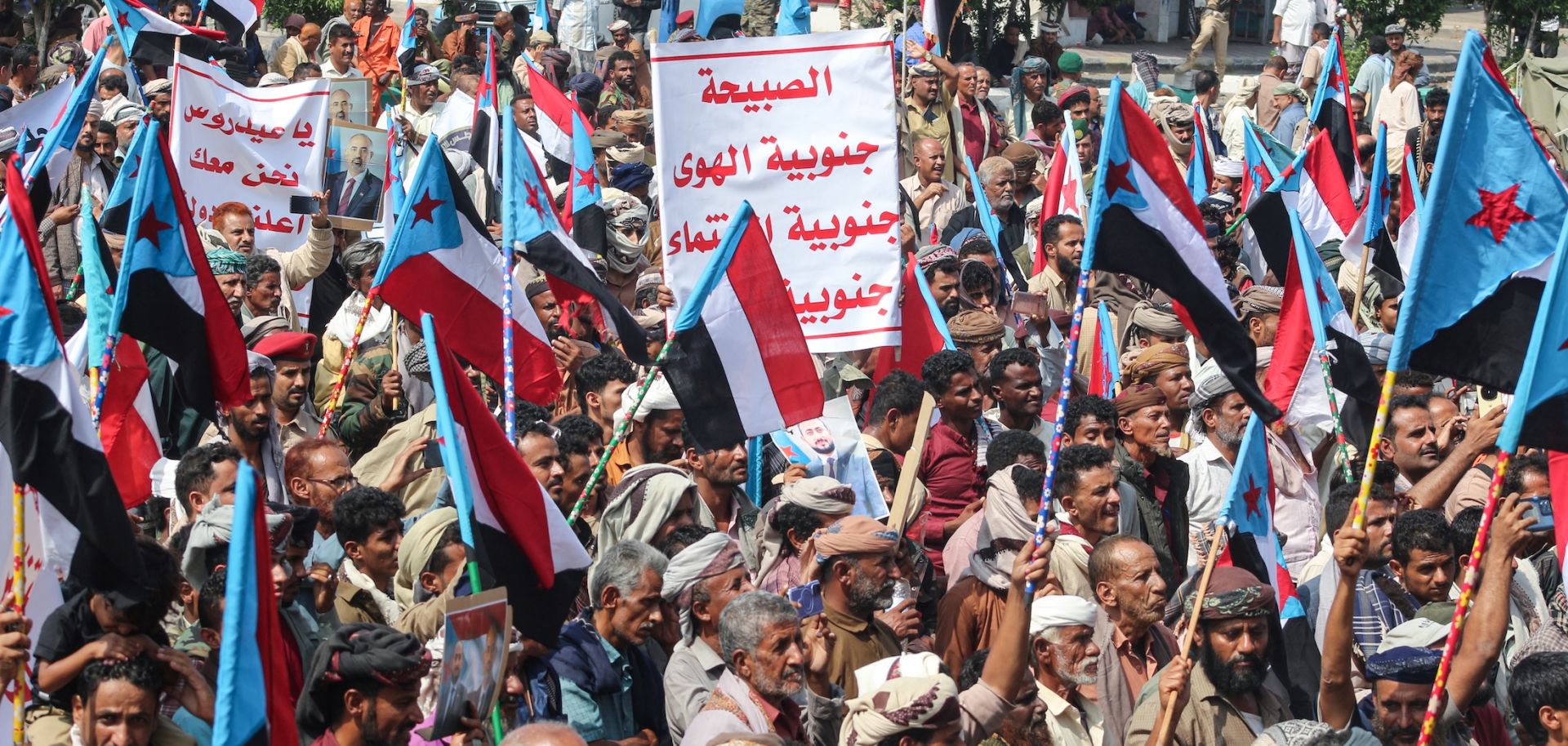
In Yemen, territorial advances by UAE-backed forces will deepen fragmentation within the anti-Houthi camp, triggering violence that will undermine stalled ceasefire efforts. Despite Emirati hopes, a near-term push toward southern independence is unlikely, but renewed instability would encourage the Houthis to launch their own offensive. On Dec. 14, the UAE-backed Southern Transitional Council (STC) announced its rejection of Saudi mediation efforts aimed at securing the withdrawal of STC forces from the provinces of Hadramawt and al-Mahra, reaffirming it would maintain its deployments in the areas. The statement came after a Saudi-Emirati military delegation arrived in the port city of Aden on Dec. 12 to discuss steps to de-escalate tensions in southern Yemen following the STC's claim that it had consolidated control across much of the south of the country and that its forces were present throughout the broader Aden province, the seat of Yemen's Saudi-backed internationally recognized government (IRG), following a lightning offensive that started on Dec. 4.
- Yemen has been fragile and fragmented since the onset of the civil war in 2014. Saudi Arabia and the United Arab Emirates intervened militarily in Yemen in 2015 as part of a joint coalition aimed at restoring the internationally recognized government and rolling back Houthi territorial gains. Today, three main entities control most of the country: the Iran-backed Houthis in the north and the capital Sanaa; the Saudi-backed Presidential Leadership Council (PLC), based in Aden, the executive body of the IRG; and the STC. Other smaller groups maintain influence in some regions, such as the UAE-backed Yemeni National Resistance Forces and the Hadrami Elite Forces.
The STC's latest offensive underscores the deepening political and military fractures within Yemen's anti-Houthi bloc, between the STC and the IRG, as well as between their principal external sponsors, the United Arab Emirates and Saudi Arabia. Although Abu Dhabi and Riyadh continue to publicly claim that they are coordinating, their Yemen strategies have increasingly diverged over time, reflecting broader competition in regions, including Sudan and the Horn of Africa. Saudi Arabia has largely focused on stabilizing Yemen through the IRG, promoting a transitional political process and pursuing a ceasefire with the Houthis to preserve territorial unity and reduce cross-border security threats. In contrast, the STC and its Emirati backers have long advocated for southern autonomy or outright secession and have favored a tougher posture toward the Houthis, viewing decentralization as a more viable end state. The recent STC advance aligns with this approach, enabling the group to convert military gains into political and institutional influence, strengthen the United Arab Emirates' hand within the PLC and sideline Saudi-aligned actors. This shift further erodes cohesion within the anti-Houthi camp, complicating unified negotiations on governance within anti-Houthi-held areas and with the Houthis in the broader Yemeni ceasefire negotiations and peace process. It also heightens the risk of internal rivalries that could weaken governance and disrupt security coordination.
- In 2019, the United Arab Emirates announced a partial military withdrawal from Yemen, formally shifting from a direct combat role to support for its local proxies, particularly the STC. Saudi forces largely pulled back following a 2022 ceasefire. Though it has technically lapsed, until now the tenuous deal has largely prevented major fighting.
- Saudi-UAE divergences in Sudan have become increasingly explicit as of late. Saudi Arabia, broadly aligned with the Sudanese Armed Forces, prioritizes de-escalation, Red Sea security and diplomatic mediation. The United Arab Emirates has strongly backed the Rapid Support Forces as part of its proxy-based influence strategy.
The STC's control of Hadramawt is likely to provoke tribal resistance and localized clashes around strategic assets, further complicating intra-coalition talks and further freezing broader ceasefire talks. In Hadramawt, the STC has reportedly seized control of key oil fields, urban centers such as Sayoun and military positions previously held by IRG-affiliated forces or allied tribes. The group has also begun asserting de facto governance by raising flags representing South Arabia (a historical region comprising the southern provinces of Yemen) over municipal buildings and military barracks, which suggests STC intent to entrench long-term territorial and governance control. These moves are likely to anger Saudi-backed forces and local Hadrami tribes, which largely view themselves as independent of foreign powers and remain deeply skeptical of the STC's governance model, which locals have criticised for corruption, abuses and failure to deliver basic public services like electricity and water. The failed Dec. 14 talks were designed to contain the fallout from the STC's advance and to return to the transitional framework within the IRG and the PLC. Thus, the STC's rejection of Saudi Arabia's demands will complicate future talks on governance in the territories recently captured by the STC and other territories still under the control of the IRG or other militias like Taiz and Marib. As a result, sporadic clashes between UAE- and Saudi-backed groups are likely around strategic assets such as oil infrastructure, logistical hubs, major roads and urban areas like Sayoun or key barracks. Ultimately, these complicated dynamics within the anti-Houthi coalition mean that ceasefire talks will remain frozen for the foreseeable future, despite Saudi efforts, undermining the broader Yemeni ceasefire and peace process designed to ultimately lead to a unified Yemeni state.
- The STC's political base is concentrated in southern Yemen, drawing primary support from the cities and provinces of Aden, Lahj, Dali, parts of Abyan and Shabwa and small parts of Hadramawt under the control of the UAE-backed Hadrami Elite Forces. Support for these factions is rooted in southern Yemeni identity politics, grievances over marginalization since Yemeni unification, former Southern Yemeni military and security elites and constituencies aligned with the goal of restoring an independent southern state, with UAE financial, military and political support.
- Marib and Taiz remain the most significant regions still under IRG control, serving as strategic strongholds due to their comparatively advanced military capabilities, tribal support networks and economic importance due to their strategic location in central Yemen. Marib is also oil-rich. However, both are highly contested, resource-strained and vulnerable to pressure from the Houthis, especially if they exploit divisions among opposing forces.
In the longer term, UAE-backed gains will reshape the balance of power in southern Yemen, but fragmentation, tribal resistance and persistent security vacuums will constrain any push toward southern independence and keep instability and security risks elevated across the country. The growing dominance of UAE-backed forces in the south is shifting the balance of power, positioning the United Arab Emirates as the principal external actor in the dynamics of the Yemeni civil war, overshadowing Saudi-aligned factions and opening the door for the possible emergence of South Arabia as a de facto independent state. However, this trajectory will remain constrained not only by deepening contestation within the PLC and the IRG more broadly, but also due to deepening fragmentation and tribal resistance within the territories newly captured by the STC and the risk of escalating political and security instability. Additionally, beyond southern and eastern Yemen, provinces like Taiz and Marib continue to be governed by IRG forces which are unlikely to give ground there given the strategic advantages. A UAE-backed push to those provinces would risk encouraging the Iran-backed Houthis to launch their own attacks on the contested provinces, undermining the United Arab Emirates' strategy to lead the anti-Houthi coalition. Meanwhile, local tribes in Hadramawt in particular are likely to resist STC and UAE-backed advances, creating additional layers of insecurity along major roads, near oil fields and in urban centers. At the same time, security vacuums elsewhere are likely to persist or widen if clashes between STC and IRG-aligned forces intensify. Groups such as al Qaeda in the Arabian Peninsula (AQAP), which remains active in areas like Shabwa and parts of Abyan and benefits from smuggling routes across largely desert terrain, are well-positioned to exploit these vacuums to expand their footprint and plan attacks.
- IRG forces in Marib and Taiz retain comparatively stronger defensive capabilities than elsewhere in Yemen through experienced local units, tribal alliances and entrenched frontlines built up over years of fighting the Houthis. However, these forces remain overstretched, politically fragmented and heavily dependent on external support, making them vulnerable to renewed Houthi offensives if anti-Houthi infighting escalates or Saudi backing weakens.
Especially if hostilities between the STC and the IRG deepen and escalate into sustained clashes, the Houthis will try to exploit the situation to launch another offensive against Marib, elevating the threat of Houthi attacks on Saudi and Emirati territory. In the near term, the United Arab Emirates and its STC partners are unlikely to push offensives into Marib or Taiz, both of which remain under IRG control, as doing so before consolidating and legitimizing gains elsewhere would risk overextending their forces, further alienating Saudi-backed factions and accelerating the fragmentation of the anti-Houthi coalition. However, prolonged infighting within that coalition would present a particular opportunity for the Houthis, who have long viewed Marib as a strategic prize due to its oil fields, critical smuggling routes and symbolic value due to it being the last northern stronghold not under Houthi control. Although the Houthis' previous major offensive in 2022 on Marib failed and frontlines have frozen since then, renewed divisions among their opponents could embolden the Houthis to relaunch an assault. Capturing Marib would provide the Houthis with much-needed oil revenues, expanded smuggling corridors to sustain their military capabilities and greater political leverage in any future negotiations of a postwar Yemeni order. Alternatively, the Houthis could also exploit the divisions within the anti-Houthi coalition to launch offensives against STC-held areas to undermine them, like in Shabwa or Lahj where border clashes have occurred frequently in the past few years. Either scenario would significantly heighten regional volatility, as intensified Houthi fighting against IRG and/or STC forces would raise the likelihood of Houthi attacks on oil, gas and civilian infrastructure in Saudi Arabia and the United Arab Emirates, in a bid to pressure them to concede given Riyadh and Abu Dhabi's prioritization of internal security.
- The Houthis are increasingly well-positioned for a renewed southward push. For the past two years, they have leveraged anti-Israel grievances against the backdrop of the war in Gaza and multiple rounds of Israeli airstrikes in Yemen to justify a large military buildup and mobilize — according to their claim — millions of new recruits to their ranks. Additionally, despite attacks over the past two years from U.S., U.K. and Israeli forces, the Houthis have continued to receive shipments of arms and components from Iran to strengthen their missile and drone capabilities and capacity.
- The Houthis have in the past attacked both Saudi and Emirati territories with ballistic missiles and drones, specifically targeting oil energy facilities and airports. The last high-profile Houthi attack before the agreement on a ceasefire in Yemen occurred against an oil facility in the United Arab Emirates in 2022, which led to at least three fatalities.
- On Dec. 18, the Emirati media outlet Al Ain reported that the Houthis may be preparing for an offensive against the STC in areas such as Shabwa, claiming that the Houthis have been deploying unprecedented military reinforcements to southern fronts in the country.
