
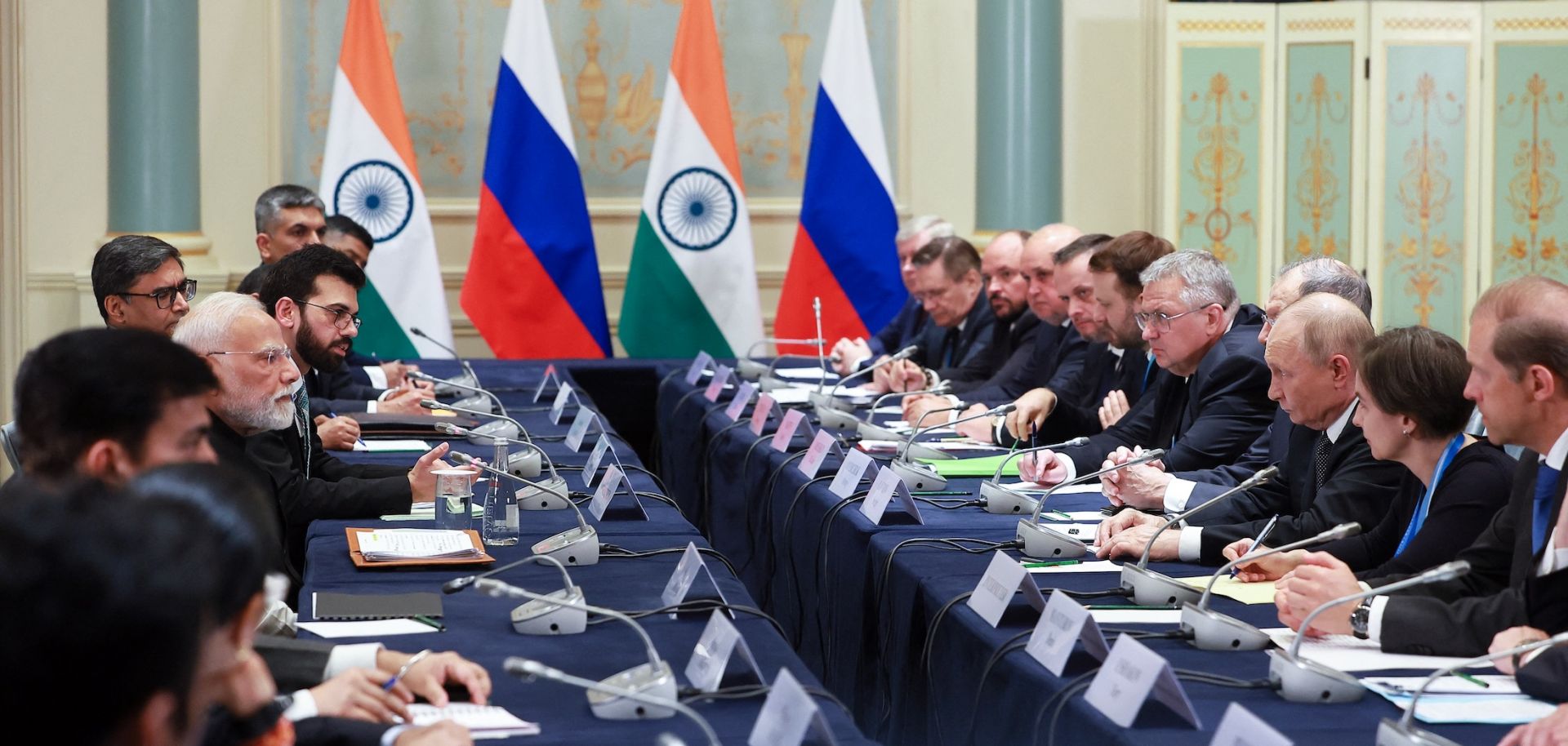
Russian President Vladimir Putin's upcoming visit to India will reinforce the symbolic strength of bilateral ties and support incremental cooperation across defense, energy and trade, though India will likely maintain selective engagement with Russia as it navigates U.S. pressure and sanctions and continues its shift toward defense and technology diversification. Putin will visit India on Dec. 4-5 for the annual India-Russia summit, where he will meet with Prime Minister Narendra Modi. Russia and India have held summits each year since 2000, following the signing of the Declaration on the India-Russia Strategic Partnership, which created their highest-level institutionalized dialogue. These meetings, typically hosted alternately by each country, aim to deepen the strategic partnership through high-level discussions.
- Putin has not visited India since December 2021, a few months before Russia launched its invasion of Ukraine in February 2022. Modi last met Putin in Moscow from July 8-9, 2024, during which the two sides signed memoranda of understanding covering trade and investment, climate change and medicine.
- Putin's upcoming trip to India follows a series of preparatory meetings, including External Affairs Minister S. Jaishankar's Nov. 17-19 trip to Moscow and a Nov. 18 meeting in New Delhi between Modi and Putin's aide Nikolay Patrushev, where they discussed expanding maritime cooperation across areas like connectivity, port development, skill-building, shipbuilding, the blue economy and Arctic operations.
Putin's visit underscores the symbolic significance of the India-Russia strategic partnership, especially as New Delhi navigates U.S. pressure over curbing Russian oil imports. The visit underscores India's balanced foreign policy, signaling to both foreign and domestic audiences that New Delhi will pursue its strategic goals without yielding to external pressure — particularly from the United States over India's continued purchases of Russian oil. In late August, the White House imposed a 25% tariff on Indian goods, arguing that the country's Russian oil imports were helping fund the war in Ukraine. Washington has also pushed New Delhi to reduce those oil imports during ongoing trade talks, but India has insisted that it needs cheap Russian crude to meet growing domestic demands, which has stalled the finalization of a trade deal. However, after the White House on Oct. 22 announced sanctions targeting Russian oil giants Rosneft and Lukoil, which took effect on Nov. 21, Indian refiners halted or scaled back purchases. As a result, India's imports of Russian oil are now expected to hit their lowest in at least three years in December, down from multi-month highs in November, as refiners seek alternatives to avoid breaching Western sanctions. Nonetheless, the latest U.S. measures are unlikely to fully sever India's energy ties with Russia, as reports indicate state-run refiners Indian Oil Corp. and Bharat Petroleum Corp. have already purchased Russian crude for January delivery, attracted by discounts from non-sanctioned sellers. Russia is also focused on sustaining oil exports to India, though payment mechanisms remain a key sticking point because Indian refiners need a workable system to continue purchases despite international sanctions. To facilitate smoother transactions, Moscow is pushing for permission to open a Central Bank of Russia representative office in Mumbai, similar to its successful decade-long presence in China.
- India imports over 80% of the crude oil it needs to fuel its economy and serve its 1.4 billion people. Traditionally, the Middle East was India's primary supplier, but this changed after Russia's 2022 invasion of Ukraine and the subsequent wave of Western sanctions, which forced Moscow to sell its oil at steep discounts. Seeking a cheaper alternative to meet growing domestic needs, India sharply increased its Russian oil purchases, which accounted for roughly 35% of its total imports in 2024 — a significant increase from just 1% before the Ukraine war began in 2022.
- Both Indian and U.S. officials have indicated that they are moving closer to finalizing a trade deal to address the trade imbalance, as India recorded a $46 billion surplus with the United States in 2024-25. Progress has been slowed by India's protectionist stance on its agriculture and dairy industries, along with its continued imports of Russian oil, which the United States has repeatedly criticized. To help narrow the surplus, India has proposed boosting its purchase of U.S. defense and energy products. New Delhi has also offered to significantly reduce tariffs on a wide range of imported U.S. goods, including industrial equipment and automobiles.
Talks will likely focus on sustaining India-Russia energy cooperation and advancing nuclear collaboration, though progress will depend on practical constraints like sanctions and logistics. Putin will likely encourage India to maintain its purchases of Russian oil, potentially by offering additional discounts. However, India's ability to sustain these flows will ultimately hinge on whether the operating environment remains workable for its state-owned and private refiners. If shipping, insurance, banking or payment channels become too constrained under evolving Western sanctions, India's commercial actors may be forced to scale back their Russian oil purchases, regardless of political intent. In effect, the durability of India-Russia energy cooperation will be shaped less by high-level commitments than by the practical viability of moving Russian crude through increasingly complex logistical and financial systems. Bilateral trade will also be a discussion point, with a focus on deepening collaboration in nuclear energy (where Russia is eager to broaden its role), as both countries work toward a shared goal of $100 billion in trade by 2030. Key items may include accelerating work on additional reactors at the Kudankulam nuclear power plant, India's largest nuclear facility (where Russia is already involved in construction and operations), and evaluating Rosatom's proposals for localized large- and small-scale nuclear projects, which call for greater Indian manufacturing participation and long-term technology cooperation.
Discussions will likely also cover joint air-defense and fighter programs to upgrade India's capabilities, but cooperation will likely be limited to sustaining and upgrading existing Russian platforms amid Russia's production constraints and India's shift toward Western and indigenous systems. Putin-Modi talks will likely focus on a broad range of defense projects. These include India's October 2025 preliminary approval to acquire a large new batch of S-400 surface-to-air missiles, alongside early-stage negotiations on jointly producing the S-500 air-defense system and Russia's offer to transfer technology for its next-generation Su-57 fighter jet. For India, these initiatives would help address a growing fighter jet shortfall, modernize its existing fleet of over 200 Russian-made jets, and enhance its long-range air defense and beyond-visual-range strike capabilities. However, persistent delivery delays, such as Russia's postponed supply of the final two S-400 units from the 2018 contract, and the fact that both the S-500 and Su-57 initiatives remain at very early stages, mean that meaningful progress will be slow, leaving timelines uncertain, even as India seeks greater capability and Russia looks to secure long-term defense cooperation. India's continued purchases of Russian defense equipment, while potentially further irking the United States, will likely be less contentious than its Russian oil imports, which Washington sees as more directly undermining Western efforts to end the war in Ukraine. At the same time, New Delhi will likely keep some level of defense cooperation with Moscow to sustain existing Russian-made systems and preserve supplier diversity. But any expansion will be constrained by Russia's limited production capacity and India's preference for Western platforms, keeping most activity likely focused on maintaining or upgrading legacy equipment rather than signing major new deals.
- India has gradually reduced its heavy dependence on Russian defense systems by increasing purchases from Western suppliers. However, Russia remains India's largest source of military hardware, despite a sharp drop in Indian orders in the four years leading up to 2024, according to the Stockholm International Peace Research Institute. On Nov. 28, Indian Defence Secretary Rajesh Kumar Singh underscored that defense cooperation with Russia is enduring, stating that India does not plan to reduce it and will continue to procure equipment from both Russia and the United States.
Additionally, Putin and Modi will likely discuss lower-risk areas, such as an agreement that streamlines skilled Indian migration to ease Russia's labor shortages, as well as a potential trade deal between India and the Eurasian Economic Union. The two leaders are expected to discuss a bilateral mobility agreement to formalize legal migration, ensure social protections for Indian workers, and support the deployment of skilled manpower in key Russian sectors like construction, textiles and engineering. If implemented, such a deal would help Russia fill labor gaps and offer India a regulated channel for exporting skilled talent. However, its effectiveness will hinge on practical factors, including language and skills training, regulatory stability, and the capacity of Indian companies and workers to navigate Russia's labor laws and administrative requirements. Discussions may also touch on a potential free trade agreement between India and the Eurasian Economic Union, which includes Russia, Belarus, Kazakhstan, Armenia and Kyrgyzstan. Such an agreement could provide India with preferential access to a bloc representing significant energy, industrial and agricultural markets, while giving EAEU members expanded opportunities in Indian goods and services.
