
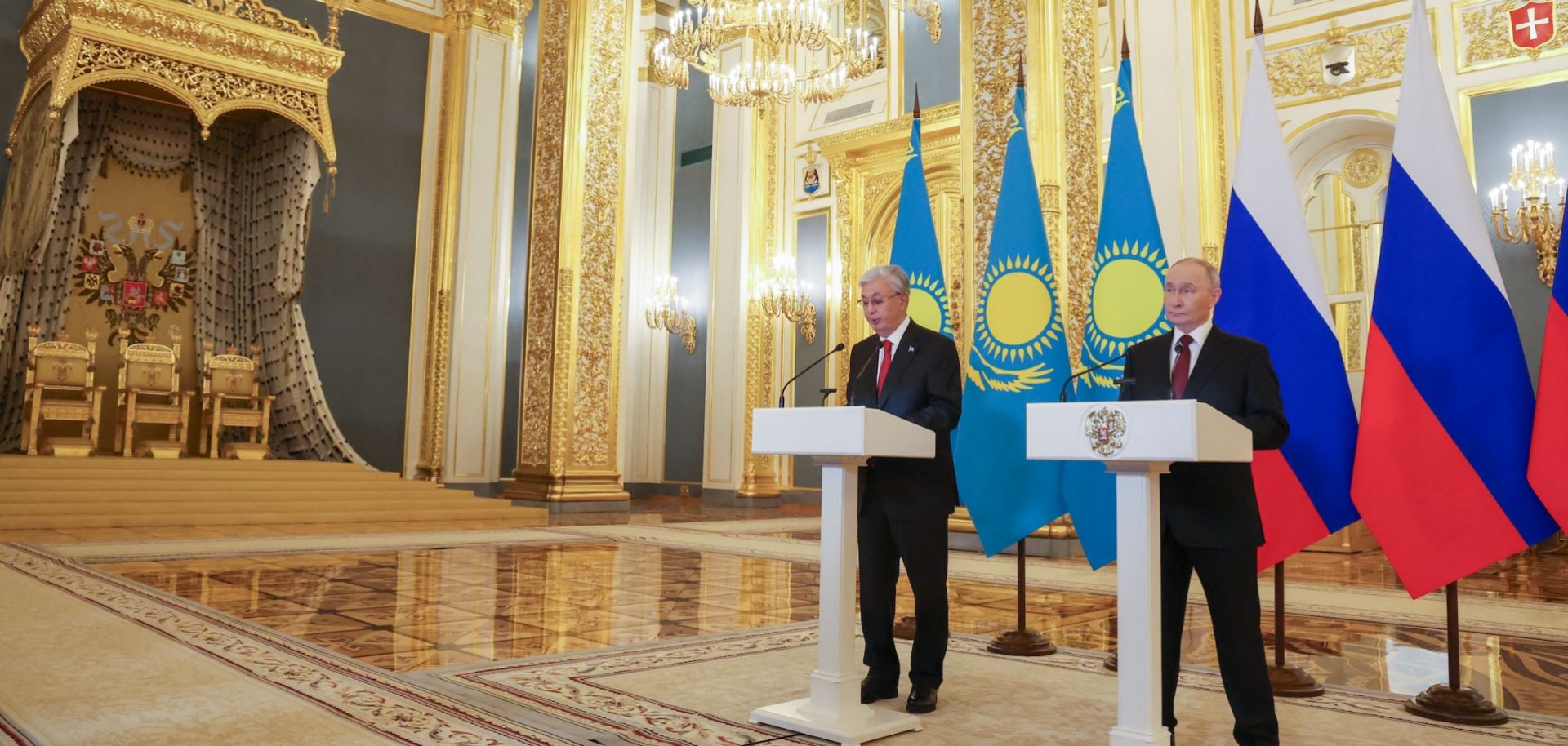
The deepening strategic alignment between Russia and Kazakhstan will reinforce the structural asymmetry in their relations, limit Astana's ability to balance between Moscow and the West, and heighten Kazakhstan's exposure to economic and political coercion from the Kremlin as regional instability grows. On Nov. 11-12, Kazakh President Kassym-Jomart Tokayev made a state visit to Russia, which culminated in the signing of a Declaration on the Transition of Bilateral Relations to a Comprehensive Strategic Partnership and Allied Relations — a largely symbolic formalization of the two countries' already deep ties. The document reaffirms Moscow and Astana's commitment to an "indivisible Eurasian security architecture" and to expanded cooperation in defense, nuclear energy and transport connectivity. Although this was the fourth in-person meeting between Tokayev and Russian President Vladimir Putin this year alone, it was the first state visit of Tokayev's tenure. Conducted with full ceremonial protocol, Putin extended personal gestures of esteem, including an hours-long one-on-one meeting in his private Kremlin apartment quarters, a courtesy reserved for only a handful of foreign leaders. Tokayev, for his part, praised Putin as "a statesman of global stature whose leadership strengthens Russian statehood and international influence," and characterized Russia as "a unique civilization and great power whose fate is intertwined with Kazakhstan's." While describing Kazakh-Russian relations as "strategic, allied and unshakable" and "an exemplary model of interstate cooperation," Tokayev also acknowledged the existence of occasional "differences in interpretation," which he framed as "inevitable in any close partnership" and noted were "consistently resolved through dialogue."
- Tokayev's visit to Russia resulted in 14 agreements and memoranda, including a transport security accord, as well as intergovernmental documents on rail transit, special economic zones, and sanitary and epidemiological safety. The two sides also agreed to develop major transport corridors, notably the North-South route linking Russia to the Persian Gulf via Kazakhstan and Turkmenistan, and to modernize key border crossings. Additionally, Kazakhstan granted consent for the opening of a Russian Consulate General in Aktau, a strategic hub on the Trans-Caspian corridor — a trade route connecting Europe to East Asia that bypasses Russia.
- Between January and August 2025, the European Union remained Kazakhstan's largest trading partner, accounting for 32% of total trade, followed by China (23.3%), Russia (18.9%) and Turkey (3.8%). Compared with 2021, the European Union and China have expanded their shares of Kazakhstan's trade, while Russia's has fallen from 24.2%. This year, Kazakh-Russian trade further weakened, with total turnover down 5.7% year-on-year. While traditional Kazakh exports to Russia (e.g., ores and uranium), declined, shipments of high-tech goods (e.g., laptops, notebooks and smartphones) rose nearly threefold, underscoring Kazakhstan's growing role as a transit hub for sanctioned products entering Russia, with over 96% of bilateral trade settled in local currencies.
Tokayev's reception in Moscow reflected the Kremlin's strategic urgency of shoring up its Eurasian flank amid new Western sanctions and deepening fiscal pressures, as well as Kazakhstan's cautious drift toward the United States, but the visit produced few tangible concessions from Russia. The visit came just one week after the C5+1 summit in Washington, where Tokayev and other Central Asian leaders met U.S. President Donald Trump to discuss critical minerals, energy corridors and regional connectivity. Tokayev's carefully choreographed encounter in Moscow was thus designed to reaffirm Russia's primacy in Kazakhstan's foreign policy hierarchy following the U.S.-hosted summit, and to counter perceptions (at home and abroad) of Astana's tilt toward the West. The visit also came less than two weeks after the Trump administration imposed sweeping sanctions on Russia's two largest oil producers, Rosneft and Lukoil, with immediate spillover effects on Kazakhstan's Kalamkas-More and Khazar offshore projects, in which Lukoil owns a 50% stake in both. Even as Western sanctions deepened Russia's energy isolation, Moscow and Astana signed a memorandum of understanding outlining the next steps for constructing Kazakhstan's first nuclear power plant. While the declaration formally reaffirmed that the project will be led by Rosatom, Russia's atomic energy corporation, the sides failed to agree on financing terms, raising doubts that Moscow can secure the necessary export credits amid mounting fiscal pressures and its repeated failures to deliver on major development projects abroad. Meanwhile, Tokayev and his delegation also arrived in Moscow under growing domestic pressure to protect the export-driven Kazakh economy from Russia's recent transport, border and migration regulations. These measures have disrupted cross-border trucking, and yet Moscow has refused to lift the restrictions, possibly reserving them as a bargaining chip. Russia's phytosanitary bans on agricultural commodities and periodic restrictions on grain transit through its territory have further constrained bilateral trade. In response, the two sides signed a rail transit agreement, but Astana failed to secure any significant legal protections since the accords offered only procedural coordination measures, leaving Kazakhstan exposed to the same discretionary non-tariff barriers that Moscow routinely weaponizes. A separate sanitary and epidemiological cooperation agreement likewise offered no substantive safeguards for Kazakh exports, deferring implementation to future protocols and leaving Russia's discretionary control over inspections intact.
- In April 2024, Kazakhstan and Russia agreed to build three coal-fired thermal power plants in northern and eastern Kazakhstan, aiming to alleviate chronic winter electricity shortages in these areas due to aging, Soviet-era power infrastructure. In July 2025, however, Russia pulled out of the projects after its sole operator of electricity imports and exports, InterRAO Export, failed to obtain export credit guarantees, forcing Kazakhstan to seek investors from China and South Korea.
- The Baiterek project, launched in 2004 as a joint Kazakh-Russian venture to modernize the Baikonur Cosmodrome's Zenit-M site for the Soyuz-5 rocket, remains stalled due to delays and funding disputes. Kazakhstan has invested over $210 million (including $127 million for 2025) in the project, while Russia has failed to meet its obligations. In 2023, Astana seized $22 million in Roscosmos assets over debts. Despite these setbacks, the two sides signed a new protocol to keep the project alive, with Putin claiming that launches could begin by late 2025, a timeline widely regarded as unrealistic given the project's financial and technical problems.
- Since Sept. 1, Russia has enforced a new rule cutting the visa-free stay for citizens of countries with which it has visa-free regimes, mostly former Soviet republics, from 180 to 90 days per year. The measure — which also applies to Kazakhstan and Kyrgyzstan, despite their membership in the Eurasian Economic Union (EAEU) — has disrupted cross-border logistics and left thousands of Kazakh truck drivers at risk of losing access to Russian routes or detention. Severe congestion at major crossings, where queues of thousands of trucks have been reported, has further compounded the problem.
As Russia's economy slows and its industrial base weakens, it is increasingly relying on Kazakhstan as a logistical, energy and sanctions-evasion hub, which will reinforce an asymmetrical interdependence that Moscow will weaponize against Astana through at least the end of the decade. Kazakhstan is poised to become an increasingly crucial hub for the re-export and procurement of sanctioned goods as Russia, facing mounting fiscal pressure and slowing defense and industrial production, intensifies its search for critical imports and dual-use technologies. Kazakhstan will seek to quietly distance itself from this role, primarily due to concerns over secondary sanctions, given its deep reliance on the European Union for trade and oil exports. However, geography, infrastructure and the institutional framework of the EAEU will continue to give Moscow leverage over Kazakhstan's trade flows, foreign policy and broader geopolitical behavior, reinforced through a dense web of political, economic and security dependencies across critical sectors. This asymmetrical relationship will likely deepen as Gazprom-led gasification programs for northern and eastern Kazakhstan move forward, enabling Russia to secure a new transit route for its gas to China, and as implementation begins on the 2025 memorandum increasing Russian oil transit to China through Kazakhstan, further strengthening the Kremlin's ability to use energy as a geopolitical instrument. This growing multilayered integration will further increase Kazakhstan's exposure to Russia's fiscal volatility, meaning that any sharp ruble devaluation — an increasingly likely scenario under Russian budgetary strain — would transmit immediate inflationary pressure into Kazakhstan's already overheated economy. The political dimension of this dependence will become even more significant over the next 6-12 months as Kazakhstan embarks on constitutional reforms and succession discussions gain momentum, creating new opportunities for Moscow to exert influence over domestic stability and leadership continuity. Through 2029, when Tokayev's term ends, Kazakhstan will continue accommodating Moscow's interests in key sectors like energy and security, as seen in Astana's decision to award Rosatom a contract to build its first nuclear plant. Tokayev's political survival will remain closely tied to Putin, who acts as a personal guarantor of his regime's continuity (having intervened at Tokayev's request to quell violent unrest in Kazakhstan in January 2022) and a source of external legitimacy amid declining living standards, domestic reforms and succession uncertainty. However, Tokayev's successor, whether Moscow's preferred candidate or emerging from within the ruling elite, will likely belong to a generation with little personal or political attachment to Kazakhstan's Soviet past. As this new cohort rises and the Kazakh population gains more historical distance from the Soviet Union, Moscow's use of symbolic narratives, such as appeals to and the valorization of the "Great Patriotic War" and wartime unity, will become less effective, eroding one of the Kremlin's most enduring instruments of soft influence.
- According to the Russian state-linked Center for Macroeconomic Analysis and Short-Term Forecasting, amid the slowdown in Russia's defense and industrial output, Russia must prioritize maintaining access to critical foreign technologies and components "at any cost," with its industrial capacity now dependent on the unrestricted expansion of parallel and gray import channels. The Center assumes that Western sanctions will persist even after active hostilities end, treating them as a lasting structural constraint and urging Moscow to build a self-sufficient, sanctions-resilient economy that relies permanently on alternative logistics networks and "friendly" intermediaries outside Western jurisdiction.
- Russia maintains significant leverage over Kazakhstan's critical infrastructure and energy networks. It controls Kazakhstan's main oil export route through the Caspian Pipeline Consortium. It also supplies about 4% of Kazakhstan's electricity to cover shortages in the north and west, where some districts are entirely reliant on Russian power. Additionally, Russia delivers drinking water to the Mangystau region on the Caspian coast, where chronic water scarcity makes these supplies strategically vital. Moreover, through its subsidiary Uranium One Group, Russia's Rosatom reportedly controls about 58% of Kazakhstan's uranium reserves through joint ventures, consolidating its position as the dominant foreign actor in this strategic sector.
- After reaching an agreement with China in September to raise annual oil supplies through Kazakhstan, Russia sent a proposal to Kazakhstan to increase transit volumes, which is now under joint technical review to determine whether new pumping stations or flow-enhancing additives are needed. In October, Russia and Kazakhstan signed a memorandum to build a new trunk gas pipeline supplying Russian gas to northern and eastern Kazakhstan and potentially transiting to China (the sides must agree on pricing terms, a key sticking point that could delay implementation). Astana and Moscow also reached a long-term agreement on processing Karachaganak gas at Russia's Orenburg plant, which deepens a key leverage point for Russia since Kazakhstan's oil and gas production relies on the uninterrupted operation of the Orenburg facility.
- In his annual address to Kazakhstan's parliament on Sept. 8, Tokayev proposed a constitutional reform to abolish the Senate and create a unicameral legislature. This change would eliminate the current first-in-line for succession (the Senate speaker), should the presidency become vacant due to death, incapacitation or resignation. As deliberations over the reform kick off in 2026, the question of who will eventually replace Tokayev is set to intensify. This will exacerbate the fundamental uncertainty clouding Kazakhstan's political future, a common phenomenon in systems where power is concentrated in a single leader, institutions are weak and no clear succession mechanisms exist. Should this lead to greater political instability or power struggles among competing elites, Moscow could exploit its substantial leverage to influence an outcome that aligns with its interests.
- The waning prevalence of the Russian language in Kazakh public life and education will reinforce the long-term decline in Russia's cultural influence in the country. Although Russian is still widely spoken among the bureaucracy and urban elites in major cities like Astana and Almaty, its overall societal use in Kazakhstan is declining. Roughly 70% of all school-age children now attend Kazakh-language schools, a significant increase from the 30% enrollment rate at Kazakhstan's independence in 1991. Over 84% of ethnic Kazakh students are also now enrolled in these institutions.
Ultimately, the outcome of Russia's war in Ukraine will remain the key variable shaping regional security, but most scenarios will carry downside risks for Kazakhstan. A peace settlement favorable to Moscow would most likely embolden it to press harder in Central Asia, demanding policy alignment and further reducing Astana's autonomy. However, a frozen conflict would also present a risk for Kazakhstan, as heightened domestic pressure from a stalemated war could compel Russia to seek a decisive outcome elsewhere to demonstrate strength. In this scenario, Kazakhstan could become a target, as a military intervention would offer Moscow a strategic shortcut to reassert dominance, counterbalance China's economic influence, secure control over critical energy and transit corridors, create a militarized buffer in its vast southern border, and permanently halt Kazakhstan's drift toward other powers. In this scenario, Kazakhstan's primary vulnerability would be its Russian-speaking north, where Moscow could engineer a casus belli by activating and amplifying far-right, ultranationalist agitation over "persecuted compatriots." However, the actual strategic goal of such a military intervention would be to discipline what the Kremlin sees (regardless of veracity) as an increasingly autonomous Kazakhstan, and to secure Russian interests in transit and energy without having to negotiate from a position of declining leverage, particularly as its trade asymmetry with Beijing deepens. China, whose Belt and Road investments in Kazakhstan have grown by over 400% in the first half of 2025 alone compared with the entire previous year, would likely oppose any military action. But Moscow could preempt this — albeit at the risk of straining its increasingly important ties with Beijing — by weaponizing deep-seated Sinophobic sentiment in Kazakhstan. This would likely involve amplifying the potent narrative of corrupt Kazakh elites "selling land to Beijing" to catalyze anti-China and anti-government protests, in a bid to paralyze the Kazakh government and constrain any coordinated response with China.
- More restrained trajectories are also possible, though less likely in the near term. A military victory in Ukraine could exhaust Russia's offensive capacity for years, forcing its strategic focus to shift toward internal economic recovery and military rebuilding, rather than new conflicts. Similarly, a prolonged stalemate could fuel domestic discontent and make the Kremlin less likely, not more, to launch a risky diversionary war in Kazakhstan, should the fear of another military failure triggering the collapse of Putin's regime outweigh any potential benefit, thus making political survival the overriding priority.
- Kazakhstan shares with Russia the longest continuous land border, which spans 4,700 miles and remains thinly defended. This extensive frontier is particularly notable because several of the bordering Kazakh regions are home to large ethnic Russian populations: Russians constitute over 44% of the population in both North Kazakhstan (44.4%) and East Kazakhstan (44.2%), and substantial minorities in Kostanay (33.5%) and Pavlodar (28.9%). Nationally, ethnic Kazakhs comprise around 71% of the population (14.46 million), and Russians make up 14.6% (2.96 million); however, in southern regions like Kyzylorda and Turkestan, the ethnic Russian share drops to less than 2%.
- The "Russian Community," the largest ultranationalist organization in Russia that was formed in late 2020, has reportedly been assisting in patrols along the Russian-Kazakh border. One of its cofounders, Andrey Tkachuk, formerly served as deputy speaker of the City Council of Omsk, a Russian city bordering Kazakhstan. The Russian Community's activities reflect a broader trend in which the Kremlin tolerates or co-opts far-right movements under the guise of border security. The organization publicly claims to promote the "unity of the Russian people" and operates jointly with Russian security forces during raids targeting migrants. This comes amid a wider increase in nationalist and xenophobic incidents in Russia; according to the SOVA Research Center, a Russian NGO that tracks xenophobia and radical nationalism, Russia is experiencing a sharp rise in neo-Nazi and far-right violence, with hate crime attacks increasing by roughly 1,000% in 2025 compared with 2022.
