
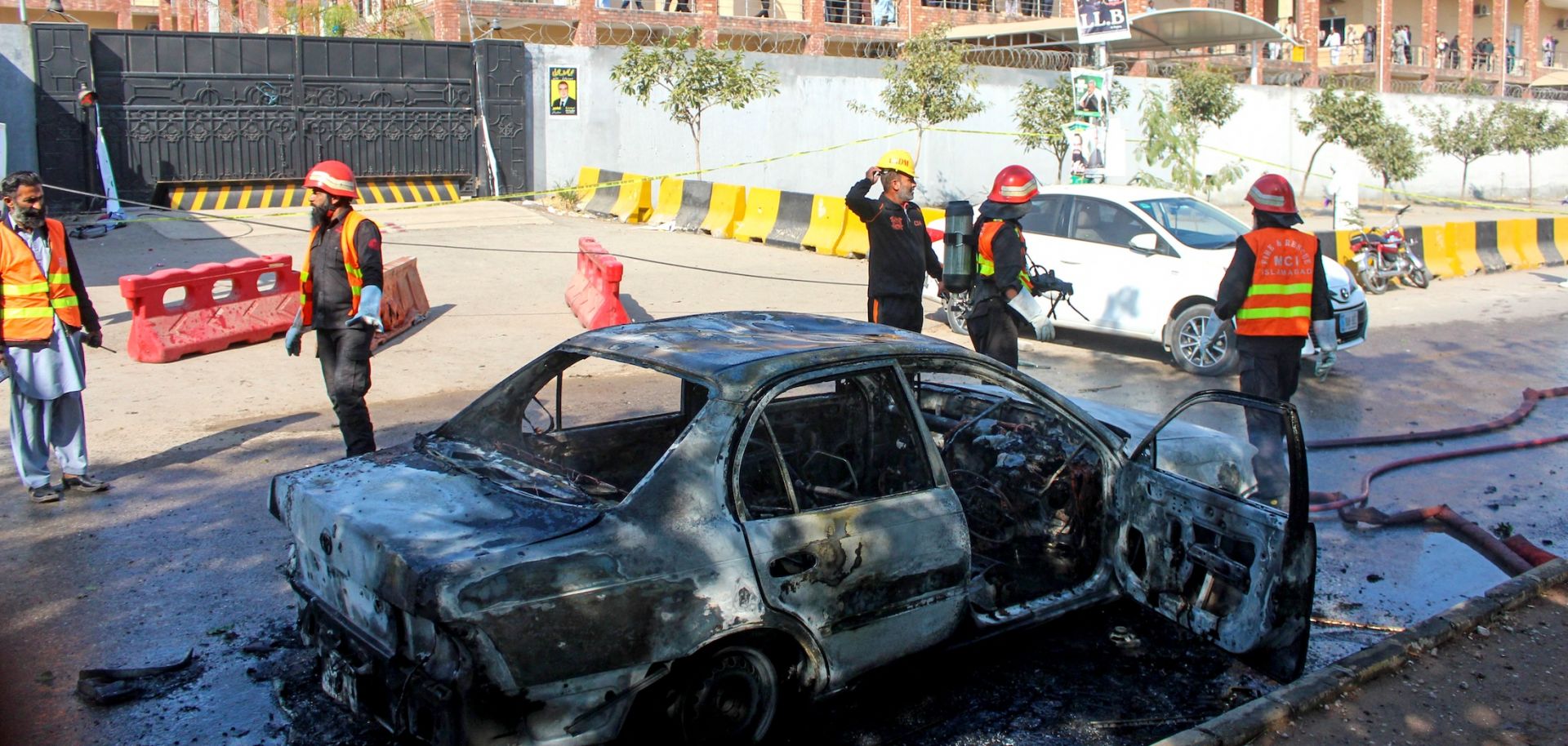
Back-to-back explosions in New Delhi and Islamabad appear unlikely to trigger imminent Indian or Pakistani retaliation against the other, but severe bilateral mistrust and tensions will sustain the risk of renewed cross-border strikes against targets in major cities should either country determine the other culpable for the recent blasts. On Nov. 11, a suicide bombing killed at least 12 people and injured 36 outside the District Judicial Complex in Islamabad, Pakistan. While the Afghanistan-based Tehrik-i-Taliban Pakistan (TTP) militant group denied responsibility, a hard-line TTP faction, Jamaat-ul-Ahrar (JuA), subsequently claimed the attack and said it targeted "the judges, lawyers, and other staff who enforce Pakistan's un-Islamic laws." Pakistani authorities are still investigating "all aspects" of the bombing, though some top officials have suggested it occurred with Indian support, with Pakistan's prime minister attributing the attack to India-backed militants, and the country's interior minister claiming "Indian-backed elements and Afghan Taliban proxies" were responsible. The Islamabad attack occurred just a day after a vehicle exploded near the Red Fort historic site in India's capital, New Delhi. Indian authorities have yet to confirm whether that blast was an intentional attack, but they are investigating it under anti-terrorism laws that facilitate greater resourcing and expanded powers. To this end, Indian media reported on Nov. 11 that authorities were looking into a possible connection to a recently busted, Islamist extremist network that India believes has ties to the Pakistan-linked Jaish-e-Muhammad and al Qaeda-linked Ansar Ghazwat-ul-Hind militant groups.
- Militants last targeted Islamabad in December 2022, when a TTP suicide bomber detonated his explosives while being chased by police, killing a police officer and wounding six others. Authorities at the time said the bomber had intended to attack a high-profile target in the capital before police foiled his efforts. Another attack also occurred earlier that year in January, when TTP gunmen fired at a police checkpoint in the capital, killing a police officer and wounding two others.
- If JuA is ultimately confirmed to be behind the Nov. 11 attack in Islamabad, it would be the second major attack by the group in recent years. JuA previously claimed responsibility for the January 2023 bombing of a mosque in a heavily secured Pakistani government compound in Peshawar, which killed 84 people and wounded 217 others, most of whom were security personnel. Similar to what has been reported following the Nov. 11, 2025, attack, JuA also later claimed responsibility for the mosque attack, while TTP distanced itself from the bombing and condemned it as against the group's rules of engagement, which generally seek to avoid civilian casualties and targets, like mosques.
Tensions and mistrust between Pakistan and India remain high following their May clashes and amid India's growing ties with the Afghan Taliban, the latter of which Islamabad has long accused of harboring anti-Pakistan militants. The attack in Islamabad and the explosion in New Delhi occurred months after an April 22 militant attack in India-administered Kashmir killed 26 people and injured 20 others. India blamed Pakistan for the Kashmir attack, but publicized limited evidence to back up this claim. Pakistan rejected the accusations as baseless, and the two countries subsequently imposed a series of tit-for-tat retaliatory measures that further strained bilateral relations. Weeks later, on May 7, India conducted its deepest strikes in Pakistan in years, bombing alleged militant targets in the country's Punjab province and Pakistan-administered Kashmir. The two countries then exchanged escalating kinetic strikes on suspected militant and military sites in not only disputed Kashmir but also major cities, bringing them to the brink of full-scale war by May 10 before agreeing to a ceasefire. While the ceasefire has broadly held, tensions and mistrust between India and Pakistan remain high. On May 15, India's defense minister emphasized that any future militant attack on Indian soil would be treated as "an act of war," and both countries have since prioritized defense spending and acquisitions of additional materiel. Tensions have worsened in recent weeks amid India's efforts to strengthen ties with the Afghan Taliban, which Pakistan has long accused of harboring TTP and other anti-Pakistan militants. Exacerbating Pakistani concerns, the recent growth in India-Afghanistan ties has coincided with Pakistan intensifying counterterrorism operations against TTP and ramping up pressure on the Afghan Taliban to constrain the group. This has led to Pakistani strikes against alleged militants in Afghanistan, as well as the most intense clashes reported between Pakistan and the Afghan Taliban since August 2021.
- Following the April 22 militant attack, India sharply reduced its diplomatic presence in Islamabad, closed the Attari-Wagah border crossing — the only operational land link with Pakistan — and stopped issuing visas to Pakistani nationals, ordering those already in India to leave. New Delhi also suspended the Indus Water Treaty, which regulates the sharing of the Indus River system. In retaliation, Pakistan closed its airspace to Indian carriers, halted all trade with India (including goods routed through third countries), and cancelled visas for all Indian citizens except Sikh pilgrims. India then imposed reciprocal measures, barring all Pakistani military and commercial flights from its airspace. The vast majority of these and other restrictions remain in effect.
- The Afghan Taliban's foreign minister visited India from Oct. 9-16, marking the Taliban's highest-level trip to New Delhi since retaking power in Afghanistan. By strengthening ties with the Taliban, India is primarily seeking to counter China's growing influence in Afghanistan and prevent potential instability from spilling over into India. However, its ability to exacerbate Pakistan's challenges, even by inflaming Islamabad's threat perceptions, is likely increasingly motivating New Delhi's efforts as well.
While neither India nor Pakistan appears poised to imminently retaliate for the back-to-back blasts in their respective capitals, both have incentives to respond with force and/or other measures should they ultimately determine the other to be complicit in the recent incidents. While both Indian and Pakistani officials have at least implied the other's complicity in the recent bombings, immediate kinetic or other retaliation currently appears unlikely. For one, exchanges of such accusations have become increasingly common, especially following the two countries' May clashes. Both governments are also still investigating the Islamabad and New Delhi blasts, and neither has yet to definitively accuse the other of responsibility. Additionally, neither side appears to have taken publicly observable steps that would normally precede kinetic action. That said, bilateral mistrust and tensions remain high, and India in particular demonstrated a willingness to kinetically retaliate against Pakistan following the Kashmir attack in May, despite publicly presenting limited evidence of Islamabad's direct involvement in the attack. This suggests that retaliation of some form remains possible — especially if, over the coming days or weeks, Indian or Pakistani authorities conclude (or even merely strongly believe) that the other was complicit in recent events. While this would be most prominently indicated by officials outright announcing that the other country was responsible for or otherwise complicit in the recent blasts, media reports of major military mobilizations, civil defense drills, meetings of top national security officials and similar developments may also suggest preparations for a response. Based on India's prior actions against Pakistan, as well as its broader stability and robust economy, India would likely be more willing than Pakistan to retaliate first and more severely. That said, Pakistan's concern over growing Indian-Afghan ties — alongside its tentatively stabilizing economy and Islamabad's reported successes during the May clashes (which purportedly included shooting down several of India's advanced, Western-made jets) — may make Pakistan more willing than before to retaliate earlier and/or more severely.
- Both India and Pakistan have convened meetings of top officials in the aftermath of the recent explosions in their capitals. However, media reports and officials' statements so far suggest the meetings are geared toward finding those directly responsible for the blasts, rather than being potential indicators of imminent military action.
Both countries, especially India, have non-kinetic means to respond, but the threshold to escalate to force is likely lower than it was in May and could lead to attacks against major cities in both countries. Should India or Pakistan choose to retaliate, each would consider strengthening the measures previously imposed against the other earlier this year. For instance, Pakistan could reimpose restrictions it recently eased on cross-border travel for Indian Sikh pilgrims, and India could leverage its upstream location on the Indus River. To the latter point, India could withhold or delay the sharing of crucial hydrological data, or pledge to accelerate over the coming months domestic water infrastructure projects it said it would pursue after suspending the Indus Water Treaty. These actions would threaten to escalate tensions and draw a severe Pakistani response, especially as Pakistan faces growing water scarcity and has repeatedly warned India that any disruption to water supplies Pakistan is afforded under the aforementioned treaty would be viewed as a serious provocation. In a more escalatory scenario, India and Pakistan could resort to kinetic options, particularly since both countries have already exhausted many of their obvious non-kinetic forms of retaliation since their May conflict, lowering the threshold to use force. Should the countries pursue kinetic retaliation, but seek to avoid the kind of costly and damaging days-long clashes they fought in May, they could pursue strikes limited to alleged militant sites or military targets in Kashmir. Even in this scenario, Pakistan would also almost certainly be willing to target alleged militants in Afghanistan to retaliate for the Islamabad attack. That said, both India and Pakistan in May demonstrated a willingness to more quickly undertake severe action against each other than in prior clashes, namely by rapidly escalating to strikes against military sites in each other's major cities. Thus, any return to larger-scale conflict would have a higher likelihood of including more geographically expansive strikes than in prior years, especially should either side claim strong evidence that the perpetrators of the recent blasts received direct support from the other. Any strikes undertaken by one side would almost certainly be reciprocated by the other and threaten at least days of clashes, though the costs of a prolonged conflict and regional and international efforts to stem further violence would probably limit unchecked clashes.
- While the U.S. embassies in India and Pakistan have publicly condemned the blasts, no direct diplomatic measures have been reported. Additionally, thus far, major powers such as China, Russia and the United States have not publicly intervened to de-escalate.
