
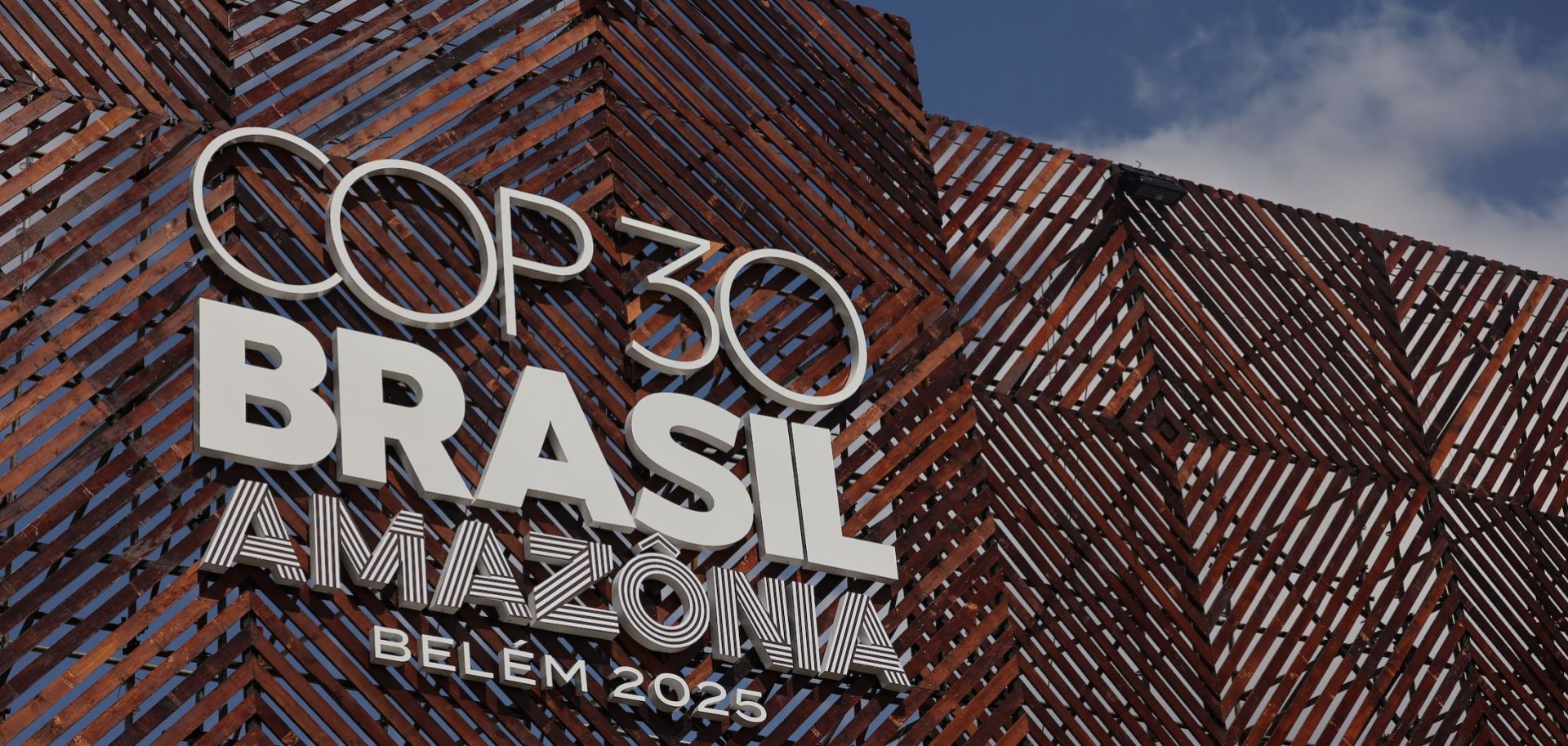
At the COP30 climate conference, countries are likely to reach only limited agreements on climate financing and carbon market frameworks while failing to achieve consensus on phasing out fossil fuels, making significant progress on implementation unlikely and postponing key decisions for another year. Brazil will host the 30th U.N. Climate Change Conference (COP30) from Nov. 10 to 21 in the Amazonian city of Belem. The event's agenda has been structured around six thematic axes: energy, industry and transport; forests, oceans and biodiversity; agriculture and food systems; cities, infrastructure and water; human and social development; and cross-cutting issues. The Brazilian government is seeking to build on previous COP outcomes while pushing the transition from negotiation to execution across mitigation, adaptation and climate finance. Delegates from more than 170 countries will seek to finalize the implementation phase of the 2015 Paris Agreement, which consists of five-year review cycles of countries' climate action plans. Key negotiation items will include language around phasing out fossil fuels, scaling up climate finance, rules for a global carbon-markets regime, the next round of nationally determined contributions (NDCs 3.0), the operationalization of the Loss and Damage Fund and of the New Collective Quantified Goal (NCQG) and Brazil's proposal for a Tropical Forests Forever Facility (TFFF).
- NDCs are the climate action plans under the Paris Agreement to limit global warming. Countries set their own targets to reduce greenhouse gas emissions and adapt to climate change impacts, detailing specific policies to achieve such targets. NDCs are required to be updated and resubmitted every five years, with each successive plan needing to show a higher level of ambition, although they are not a legally binding or enforceable commitment.
- The Loss and Damage Fund, created in 2022 at COP27 in Egypt, is designed to provide support in cases when adaptation strategies are inadequate or implemented too late and damage and risk has already happened.
- The NCQG on climate finance was agreed in 2024 at COP29 in Baku. It aims to triple annual support for developing countries to $300 billion annually by 2035 and to finalize technical rules for Article 6 of the Paris Agreement, which aim to standardize international carbon trading.
- The TFFF is Brazil's flagship nature and finance proposal for the conference and consists of an investment fund, designed to blend elements of traditional development funding, such as aid, grants or other types of financial assistance, with the generation of financial returns to reward tropical forest nations for protecting their forests.
Discussions in Belem will focus on the implementation of breakthroughs made at previous conferences but face persisting challenges, including countries' conflicting positions and limited financial resources and political will. COP30 builds on three years of contentious but incremental progress. In addition to the creation of the Loss and Damage Fund at COP27, COP28 in Dubai in 2023 enabled the first agreement on language about a transition away from fossil fuels, even if commitments were non-binding and subject to caveats. However, the same commitment was not renewed in 2024, at COP29 in Baku. In Azerbaijan, a headline finance figure for climate change was achieved after years of debate over donor eligibility and transparency and a framework for international carbon markets was established. Despite these important milestones, persistent divides between developed and developing countries over responsibility, financing and timelines, large emitters' push against explicit or binding commitments in recent conferences and vague wording on fossil fuels' phaseout have underscored challenges and limitations of consensus-based negotiations. The discussions in Belem come amid environmentalists and the international community's mounting pressure to translate commitments into measurable policies, as the Paris Agreement's first five-year review, known as Global Stocktake and finished in 2023, concluded that collective measures have proved insufficient to limit the increase in global average temperature to 1.5 C above pre-industrial levels as established in 2015. Additionally, COP30 takes place amid renewed geopolitical polarization, a U.S.-led renewed focus on fossil fuels, the European Union (EU)'s push for stricter compliance frameworks, a broader retreat from ESG norms and an outlook for developed countries' constrained fiscal space amid increased defense spending. More importantly, the United States (which will not send high-level officials to Belem) is in the process of exiting the Paris Agreement and has threatened to retaliate against countries that push for stricter climate change policies. This will give many emerging economies, oil-producing Arab states and China the ammunition they need to reject the policies they disagree with, further reducing the room for consensus during COP30.
Disagreements over the future of fossil fuels will likely prevent any meaningful consensus on the issue. The debate around phasing out fossil fuels will continue to be contentious at COP30. Language adopted at COP28 was unprecedented but non-binding and little progress was made at the next year's COP29 in the face of strong pushback from major oil producers. Given persistent antagonistic positions and a gap between various countries' stances, consensus on any language on curbing fossil fuels will almost certainly not be reached at COP30. The delegations may not even agree on a communique or issue a vaguely worded document around the shift away from fossil fuels. The low probability scenario of consensus on the matter being reached would directly impact those industries that still heavily rely on fossil fuels or emit large volumes of greenhouse gases. In this scenario, stronger language on curbing fossil fuels — even if non-binding — could represent financial and operational obstacles for energy and industrial companies because it would open the door to stricter regulation and environmental requirements to ensure compliance with climate goals. Investors would deepen their scrutiny of credible transition strategies while also taking into account profitability. Firms in the oil and gas, utilities, steel, cement or shipping sectors would be especially exposed to such risks, which would likely materialize in stocks' and bonds' performances or financing costs.
- The European Union and small island states will likely press for a global phaseout of fossil fuels with clear deadlines, the inclusion of unabated fossil fuel bans in national pledges, the elimination of fossil-fuel subsidies along with industrial decarbonization and expansion of renewable capacity.
- Major oil producing countries, including members of the Organization of the Petroleum Exporting Countries (OPEC), will likely continue to emphasize energy security, economic development and the role of fossil fuels in the energy transition. OPEC states favor a "phase-down," a transition via carbon-capture, utilization and storage (CCUS) or may even not support any language that opposes fossil fuels at all.
- Global South countries, such as China, are likely to defend the option to invest in coal plants. Others, such as Brazil, will defend being allowed to explore new oil frontiers while expanding investments in renewable energy and electrification. Developing nations more broadly will condition the shift away from fossil fuels on financing and technology transfers.
Mechanisms to scale up climate finance, such as a global carbon credit market, will also remain divisive, with limited progress limiting the potential mobilization of private capital at scale to fund energy transition and decarbonization efforts. The negotiators at COP30 will face significant challenges over the structure, time frame, contributions and oversight of the $300 billion NCQG. A key challenge will be addressing developing economies' calls for predictable funding with developed countries' reluctance to commit to binding targets. Delegates will discuss if contributions should remain voluntary or mandatory and if non-binding commitments should be expanded to high-income fossil fuel producers and large emitters from the developing world, such as China, Russia or Gulf countries. The establishment of global standards for carbon markets could unlock hundreds of billions in private capital, which could be crucial to funding the global energy transition or decarbonization initiatives. Such an event would reshape companies' offsetting strategies, reduce greenwashing risks while helping establish which countries, sectors or types of projects would benefit the most from capital inflows. However, persisting disagreements over credit integrity, double counting and regulatory oversight will likely prevail. Private sector players will likely remain exposed to a myriad of regulations worldwide and reputational risks stemming from fraudulent carbon credit projects, which will likely continue to curb large-scale offsetting efforts. Another obstacle on the financing front will be balancing public versus private capital flows, with calls for multilateral development banks to align lending frameworks with the Paris Agreement and mobilize significantly more blended resources, with both public and private funds. At COP30, delegations will seek to establish a long-term governance model and diversified donor base for the Loss and Damage Fund, which has been temporarily hosted by the World Bank. However, the high cost of capital and financial risks of investing in developing countries, weak regulatory environments, the lack of clear climate-related taxonomies and reporting standards and often insufficient financial returns will likely deter progress in blended financing discussions, further curbing concrete achievements on the financing front at the conference.
- Developing countries argue for mandatory, publicly funded contributions, emphasizing that developed nations bear historical responsibility for the majority of emissions that cause climate change. By contrast, developed countries defend a more flexible approach that includes securing various public and private funds while keeping contributions voluntary.
- An October 2025 report released by 35 finance ministers outlines reforms in credit-rating, development-bank lending and insurance markets to mobilize up to $1.3 trillion per year by the mid-2030s, though estimates indicate that only about 5% of that target had been realized by September 2025.
- Brazil's flagship TFFF proposes a blended-finance mechanism combining public and private capital aiming to raise $125 billion to reward forest conservation in tropical nations, with allocations based on total forest cover.
Against this backdrop, the pledges to meet climate targets will likely remain aspirational while governments' incapacity to reach agreements on major topics is likely to limit the private sector's participation in green financing. COP30 will most likely further expose the enduring gap between countries' rhetorical ambition and capacity and willingness to implement changes to accelerate the energy transition and reduce greenhouse gas emissions. Many nations' self-imposed targets have not been fully implemented. Many of the upcoming pledges are likely to also remain aspirational partially because aligning policy frameworks, domestic regulation, capital flows and governance will remain significant operational challenges for the foreseeable future. Moreover, given the current gap in public financing is estimated in the tens of trillions of dollars, private capital would be necessary to fund initiatives and make it feasible to meet global targets. In addition, a lack of clear global norms, consolidated climate finance mechanisms and functional carbon market means that there will likely be fewer incentives for investments in renewable energy, sustainable infrastructure and reforestation projects. The private sector is likely to remain critical in the energy transition process, even though the scale of its participation will likely be smaller than that needed to fulfill countries' ambitious pledges.
- Countries had to submit their next round of NDCs ahead of the conference, outlining 2035 targets that must reflect both the findings of the Global Stocktake and the availability of finance; however, as of Oct. 28, only 64 delegations did so in advance. NDCs for 131 countries were still missing. Even among those which did submit their pledges, most are considered underwhelming or insufficient to keep global warming to within the Paris Agreement's target.
