
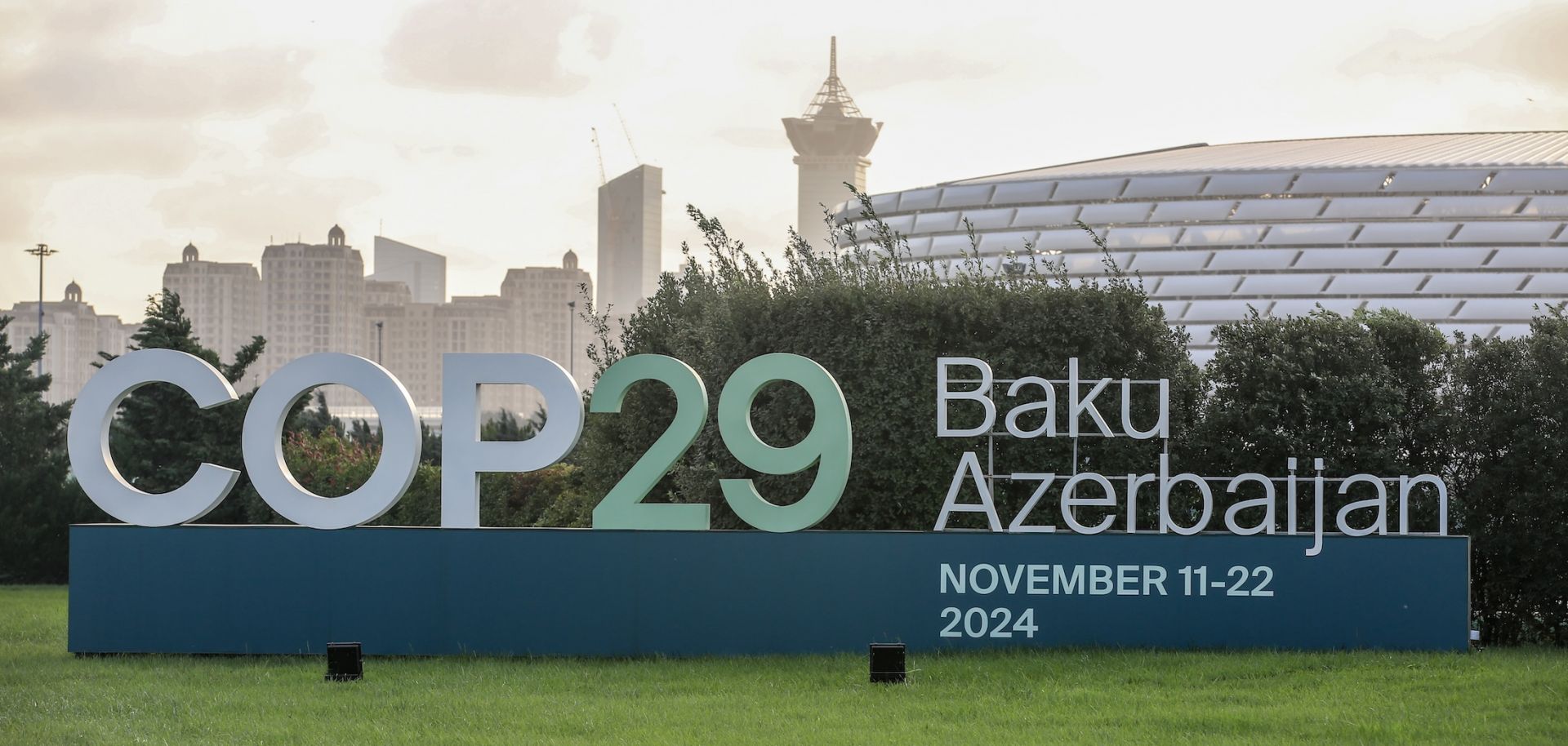
Negotiators at this year's U.N. Climate Change Conference will ultimately reach a new global climate finance deal, but it and other decisions made at the conference will fall short of what many climate hawks and developing countries want, keeping progress on the global energy transition from accelerating. COP29 will be held Nov. 11-22 in Baku, Azerbaijan. Many have dubbed this iteration of the annual conference the "Finance COP," as most negotiations at the annual climate summit will focus on climate finance-related issues. The centerpiece of negotiations will be on the so-called New Collective Quantified Goal on Climate Finance, or NCQG, that will replace the previous $100 billion target agreed to in 2009 for climate finance by developed countries that was finally exceeded in 2022, two years after the original target of 2020. Negotiators will also discuss funding for the Fund for Responding to Loss and Damage agreed to at last year's COP28. This year's conference also comes ahead of countries submitting new nationally determined contributions, which are the countries' action plans to achieve their emissions reduction targets, under the Paris Agreement ahead of a deadline of nine to 12 months ahead of COP30 in Brazil next year.
- Azerbaijani Minister of Ecology and Natural Resources and COP29 President-designate Mukhtar Babayev unveiled the COP29 Action Agenda in September. It includes 14 initiatives that Baku hopes to also achieve at the conference, including a new Climate Finance Action Fund that will include contributions from fossil fuel-producing countries like Azerbaijan, the COP Truce Appeal aiming to reduce tension at the conference despite a series of ongoing conflicts, a new energy storage and grid pledge to boost global energy storage capacity six times above 2022 levels, and a new dialogue on water and climate change.
Negotiations surrounding the NCQG are likely to be highly contentious as Western countries try to get other countries to also contribute to the pledge. While there is a general consensus that trillions of dollars are needed to help developing countries finance their energy transitions and invest in climate adaptation measures, significant disagreements surround the NCQG, even at some of the most fundamental levels. After months of technical negotiations this year on the NCQG with little movement, the co-chairs for the NCQG in October published a nine-page framework for a draft negotiating text that will serve as the basis of negotiations at COP29. The document includes more than 100 different places where terms have not been agreed upon. The document includes three different options for the NCQG's structure: a goal that only targets the mobilization of climate finance by developed countries to developing countries over a time period or target year, a goal that includes annual investment goals from all sources in addition to a core international support goal, or a combination of the two. Under the first option, there is also significant disagreement around the size of the goal, with proposed options in the draft text ranging from at least $1 trillion to $2 trillion, as well as the timeline that the goal will need to be hit, with some proposals having the deadline as early as 2029 or as late as 2035. There have also been significant disagreements on whether countries other than developed, mainly Western, countries that were a part of the $100 billion 2009 pledge will also need to contribute. One of the proposals would see countries that have a gross national income per capita above $52,000 in purchasing power parity terms or countries that are top 10 emitters with at least $20,000 or $22,000 GNI per capita in PPP terms also contributing. That definition, if adopted, would include large oil-producing countries like Saudi Arabia and the United Arab Emirates due to their high income as well as Russia and China due to their high emissions.
Ultimately, negotiators are highly likely to come to some sort of agreement, but it will be watered down in order to reach the consensus needed to win its approval. Given the importance of the NCQG, negotiators are highly unlikely to walk away without an agreement, as doing so would be a significant blow to tackling climate change abroad. Western countries' demands to get non-Western countries like China to contribute to a specific pledge officially, however, will likely encounter roadblocks. While some countries, possibly including the United Arab Emirates, may be willing to do so, others like China are less likely to do so due to their level of development and GNI being far below the West's — whose wealth was generated by fossil fuel consumption — and thus they say they should not have to contribute. Climate change negotiations also operate on consensus, which means that if China single-handedly wants to block an agreement, it can. A watered-down NCQG could include a topline pledge by Western countries in addition to an open-ended global target that is not a pledge by the entire world or a supplemental pledge by countries like China that does not include a large official target (or does not include any target) to also help invest in climate change related projects abroad. If the West is unable to convince countries like China to take part in the pledge, they will likely only support relatively modest topline figures for the NCQG pledge and/or support a longer timeframe for the commitment to be realized.
Beyond climate finance, COP29 will also serve as a springboard for countries' upcoming crucial nationally determined contributions due to be submitted in 2025, though significant announcements regarding the phase-out of fossil fuels — which would be reflected in next year's nationally determined contributions — is unlikely. New pledges of nationally determined contributions, which are known as NDCs 3.0 given this is the third round of contributions, are due to be set by Feb. 10, 2025. They will be critical for the long-term direction of climate change and the energy transition for several reasons. The NDCs 3.0 are supposed to be informed by last year's global stocktake, which found that the world was not on track to meet most of the Paris Agreement's goals. Climate activists and European countries are hoping that the stocktake will result in most countries taking far more ambitious pledges in their updated NDCs 3.0. The European Union will also push in COP29 for more countries to agree to phase out, not just phase down, fossil fuels, but opposition from oil- and gas-producing countries to previous European efforts to include such language will likely stymie EU efforts this go-round, too. With their new NDCs 3.0, countries will not only be updating their 2030 targets, but also submitting detailed 2035 targets for the first time; 2035 is symbolic because it marks the halfway point between the Paris Agreement's original 2020 goals and the 2050 timeline for ambitious outcomes like pledges to reach net-zero emissions globally. Other negotiations at the COP29 conference, including talks on the NCQG, will also help inform countries' upcoming NDCs 3.0 as a more ambitious NCQG, in theory, opens opportunities for developing countries to receive financial support to submit more ambitious targets for 2035. While many countries will submit NDCs 3.0 after COP29, some are likely to submit theirs at the conference.
Negotiators will also discuss carbon markets, the Fund for Responding to Loss and Damage, climate adaptation and potentially even carbon border taxes. As usual, the agenda for COP29 is packed, but there are several negotiations worth monitoring closely. First, any progress on negotiations about the Paris Agreement's Article 6 — which allows countries to trade carbon credits generated from reducing greenhouse gas emissions to other countries in order to meet their climate goals — would be notable. Global carbon markets have been viewed as a way to boost climate ambition and unlock investment into clean energy technologies due to the potential ease of cross-border sales of carbon credits. Global carbon markets, however, have struggled in recent years due to concerns over the quality of carbon credits and whether they actually help mitigate the climate crisis and climate emissions. A U.N.-backed agreement at COP29 would help bolster those markets, but progress in recent COP conferences, including COP28, has been sluggish over the complexity of the issue on technical issues like how to set standards for carbon credits and whether they will need to undergo a technical review before being used. Second, the Fund for Responding to Loss and Damage was one of the most important achievements at the last two climate change conferences, and is now becoming operational. Negotiators are likely to discuss funding mechanisms for the fund, which they hope to have in place next year. It is also unclear the extent to which the NCQG and the Fund for Responding to Loss and Damage will overlap and whether the former will even include loss and damage funding. If there is only limited progress on financing the fund, it would make it more difficult for poor countries to respond to future natural disasters. Third, progress on climate adaptation negotiations will be important. At COP28, countries adopted a framework for the Global Goal on Adaptation that lays out targets for adaptation in 2030 and a two-year work program on how to measure adaptation progress. These talks will be crucial, as shifting more of climate finance away from mitigating climate change to coping with climate change (e.g., adaptation) is also a fundamental part of negotiating outlays that the NCQG will cover. Finally, at the behest of the so-called BASIC — Brazil, South Africa, India, and China — bloc, Beijing has formally requested that countries hold talks on carbon border taxes and "restrictive trade measures." This represents a challenge to the EU carbon border adjustment mechanism, which places additional taxes on the imports of certain high-carbon goods, many of which BASIC countries produce. China's proposal to discuss the issue suggests that it may attempt to attach talks or demands on it to other issues that the European Union wants to discuss, a common tactic used by China in previous climate negotiations. These could include weakening language regarding the phase-out of fossil fuels or withholding support for language that suggests it should contribute to any global climate finance target.
Donald Trump’s Nov. 5 victory in the U.S. presidential election will also loom large over COP29 as he will likely reverse most of the Biden administration’s green policies and reduce U.S. support for climate finance. Trump has already promised to bring the United States out of the Paris Agreement if reelected. While in practice, the United States would not cease to be a participant until after 2025, U.S. negotiating leverage at COP29 (and COP30) would evaporate. This would also weaken European leverage, leading to even weaker climate deals emerging from the conference — especially as countries like China or India point to the U.S. exit as proof they should not make significant concessions. The Trump administration will likely not honor any of the U.S. financing commitments to initiatives like the NCQG or Fund for Responding to Loss and Damage. And Trump may go even further than simply exiting the Paris Agreement. Think tanks aligned with the former president that have been drafting day one executive orders have also proposed a version where Trump would trigger the U.S. withdrawal from the 1992 U.N. Framework Convention on Climate Change. While it is unclear if he can legally withdraw from this treaty without Senate approval (and any attempt to do so would certainly be challenged in U.S. courts), exiting the treaty would be far more significant than exiting the Paris Agreement. This is because any future president would be unable to reenter the agreement with a stroke of a pen, but would rather need to resubmit the treaty to the Senate for two-thirds approval — where it would be highly unlikely to pass given near-unanimous opposition to the Paris Agreement among Republicans.
