
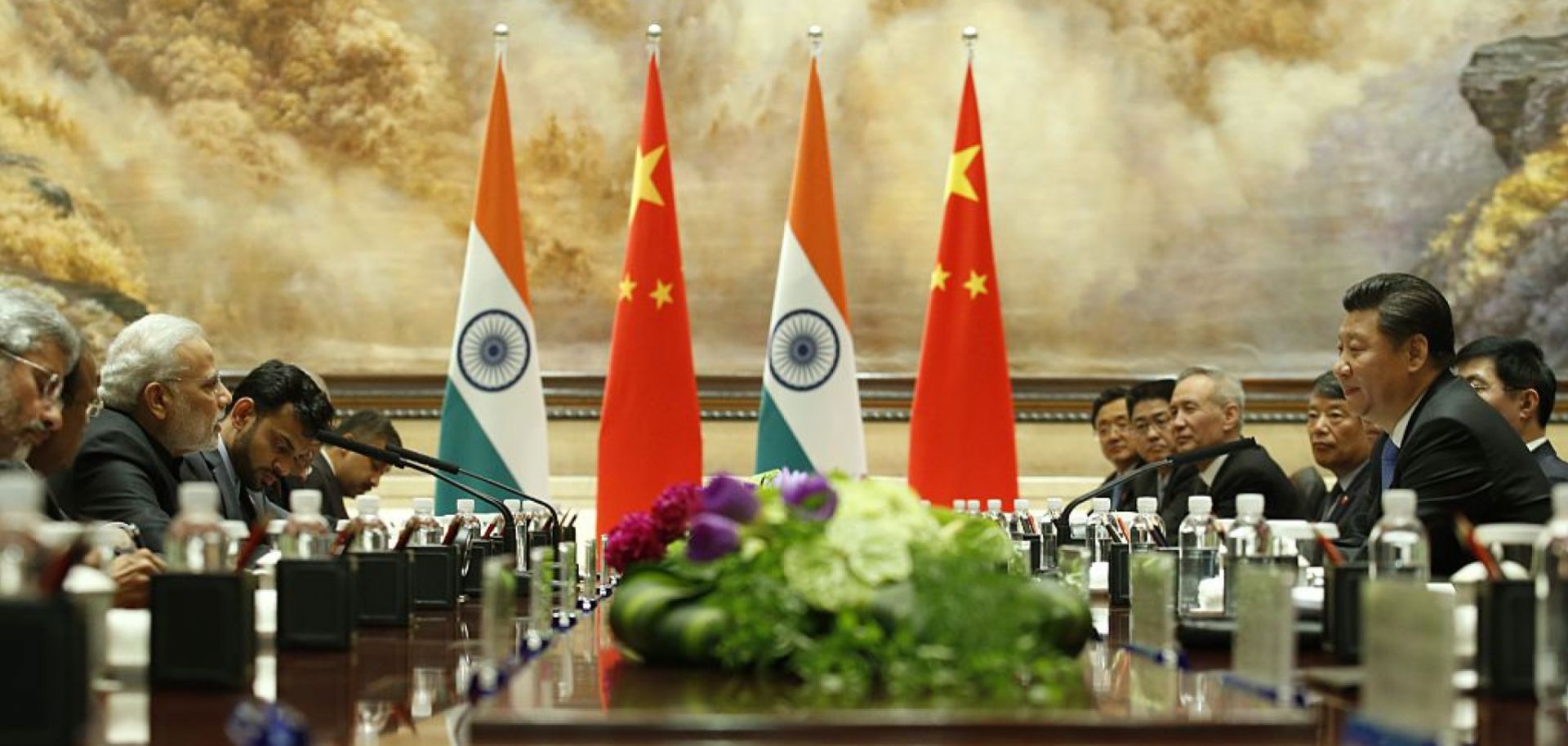
Despite gradual improvements and cautious steps toward economic and border cooperation between India and China, strategic competition will limit the scope for deeper engagement. On Aug. 31, Indian Prime Minister Narendra Modi will travel to China to attend the annual Shanghai Cooperation Organization (SCO) Heads of Government Council meeting. This will mark his first visit to China since June 2018, as well as the first since the deadly border clashes between Indian and Chinese troops broke out in the Galwan Valley in mid-2020, which saw bilateral ties plunge to their lowest point in decades.
- In the aftermath of the 2020 clashes, New Delhi imposed stricter curbs on Chinese investments and tightened scrutiny on infrastructure contracts. India also later banned over 200 Chinese apps, including TikTok, citing national security concerns. The freeze in relations lasted for several years, with multiple rounds of military and diplomatic talks failing to produce a breakthrough. In October 2024, the two sides agreed to new border-patrolling protocols and partial troop disengagement in eastern Ladakh, a move that helped stabilize relations and paved the way for renewed engagement.
- On Oct. 21, 2024, India's Foreign Secretary Vikram Misri announced that Indian and Chinese commanders had finalized a new border-patrolling arrangement, restoring access to key friction points, such as the Depsang Plains and Demchok, marking a major step toward stabilizing the Line of Actual Control. Two days later, on Oct. 23, Indian Prime Minister Narendra Modi and Chinese President Xi Jinping held their first formal meeting in over five years on the sidelines of the BRICS summit in Kazan, Russia, where they endorsed the agreement and signaled a tentative thaw in bilateral ties.
The improvement in India-China ties comes as India contends with strained ties with the United States over tariffs and as China is seeking new destinations for its exports, paving the way for closer bilateral cooperation. Modi's visit to China follows Chinese Foreign Minister Wang Yi's trip to New Delhi on Aug. 18, his first visit in over three years, during which he met with Modi, National Security Adviser Ajit Doval and Foreign Minister Subrahmanyam Jaishankar. The two sides agreed to resume bilateral direct flights, maintain regular communications on transboundary rivers and water issues, and establish a working group to explore formal demarcation of disputed border sections, steps that reflect continued efforts to ease tensions following the 2020 border clashes. While initiatives to reduce differences between India and China have been ongoing for some time, this renewed engagement also follows the United States' move to impose a 50% tariff on Indian imports, which has strained New Delhi's ties with Washington, pushing it to seek alternative economic partners. At the same time, China's economy is showing signs of slowing, with overcapacity in certain goods, making India's large and growing market an attractive destination for Chinese exports. India, while cautious about Chinese investment, recognizes the potential economic benefits such investment could bring. However, for this to materialize, New Delhi would need to ease some of its current restrictions on Chinese investment, a step that currently appears unlikely given the domestic pushback it would generate and the government's continued emphasis on national security concerns.
- In June 2025, Beijing allowed Indian pilgrims to visit holy sites in Tibet, while India resumed issuing tourist visas to Chinese nationals starting July 24, signaling a thaw in bilateral ties. In another move reflecting easing tensions, China relaxed restrictions on exporting urea to India on Aug. 12, allowing India to import up to 300,000 tons of Chinese urea.
- According to Bloomberg, India's Adani Group is in talks with leading Chinese electric vehicle producer BYD to produce batteries in India as part of the country's clean energy expansion. The potential deal reflects Adani Group's push to mass-produce lithium-ion cells for electric vehicles and energy storage, leveraging BYD's position as the world's top EV maker and a global leader in battery technology.
- Since April, India and the United States have held five rounds of negotiations to finalize a trade agreement, but disagreements over access to India's farm and dairy markets and its continued purchases of Russian oil, which the Trump administration claims are funding the war in Ukraine, have stalled progress. In July, the United States imposed a 25% tariff on Indian imports, which took effect on Aug. 7 under Trump's reciprocal tariff measures. Washington later announced an additional 25% tariff on Indian products over India's ongoing Russian oil purchases, which took effect on Aug. 27.
India-China relations will likely improve in modest ways, such as resuming flights, border trade and limited economic cooperation; however, full normalization remains unlikely due to enduring strategic and security concerns, including territorial disputes and border tensions. Modi's upcoming visit will provide an opportunity for India and China to finalize the resumption of bilateral direct flights and explore other areas of cooperation, including strengthening business ties and easing economic restrictions. Officials in New Delhi have indicated that the two sides will also discuss resuming border trade in locally produced goods after more than five years, which would involve reopening designated trading points along their shared border. Separately, broader economic cooperation could include China supplying India with critical goods like fertilizers, rare earths and tunnel-boring machines. While it remains unclear whether Beijing will expedite export licenses, facilitating these supplies could help India secure fertilizer availability, support key industries like electronics and clean energy, and accelerate infrastructure projects. Other potential short-term opportunities include India unbanning certain Chinese apps. But despite these deals, India's deep-seated strategic and security concerns will put an upper limit on its rapprochement with China. India remains cautious of Beijing's intentions, given China's military assertiveness in the South China Sea and Taiwan, as well as its ongoing territorial claims over Arunachal Pradesh. Compounding these concerns is China's close partnership with Pakistan, which has become Islamabad's key defense partner since the end of the Cold War. These dynamics make it unlikely that India will fully ease investment scrutiny or pursue complete normalization with China. While recent developments suggest gradual improvements and Trump-era tariff pressures offer an economic incentive for cooperation, competition will continue to shape the relationship. India is also seeking to strengthen its manufacturing sector and take advantage of countries trying to diversify away from Chinese supply chains, further highlighting the limits of closer engagement amid persistent strategic rivalry.
- Bilateral trade between India and China reached $118.40 billion in fiscal year 2024, making China one of India's top trading partners. Border trade was valued at $3.16 million in 2017-18 but was suspended following the 2020 attacks along the disputed border. Previously, India and China would exchange items such as spices, carpets, wooden furniture, cattle fodder, pottery, medicinal plants, electrical goods and wool through three approved points along their porder. The revival of this border trade would represent a cautious, modest step toward strengthening economic ties, particularly for locally produced goods traded at these points.
- On Aug. 12, India approved plans to complete its hydropower plant in about six years in Arunachal Pradesh, a disputed border region where China has established small settlements. The project will be built on the Siyom River, which feeds into the Brahmaputra, a major river shared with China. This decision follows China's announcement of a massive hydroelectric project on the Yarlung Tsangpo River, the upstream portion of the Brahmaputra, raising concerns in India due to its size, location in a seismically active area and potential impact on downstream water flow.
- During the May clash with India, Pakistan reportedly used Chinese-made J-10C jets to shoot down five Indian fighter jets, with India asserting that China also provided air defense and satellite support, reinforcing New Delhi's perception of Beijing as an unreliable security partner.
- Despite India's ongoing trade tensions with the United States, bilateral ties remain very active on security issues. For example, India and the United States are preparing for the 21st edition of their joint military exercise in September, signaling continued defense cooperation. In addition, India's Foreign Secretary Vikram Misri has emphasized India's commitment to the Quad (a strategic partnership between Australia, India, Japan and the United States) ahead of Modi's August 29-30 visit to Japan.
