
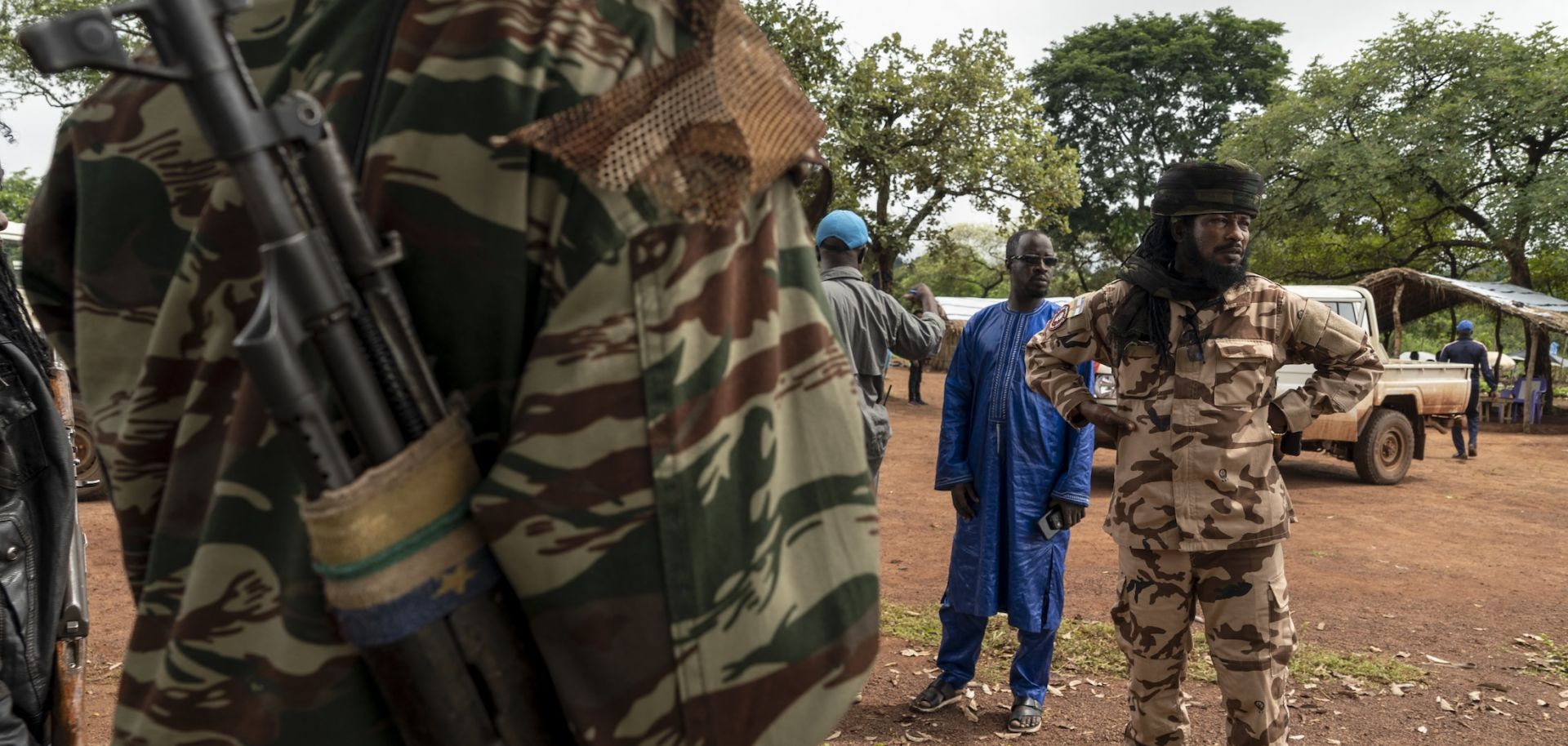
In the Central African Republic (CAR), a recent peace deal will open the door to improved security and stability, but it faces myriad pitfalls and contentious elections later this year could result in violence; separately, Russian paramilitaries are set to remain in the country, even if their role changes. On Aug. 11, President Faustin-Archange Touadera claimed significant progress in the disarmament, remobilization and reintegration (DDR) process since his government reached a peace agreement with key rebel groups in April. The agreement, mediated by Chad and made official in July, has resulted in the formal dissolution of both the Union for Peace in the Central African Republic (UPC) and Return, Reclamation, and Rehabilitation (3R) after the groups agreed to cease hostilities following a rebellion that began in 2012. Under the new deal, the CAR government committed to reintegrating eligible fighters into state security forces and enrolling others in DDR programs — building on the broader 2019 Khartoum-Bangui peace process, which aimed to end years of conflict through ceasefires, transitional justice and inclusive governance with 14 armed groups. The April agreement also precedes CAR's general elections in December, with President Touadera officially declaring his candidacy for a controversial third term on July 26. Additionally, it comes as Russia is transitioning its military presence in the CAR from the Wagner Group to the Africa Corps, a new state-controlled paramilitary force seen as Wagner's successor.
- The 3R and UPC rebel groups were part of the Coalition of Patriots for Change (CPC), a rebel alliance formed in December 2020 by former President Francois Bozize (now in exile), with the primary goal of overthrowing President Touadera. Touadera previously served as prime minister under Bozize from 2008 to 2013 and left office when the Seleka coalition — a predominantly Muslim rebel alliance formed from various armed groups dissatisfied with the government — launched its 2012 uprising to oust Bozize. Touadera later reemerged to run for president in 2015.
- A 2023 referendum removed presidential term limits, clearing the way for Touadera's third-term bid. But earlier attempts to amend the constitution were blocked, making his run legally permissible but politically divisive.
- Wagner, which first deployed to Mali in December 2021, officially announced its exit from the Sahel nation on June 6. This left the Africa Corps as the sole Russian force in Mali, with many former Wagner commanders and fighters absorbed into its ranks. In 2024, the Africa Corps deployed several hundred personnel to Burkina Faso and Niger. The paramilitary group was formed after its leader, Yevgeny Prigozhin, died in 2023 following his short-lived rebellion against Russian authorities.
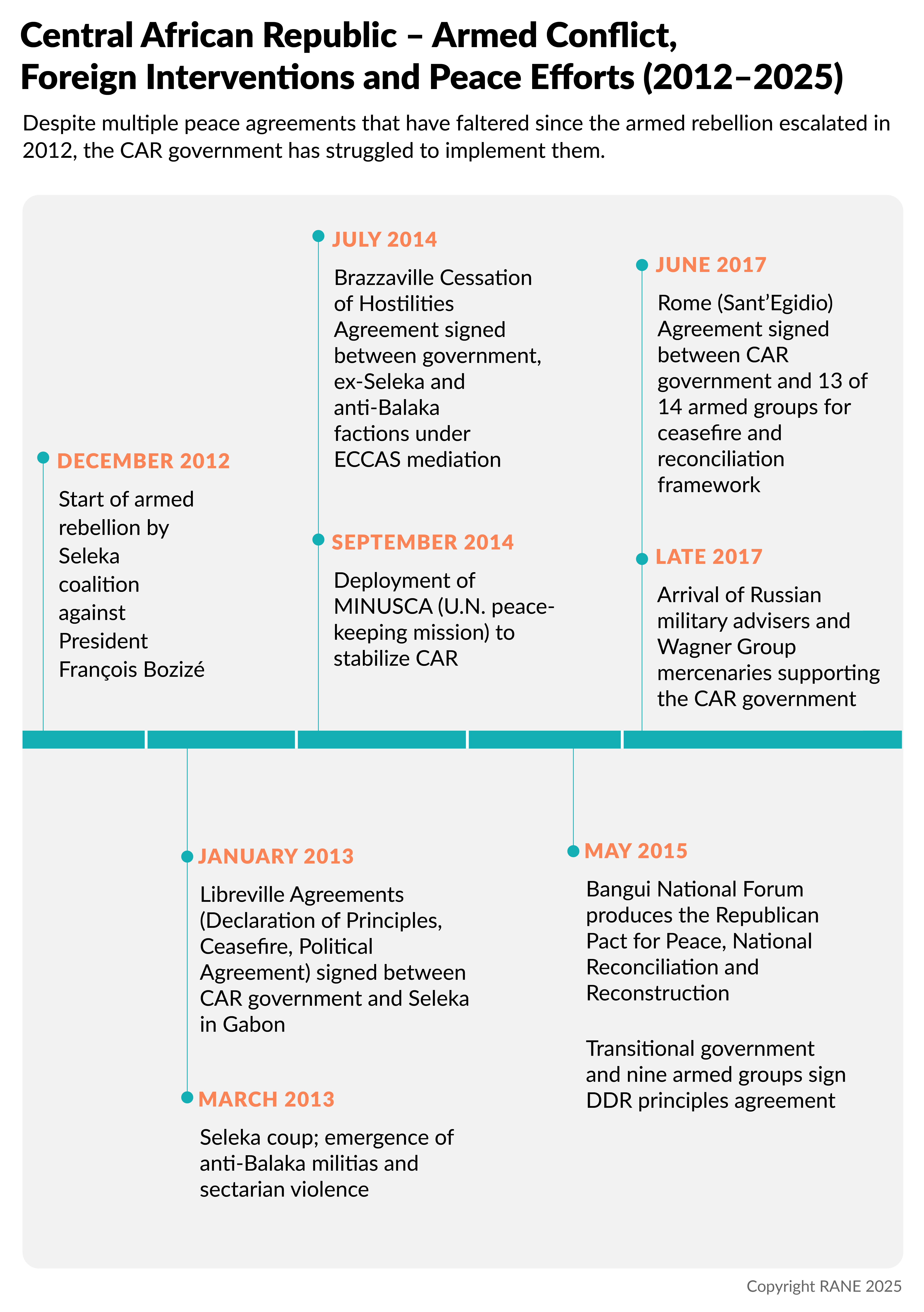
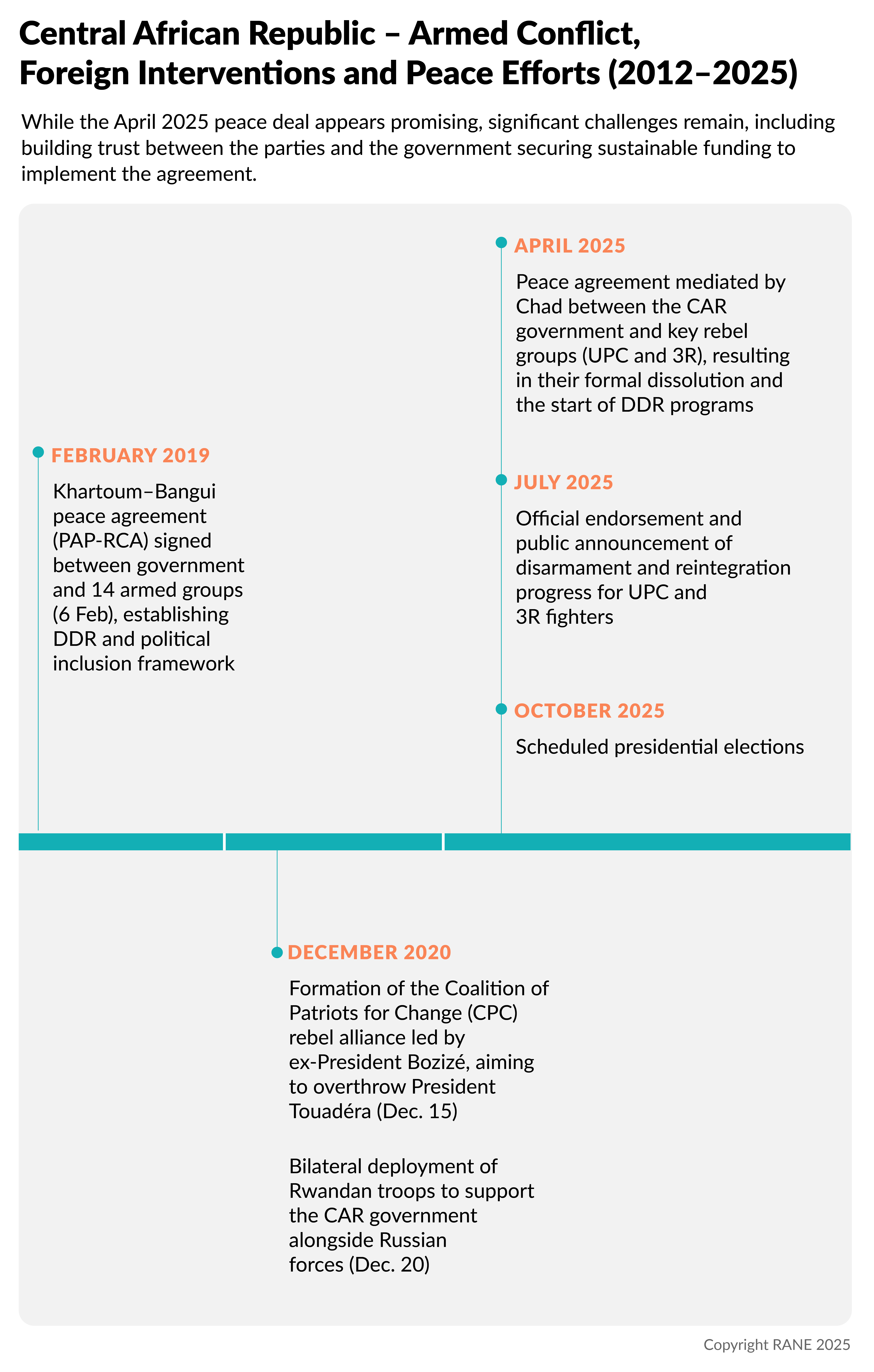
After years of violence, the armed rebellion in the Central African Republic escalated in 2012 and has since persisted across many parts of the country despite interventions by Russia, Rwanda and the United Nations. While the armed rebellion began in 2012, it was rooted in years of political instability and localized conflicts that had afflicted the CAR long before then. The Seleka coalition launched its uprising in 2012, aiming to overthrow former President Bozize. In 2013, Seleka forces successfully seized power through a coup, but their rule was marked by widespread abuses and human rights violations, which in turn sparked violent sectarian reprisals from mainly Christian anti-Balaka militias. These militias initially emerged as loosely organized self-defense groups to resist the Seleka, but later became known for attacking Muslim civilians and committing widespread atrocities. Efforts to restore peace included several agreements. But these deals repeatedly failed due to mutual mistrust, weak enforcement mechanisms and the government's failure to integrate rebel leaders meaningfully into political and security structures, leading to increased rebel activity in the north, central and western parts of the country. In parallel, the government requested expanded economic and military assistance from Russia, which began deploying military advisers and paramilitaries to CAR in 2017, notably through the Wagner Group. The Russians were deployed three years after the U.N. peacekeeping mission in the CAR started in 2014, mostly playing a logistical support and territorial stabilization role to prevent rebel groups from seizing control of key towns. In late 2020, ahead of the December presidential election, the rebel groups 3R and UPC joined the broader CPC alliance, led by former President Bozize — aiming to disrupt the electoral process, overthrow President Touadera and force the establishment of a transitional government. However, military defeats, largely at the hands of Wagner and Rwandan troops, forced Bozize into exile (reportedly in West Africa), significantly reducing his influence over the remaining CPC factions. Despite this, some Bozize loyalists continue to operate in rural strongholds, sustaining attacks on security forces and civilians.
- France militarily intervened in the CAR in 2013 to limit fighting between the Seleka and anti-Balaka groups. But France's presence gradually receded amid ongoing security issues and worsening relations with the CAR government, creating an opening for Russia.
- Since establishing its presence in the CAR in late 2017, Russia has secured lucrative mining concessions for gold, diamonds and uranium, and has also invested in timber, logging and smuggling. This has granted Russia significant economic influence, with control of the country's key natural resources.
- Moscow's influence in the CAR was cemented during the CPC's 2020-21 offensive, when Russian forces played a decisive role in preventing the CPC's capture of Bangui. Despite allegations of human rights violations, the Wagner Group retains the upper hand through its entrenched security role, direct access to the presidency and provision of personal protection for President Touadera, alongside control over key economic assets. However, Touadera's reliance on Wagner forces has fueled anti-government sentiment within the country, with critics accusing Touadera of marginalizing opponents, enabling foreign interference and failing to address widespread insecurity and economic hardship.
- Rwanda deployed troops to the CAR in 2020 to counter the CPC's advance toward Bangui. Although coordination between Rwandan forces and Wagner mercenaries was unclear, Rwanda later withdrew its troops amid reports of serious human rights abuses by Wagner.
- Rwanda's ties to the Touadera administration have enabled it to expand its economic influence in the CAR, with Rwandan companies, including Crystal Ventures (which has ties to the ruling Rwanda Patriotic Front party) operating in the country's agriculture, agro-processing, infrastructure, regional trade, mineral trade, telecommunications and banking sectors.
The current peace deal shows more promise than prior ones due to clearer reintegration efforts and weakened rebel groups, but without sustained financial support and broader inclusion of other armed groups, there is still a significant risk of renewed conflict and continued instability in the northern, central and eastern regions of the Central African Republic. Compared with past agreements that quickly broke down, the new peace deal is more promising, particularly as reintegration plans have been clearly defined and are already underway. Some fighters are already being disarmed and enrolled in civilian programs, such as agriculture and trade. A select number have also started being integrated into the armed forces, and some have even been appointed to senior government positions. The security situation in the northwest, northeast, central and eastern regions of the CAR is further set to improve amid the gradual dissolution of the powerful 3R and UPC rebel groups, as this could significantly reduce their capacity to conduct coordinated, large-scale offensives. In the coming months, Touadea will also be incentivized to honour the government's commitments in the peace deal, as it would bolster his legitimacy and chances in the December presidential election by demonstrating his government's ability to deliver stability after years of conflict. Nonetheless, there are still myriad challenges to the deal's long-term effectiveness. President Touadera emphasized in August that the most critical risk is financial: without sufficient funding to support payments to former rebels and the broader disarmament, remobilization and reintegration process, ex-rebels could rearm and return to conflict. This risk is amplified by the fact that some rebels previously controlled resource-rich areas, engaged in extortion and cattle raiding, and maintained control over key transit routes. Additionally, although smaller in scale, ongoing attacks by armed groups that have refused to sign the agreement will continue to undermine security in parts of the country, especially given the weak capabilities of the CAR's armed forces. Some of these groups could also decide to join forces, which would pose an even bigger threat to the government, though this is unlikely due to the existing divisions among them. Continued mistrust between rebel groups could break down the agreement as well. For instance, in August, 3R rebels denounced attacks on them by Wagner forces and said it was a violation of the peace agreement.
- According to President Touadera, 375 rebels have laid down their arms as of August 2025. At least 233 UPC rebels surrendered in Maloum, Ouaka province in the central region, alongside 17 fighters from anti-Balaka groups. In Koui, northwest Ouham-Pende province, 125 3R fighters were disarmed and demobilized. Additionally, around 100 former combatants will be trained at Berengo, a camp operated by Wagner, with plans to integrate them into the CAR army; 40 will be sent to Morocco for further training, and approximately 100 will enter a reintegration program.
- While verifiable figures for the estimated number of rebels are unavailable, Voice of America reported in November 2024 that the CAR government estimated that there were around 21,000 active rebel combatants in the country and that the government aimed for at least half to surrender by the end of 2025.
- Rebel strongholds have historically been located in the CAR's northwest (Paoua, Bavara, Bozoum), northeast (Bria, Sam Ouandja), central (Kaga-Bandoro, Bambari), and eastern parts (Vakaga, Birao). Rebels have exploited artisanal gold, diamonds, timber, agricultural products, and wildlife resources in these areas, often through illicit trade and taxation of local populations. The limited presence of the state over the years has allowed the rebels to maintain control and fund their operations with minimal oversight.
Renewed youth-led protests against Touadera could undermine the legitimacy of his likely controversial victory in the December presidential election, prompting him to accelerate implementation of the 2025 peace deal to secure votes in areas previously inaccessible due to rebel violence and rely on Russian support to protect his presidency and key institutions. Before President Touadera announced his candidacy for the upcoming election, opposition parties organized large protests in April, with thousands of mostly young people voicing strong opposition to his bid for a third term. While the opposition has struggled to unite into a force capable of ousting Touadera, they will likely stage more pre-election protests and contest the election results through additional demonstrations, echoing those seen after the October 2020 polls. In a likely scenario where Touadera wins the December election amid fraud allegations, these protests could escalate, especially since the heavy Rwandan and Wagner security presence around Bangui during the last election — partly to counter CPC rebel advances — is no longer in place. Such large-scale and potentially prolonged protests could undermine Touadera's legitimacy, particularly amid growing anti-Touadera sentiment and concerns that protesters could gain support from within the government. However, a coup remains unlikely given Touadera's tight control over the CAR's security apparatus, especially in light of past rebel threats. Concerns of post-election unrest may explain reports that Touadera has requested Russia to delay the planned transition from Wagner Group mercenaries to the Africa Corps, as such restructuring could temporarily reduce the Russian paramilitaries' capacity to suppress threats to key institutions and Touadera's presidency. Meanwhile, the threat of rebel insurgency remains relatively low, supported by the initial implementation of the 2025 peace deal and the exile of former President Bozize. This creates an opportunity for Touadera to accelerate the implementation of the peace deal by offering more assistance (such as jobs) in exchange for demobilization, establishing voting polls in localities previously inaccessible due to rebel violence, holding elections there and securing additional votes. Continued support from Wagner could also help protect polling stations, ensuring locals can safely cast ballots without being threatened by remaining rebel groups.
If the 2025 peace deal holds, Russian forces could reduce their heavy military presence but would likely remain in the CAR to protect Moscow's economic interests, while Rwanda could expand its political and development role carefully, seeking to avoid direct competition with Russia. If the 2025 peace deal holds, Russian paramilitaries will likely maintain a presence in the CAR, though their role may evolve. Russian forces, presumably under the Africa Corps, would continue safeguarding the country's leaders and Moscow's economic interests, including mining concessions, while supporting the government against residual rebel activity. However, a more stable environment could reduce the need for as many direct Russian forces deployed across the country, allowing Moscow to further focus on economic influence rather than frontline security operations. Stabilization would also create space for other international actors, particularly Rwanda, to expand their political, security and development goals. Rwanda could offer to provide training to CAR armed forces and support improvements in government services, while carefully trying to limit competition with Russia, in exchange for enhanced influence over local security coordination, more access to key economic sectors, a formal role in regional stabilization efforts, and the ability to reinforce its image as a continental leader in military diplomacy and security expertise. This would be a delicate balance for Rwanda, as it seeks to maintain Western relationships and avoid antagonizing or appearing to collaborate with Russia. This balancing act would also be influenced by the United States' crucial role in easing tensions between Rwanda and the Democratic Republic of the Congo over the presence of Rwanda-backed M23 rebels in the eastern Congo, as well as the European Union's role in funding efforts to counter Islamic State militants in northern Mozambique.
- The U.N. peacekeeping mission is unlikely to leave the CAR given the persistent risk of armed rebellion, but if it did, Rwanda would likely maintain its strategic support to the government.
