
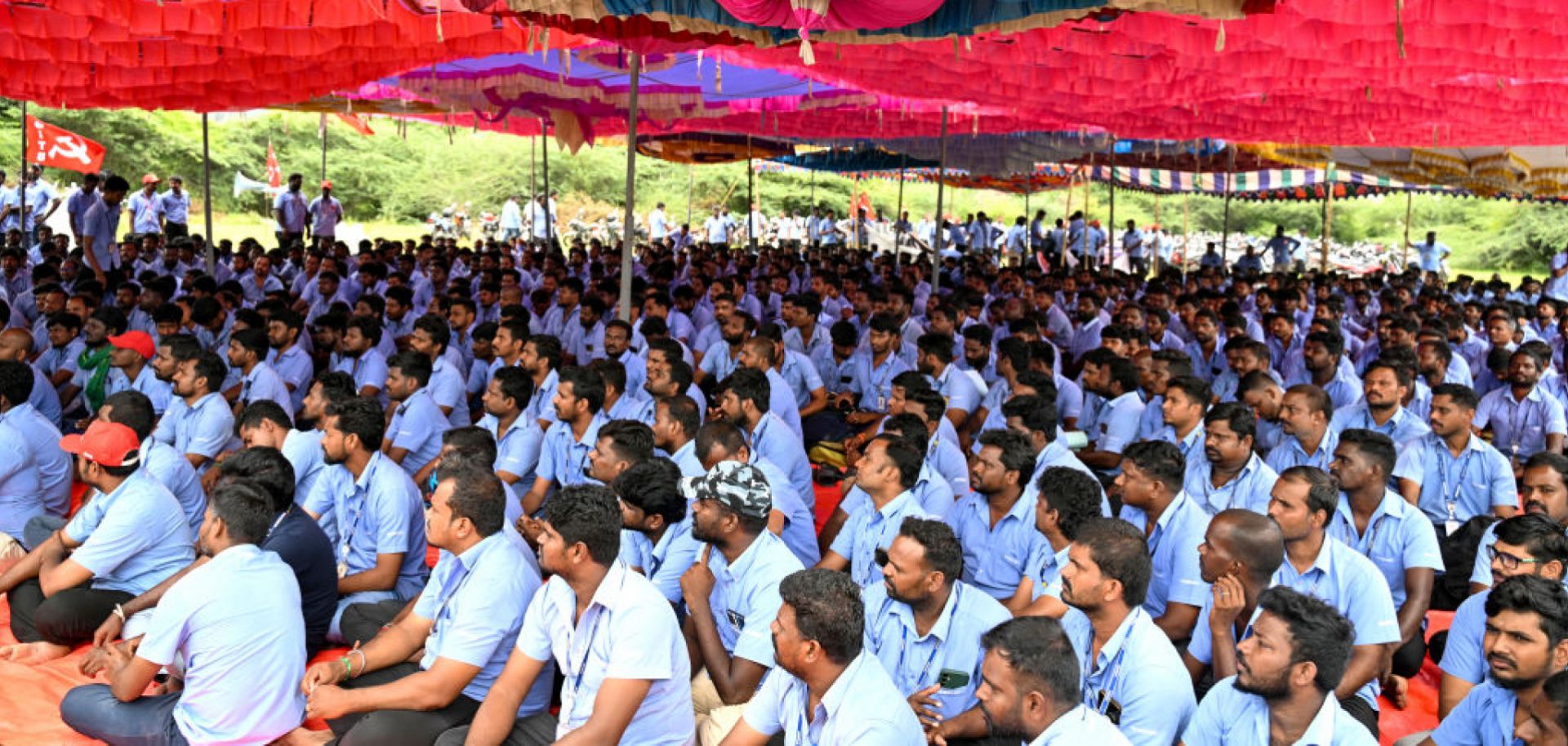
India's new labor codes, intended to streamline regulations, modernize the workforce and attract investment, will likely face prolonged delays and uneven implementation due to political resistance, trade union opposition and state-level administrative challenges, leading to regulatory fragmentation and widening gaps in investment, job creation and worker protections across states. India's long-delayed labor reform effort remains stalled as implementation of the four labor codes passed in 2019-2020 continues to face political, administrative and legal obstacles at the state level. The reforms, which seek to overhaul India's outdated and fragmented labor laws, came amid Prime Minister Narendra Modi's broader push to improve the ease of doing business and attract investment by simplifying regulations. However, the codes have not yet been implemented because of political opposition, administrative challenges and resistance from trade unions that fear the reforms may weaken worker protections.
- The new codes are meant to replace 29 existing labor laws, consolidating them into four streamlined areas: wages, industrial relations, social security and workplace safety. They are intended to create a uniform legal framework, formalize more of the workforce, and extend protections to gig and informal workers, while also giving businesses more flexibility in hiring and managing labor. The government's goal is to reduce red tape and make compliance easier for businesses, particularly foreign investors.
- The four labor codes are the Code on Wages (2019), the Code on Social Security (2020), the Occupational Safety, Health and Working Conditions (OSH) Code (2020), and the Industrial Relations Code (2020). The Code on Wages ensures minimum wages and timely payments with a uniform definition of wages to reduce disputes. The Social Security Code expands benefits to all workers, including gig workers, and introduces a Re-skilling Fund. The OSH Code improves workplace safety, mandates annual health check-ups and requires formal employment contracts for better job security. The Industrial Relations Code simplifies compliance while protecting workers' rights through dispute resolution and collective bargaining safeguards.
While most Indian states have taken steps to implement the new labor codes, full rollout remains uneven and delayed due to political opposition, administrative hurdles and a lack of consensus in several opposition-ruled regions. Most Indian states and Union Territories have taken steps toward implementing the new labor codes, but the rollout remains incomplete. Roughly 22 out of 36 jurisdictions have published draft rules for all four codes. Meanwhile, over 10 states and Union Territories have released draft rules for some, but not all, of the codes. Around seven states and Union Territories, including West Bengal, Tamil Nadu, Delhi, Meghalaya, Nagaland and Lakshadweep, have yet to publish any significant draft rules. These delays are due to a combination of political resistance, administrative hurdles and opposition from trade unions. One of the main challenges is that labor falls under the concurrent list of India's constitution, which means both the central and state governments must frame and notify their own rules. Without state-level notification, the labor codes cannot be enforced, even though Parliament has passed them. In several opposition-ruled states, such as West Bengal and Tamil Nadu, there has been ideological disagreement with the central government over the content of the reforms. This has led to reluctance in advancing the process. Trade unions in these states have also strongly opposed the new laws, arguing that they dilute worker protections and were introduced without sufficient consultation. In contrast, states governed by the ruling Bharatiya Janata Party (BJP) or parties in its National Democratic Alliance coalition, such as Gujarat, Uttar Pradesh, Madhya Pradesh and Karnataka, are more aligned with the central government's policy direction and have made greater progress toward implementation. These states are more likely to enforce the codes in the coming months. The central government continues to push for a nationwide rollout and expects full implementation by late 2025 or early 2026. While this timeline may be realistic for BJP-aligned states, progress in opposition-ruled states remains unlikely, as there are no clear indications that these states are actively working toward implementation, making further delays likely.
- India's trade unions oppose the new labor codes, arguing that they undermine worker protections and tilt the balance in favor of employers. Their key concerns include provisions that make it easier for companies to lay off workers, impose stricter limits on strikes and weaken the role of trade unions. Trade unions also argue that the government pushed through the reforms without adequately consulting with labor groups, making the process less inclusive and democratic.
The new labor codes could reduce the size of India's informal sector, improve ease of doing business and support long-term economic growth in the states where they are implemented, but progress will depend on state-level cooperation and effective enforcement. If implemented, the measures could reduce the share of workers and businesses operating in India's informal sector by mandating formal employment contracts, extending social security to gig and platform workers, and providing legal recognition for fixed-term contracts. These steps could expand the tax and welfare base, reduce compliance disputes and create a more stable labor market. However, major hurdles remain, including uneven state-level adoption, administrative capacity constraints, political resistance in some regions and challenges around effective enforcement. While some states have begun adopting the new labor codes, there is currently limited data to confirm measurable improvements in workforce formalization, investment inflows or positive labor market outcomes. Additionally, although the codes can operate without all states implementing them, full realization of these gains will likely depend on uniform state-level adoption and sustained enforcement, both of which have historically challenged India's labor reform efforts. Such uneven implementation will likely shape both labor migration and investment flows. States that adopt the codes sooner could attract more manufacturing and service-sector investment, as businesses seek streamlined regulations. Workers, especially in formal and semi-formal sectors, will likely gravitate toward states offering stronger protections and benefits, potentially widening regional economic disparities. Conversely, states that delay adoption may find themselves less competitive for both domestic and foreign investment, particularly in sectors tied to export supply chains. Meanwhile, uneven implementation will pose a challenge for foreign companies due to divergent state regulations. With labor laws governed at both the central and state levels, companies will need to operate within a fragmented regulatory environment, which will likely increase compliance burdens and raise operational costs for businesses active across multiple states.
- More developed Indian states like Maharashtra, Gujarat, Karnataka and Tamil Nadu have historically attracted significant internal migration. This trend — reflected in the migration and workforce participation data in India's 2011 Census (the most recent data available due to delays in the 2021 Census) — is attributed to these states' stronger economies, superior infrastructure, and better labor protections and benefits.
