

Growing internal and U.S. pressure will likely force the European Union to delay or amend its ambitious AI Act, leading to short-term regulatory uncertainty but potentially more favorable compliance conditions for international AI companies operating in Europe. The EU AI Act, the bloc's landmark legislation regulating artificial intelligence, is currently in the midst of a gradual, phased-in implementation schedule. On July 10, the European Commission published the ''AI Code of Practice,'' a voluntary document meant to shed light on compliance expectations for organizations ahead of the act's more stringent enforcement dates. The next enforcement date is scheduled for Aug. 2, after which developers of general purpose AI models (e.g., chatbots and other generative AI applications) will have to comply with various notification and disclosure requirements. Once the AI Act fully enters force by August 2027, organizations developing or using AI applications will have to meet regulatory requirements like risk assessments, data privacy measures and cybersecurity protections. In most cases, companies that fail to comply will incur financial penalties as high as 3% of their annual turnover. However, more serious breaches — such as using prohibited AI or applications deemed to pose existential or social threats to people — could result in penalties as high as 7% of a company's annual income.
- The European Union's AI Act separates AI use cases into four categories based on their perceptible risk, including unacceptable, high, limited and minimal. Unacceptable applications, such as using AI for social scoring, public surveillance or cognitive behavior manipulation, were the first systems to be entirely banned in February. For high-risk AI applications, like those in critical infrastructure, employment, law enforcement and education, developers and deployers will be required to conduct risk assessments, ensure data quality and employ human oversight. AI applications posing limited risks include chatbots and other generative AI systems, while minimal risk applications are generally unregulated and apply to use cases like spam filters or video games. Requirements for high-risk AI applications will take effect in August 2026, while compliance for all other systems will be required starting in August 2027.
- Under the act, general purpose AI models (e.g., chatbots) will be regulated on a two-tiered system differentiated by the computational resources they require to operate. Flagship AI models, like those released by OpenAI, Alphabet, Anthropic and Meta, are identified as posing potential ''systemic risks'' and will therefore be required to perform model evaluations, conduct red team testing and enforce robust cybersecurity rules. All general purpose AI developers will also be required to document technical aspects of their application and provide a publicly available summary for users to understand their capabilities.
- Originally expected to be published by May, the European Commission's ''AI Code of Practice'' was compiled by 13 independent experts based on input from more than 1,000 small and medium-sized enterprises, academics, civil rights organizations and representatives from the AI sector. While nonbinding, companies that sign the code are expected to have more legal certainty that they are compliant with the EU AI Act's requirements.
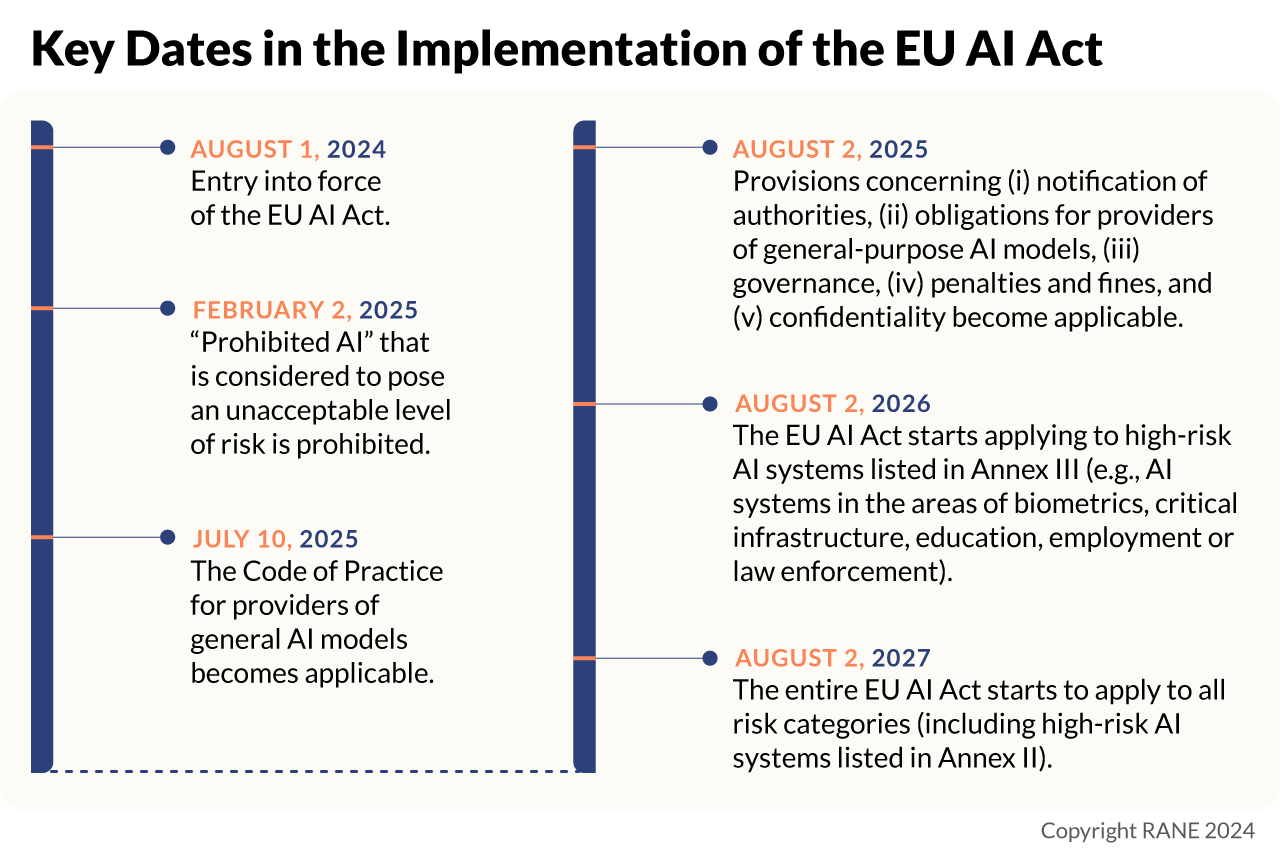
While the European Union appears determined to move forward with the AI Act, it faces constraints amid growing calls from the European private sector and the U.S. government to streamline regulatory frameworks that are onerous for companies operating in the bloc. The EU AI Act is broadly considered to be the most ambitious effort by any jurisdiction to create guardrails around the nascent artificial intelligence industry. Data privacy groups initially praised the legislation when it first took effect in August 2024. However, the AI Act has also faced criticism from those who argue that such onerous regulatory frameworks could stymy innovation in the emerging technology. When the act was being drafted, some EU member states — namely, France, Germany and Italy — expressed concern that it could curb the bloc's competitive edge against countries like the United States and China. The European Union's general regulatory environment has come into further question since former European Central Bank President and Italian Prime Minister Mario Draghi published a report on the future of European competitiveness in September 2024. In the highly influential document, Draghi recommends actions to spur growth and productivity in the bloc, and heavily advocates for simplified regulations and streamlined competition rules to ensure the European Union does not fall significantly behind its global peers. While the report's recommendations were non-binding, European Commission President Ursula von der Leyen has largely integrated Draghi's directives into the policy agenda of her second term, seeking to amend various regulatory regimes to ease compliance. The European Union's various digital regulations — including the AI Act — have been among the frameworks targeted for revision. However, the bloc has so far been reluctant to make more than minor changes. The European Union has also faced growing pressure from the European private sector and the administration of U.S. President Donald Trump — which views the bloc's digital and AI regulations as overly restrictive and discriminatory against U.S. tech companies — to implement revisions or delays to key elements of the regulatory frameworks.
- On July 3, representatives from more than 45 European organizations — including prominent technology companies ASML, Airbus and Mistral — jointly issued a letter to von der Leyen, requesting a two-year hiatus on the upcoming AI Act enforcement dates for general purpose AI systems on Aug. 2 and high-risk AI systems in August 2026. The letter argues that the European Union needs to move toward an ''innovation-friendly regulatory approach'' and ''identify pragmatic avenues for regulatory simplification.'' Despite the collective request, a European Commission spokesperson reiterated that the AI Act would be rolled out according to the legal timeline during a July 4 press conference.
- On May 21, the European Commission proposed amendments to the General Data Protection Regulation (GDPR), the bloc's extensive data privacy legal framework, that seek to streamline compliance for small and medium-sized enterprises. Brussels is also working on congruent policy initiatives like the GDPR Procedural Regulation, which seeks to accelerate and coordinate cross-border data flow investigations.
- On April 25, the U.S. Mission to the European Union — which facilitates dialogue between the transatlantic allies — sent a letter to the European Commission urging the bloc to discard the then-draft Code of Practice, arguing that it was excessively burdensome. The letter also requested that the European Union pause implementing the entire AI Act until U.S. concerns with the legislation were addressed.
- The Computer and Communications Industry Association (CCIA), an international nonprofit that represents numerous multinational technology companies such as Amazon, Google, and Meta, issued an online statement following the release of the European Commission's Code of Practice. The CCIA asserted that the ''code still imposes a disproportionate burden on AI providers'' and that ''without meaningful improvements, signatories remain at a disadvantage compared to non-signatories, thereby undermining the commission's competitiveness and simplification agenda.''
As the AI Act's more significant implementation milestones draw closer, growing industry pushback and political pressures — both internally and from the United States — will likely compel the European Union to further delay or alter the legislation, creating significant regulatory uncertainty that will likely initially hinder AI development in the bloc. Given that several high-profile U.S. and European AI companies have already voiced strong criticism of the AI Act ahead of major compliance deadlines, it is likely that similar grievances will resurface as more key provisions enter force over the next two years. Additionally, the short timeframe for general-purpose AI developers to review, sign and implement the new Code of Practice before the AI Act regulations enter force on Aug. 2 increases the likelihood that some companies will not be fully compliant. This could trigger legal challenges, as well as trade tensions with the United States, if enforcement is perceived as overly rigid. While the new EU-U.S. framework trade deal announced on July 27 does not include stipulations linked to the European Union's AI or digital regulations, the fluidity of Trump's approach to trade relations means that the White House could still seek to pressure Brussels on such issues in the coming years. Such external pressures, combined with internal efforts to streamline regulations and foster innovation within the European Union, could revive calls from EU member states and pro-business political groups in the European Parliament to amend or delay parts of the AI Act. Taken together, these factors suggest a high likelihood that Brussels will need to adjust core elements of the legislation to preserve the European Union's competitiveness and regulatory credibility. While the European Commission has signaled openness to streamlining implementation, in the short term, growing uncertainty around the AI Act's direction could deter leading AI companies from offering certain products or services in the European Union. These companies may, in turn, limit or delay their presence in the bloc in order to prioritize more permissive jurisdictions like the United States, treating the European Union as a secondary or test-averse AI market. As a result, Europe's ability to close the AI gap with competitors may weaken in the coming years.
- At least one prominent U.S. technology company, Meta, has already stated it will not endorse the AI Act's voluntary Code of Practice, claiming it ''introduces a number of legal uncertainties for model developers, as well as measures which go far beyond the scope of the AI Act.''
If, however, the European Union eventually succeeds in adapting its AI Act and other regulatory frameworks to foster a more business-friendly environment without sacrificing strong oversight, it could improve the bloc's ability to attract new AI development. If the European Commission is able to solidify and effectively communicate a clearer set of standards to companies over a longer timeframe, the bloc will be better positioned to attract new AI commercial activity. A more stable and predictable regulatory environment would reduce the perceived legal and compliance risks currently associated with operating in the EU single market, encouraging both European startups and global AI firms to scale products within the bloc. This would be especially impactful for high-risk or frontier AI models, where clarity on compliance pathways, liability exposure and enforcement thresholds remains a critical factor in determining market entry. Stronger engagement with industry and more streamlined implementation tools could also help shift perceptions around the European Union's openness to innovation. This could, in turn, significantly improve the bloc's ability to cultivate a competitive edge in the AI sector while still maintaining its commitment to thorough regulatory oversight. Striking this balance would enable the European Union to not only avoid regulatory fragmentation and business flight, but also reassert itself as a leading jurisdiction in setting global AI standards — letting the bloc steer the direction of next-generation AI governance in line with the principles and norms that underpin the spirit of the AI Act, without undermining its original purpose.
- During Politico's 2025 AI & Tech Summit on May 13, a top EU official claimed that the European Commission was open to potentially making ''targeted changes'' to its AI Act, and stressed that simplifying the legislation's implementation was Brussels' top priority.
