
The Iraqi federal government is institutionalizing its control over the Kurdistan region of Iraq through its new oil-salary deal with the Kurdistan Regional Government (KRG), but several roadblocks to implementation remain, including crucial final agreements with oil companies operating in the region. On July 17, Iraq's Council of Ministers approved a new deal with the KRG that it hopes will pave the way to resume oil exports from the semi-autonomous Kurdistan Region, which have been offline since March 2023. As part of the deal, the KRG will deliver 230,000 barrels per day (bpd) of oil to Iraq's State Oil Marketing Organization (SOMO) for export via the Ceyhan oil terminal in Turkey. The deal allocates an additional 50,000 bpd of production for local consumption in the Kurdistan Region. The KRG will hand over to SOMO any production from the Kurdistan Region that exceeds 280,000 bpd, the level that the region has been producing in 2025. In exchange, Iraq will pay the KRG $16 per barrel of production, which in theory would go to oil companies producing oil in the region as remuneration. Iraq also agreed to resume paying salaries for KRG public sector employees, which it halted in May as part of the dispute. On July 22, Iraq's federal finance ministry said that it had begun disbursing salaries for May.
- Additionally, the deal requires the KRG to transfer 120 billion Iraqi dinars ($92 million) in non-oil revenue for May to the federal finance ministry. The KRG and federal government's finance ministries and audit boards will carry out an audit over non-oil revenues that determine future shares of non-state oil revenue that the federal government will receive. A spokesman for the Association of the Petroleum Industry of Kurdistan, which represents oil producers in the Kurdistan Region, called the agreement an ''important milestone'' but added that its members were looking forward to discussions to ''establish written agreements, prior to resuming exports.''
The new deal comes as the Iraqi federal government has intensified pressure on the Kurdistan Region in recent months, driving the region into a growing financial crisis. Over the past three years, the central government has gained the upper hand against the KRG in its spat over the Kurdistan Region's autonomy. Iraq's top court has backed the federal government in a number of landmark court rulings, most notably the February 2022 ruling invalidating the Kurdistan Oil and Gas Law, which the KRG passed in 2007 in an effort to regulate the oil and gas sector by itself without federal oversight. In its ruling, the court argued that the law violated Iraq's constitution and legally, in the eyes of the federal government, invalidated the contracts signed between the KRG and oil companies operating in the Kurdistan Region. At the time, the KRG was exporting oil via Turkey without the federal government's approval, gaining its own revenue stream independent of Baghdad. In March 2023, the International Chamber of Commerce then issued an arbitration ruling ordering Turkey to pay the Iraqi government $1.5 billion in compensation for allowing unauthorized KRG oil exports to flow through the Kirkuk-Ceyhan pipeline. The ruling immediately took most of the Kurdistan Region's roughly 500,000 bpd of oil offline, though production has since recovered to about 280,000 bpd, with most oil smuggled abroad via truck, albeit at low prices. Since then, the loss of oil export revenue has pushed the KRG into financial distress, with KRG Prime Minister Masrour Barzani claiming in June 2025 that the cutoff had cost the region $25 billion in lost revenue. The KRG has also been inconsistent in paying the salaries of Kurdish public sector employees, and owes at least a billion dollars in arrears to oil companies. With unilateral exports via Turkey no longer on the table, Baghdad has effectively been able to let the crisis metastasize in the Kurdistan Region, giving it leverage to compel the KRG to concede to demands on handing over oil production, as well as some non-oil revenue, to the national government.
- The Iraqi federal government's OPEC+ commitments have also enabled it to delay resolving its oil dispute with the KRG. Despite the dispute taking about half of KRG oil offline, Iraq has consistently exceeded its OPEC+ quotas. This has, in turn, seen Iraq agree to a compensation plan that requires it to reduce production below OPEC+ quota levels to offset past overproduction. While Iraq is unlikely to fully comply with deeper OPEC+ production cuts, its high oil production outside the Kurdistan Region and its need to implement some OPEC+ cuts provide Baghdad with little incentive to complicate production matters by allowing KRG oil to re-enter the market, which would only force Iraq to reduce production at other oil fields in the country.
- The KRG has sought to increase its leverage against Baghdad as well. Kurdish parties, for example, have repeatedly threatened to exit the federal government over the dispute. In March, the KRG also signed two new controversial oil deals with HKN Energy and WesternZagros, two small U.S.-domiciled oil companies, to boost gas output for the domestic economy, demonstrating to the federal government that it can still reach deals with international oil companies. Additionally, the KRG has implored the United States to step in on its behalf in the dispute, which has resulted in several strongly-worded statements by U.S. officials, embassies and consulates. However, the extent to which Washington is pressuring Baghdad behind the scenes on the Kurdish oil issue remains unclear, given the plethora of other issues the United States is in talks with Iraq over, such as the impending withdrawal of U.S. troops and Iraq's relations with Iran.
Past KRG Attempts to Control Iraq's Oil Sector
The KRG's ability to export oil independently significantly contributed to its hawkish stance on independence during the mid-2010s. At the time, Iraq was struggling to contain the Islamic State, which had seized Mosul and conducted numerous attacks on oil fields in northern Iraq. In 2014, the KRG constructed a pipeline connecting its oil fields directly to the Kirkuk-Ceyhan pipeline, bypassing the main segment that traversed Iraq's Nineveh province, where Islamic State attacks had damaged and forced the pipeline offline. Before this pipeline segment was built, Iraq held a strategic advantage over Kurdish oil ambitions due to its control over the Kirkuk-Ceyhan pipeline, which is essential for KRG oil exports. The KRG then went on to gain control over several key oil-producing domes in the Kirkuk oil field that had previously been operated by Iraq's state-owned North Oil Company. Kurdish security forces, known as the Peshmerga, also played a crucial role in the fight against the Islamic State and the recapture of Mosul. This led the KRG to hold an independence referendum in 2017 in which over 90% of voters chose independence. However, the plan backfired and led to a military confrontation between the Peshmerga and Iraqi security forces. By this time, Iraqi forces had enhanced capabilities due to U.S. and Iranian weapon transfers and training for the fight against the Islamic State, putting them at a significant advantage over the Peshmerga. The clashes, in turn, resulted in the KRG losing 20% of the territory it had gained during the anti-Islamic State campaign. Iraqi forces were also able to regain control of most of Kirkuk. Since then, the Iraqi government has sought to re-centralize control over the country, counteracting the autonomous Kurdistan Region and similar autonomous movements in the south, particularly Basra.
Recent attacks on oil infrastructure in the Kurdistan Region also signal that pro-Iranian Iraqi militias are increasing pressure on oil companies operating in the region, though likely without formal approval from the Iraqi government. In the two weeks before the July 17 deal was signed, nearly 20 drone and rocket-propelled grenade attacks targeted Kurdish oil production facilities. The attacks damaged several fields and took around 200,000 barrels of the region's oil production offline. Although no group claimed responsibility, pro-Iranian militias were likely behind the strikes, given that the leader of one such militia, Asaib Ahl al-Haq, cautioned the KRG about the ''consequences'' of signing contracts with U.S. companies after two such deals were made in May. These attacks not only increase pressure on oil companies — the main holdouts — to reach an agreement with the federal government, but also demonstrate to Kurdish officials the leverage that Iraq has over the region. In the context of local Kurdish politics, these actions also serve as a pressure tactic against the ruling Kurdistan Democratic Party, which more closely aligns with the United States and Turkey, and which Iran has accused of harboring anti-Iranian Kurdish groups.
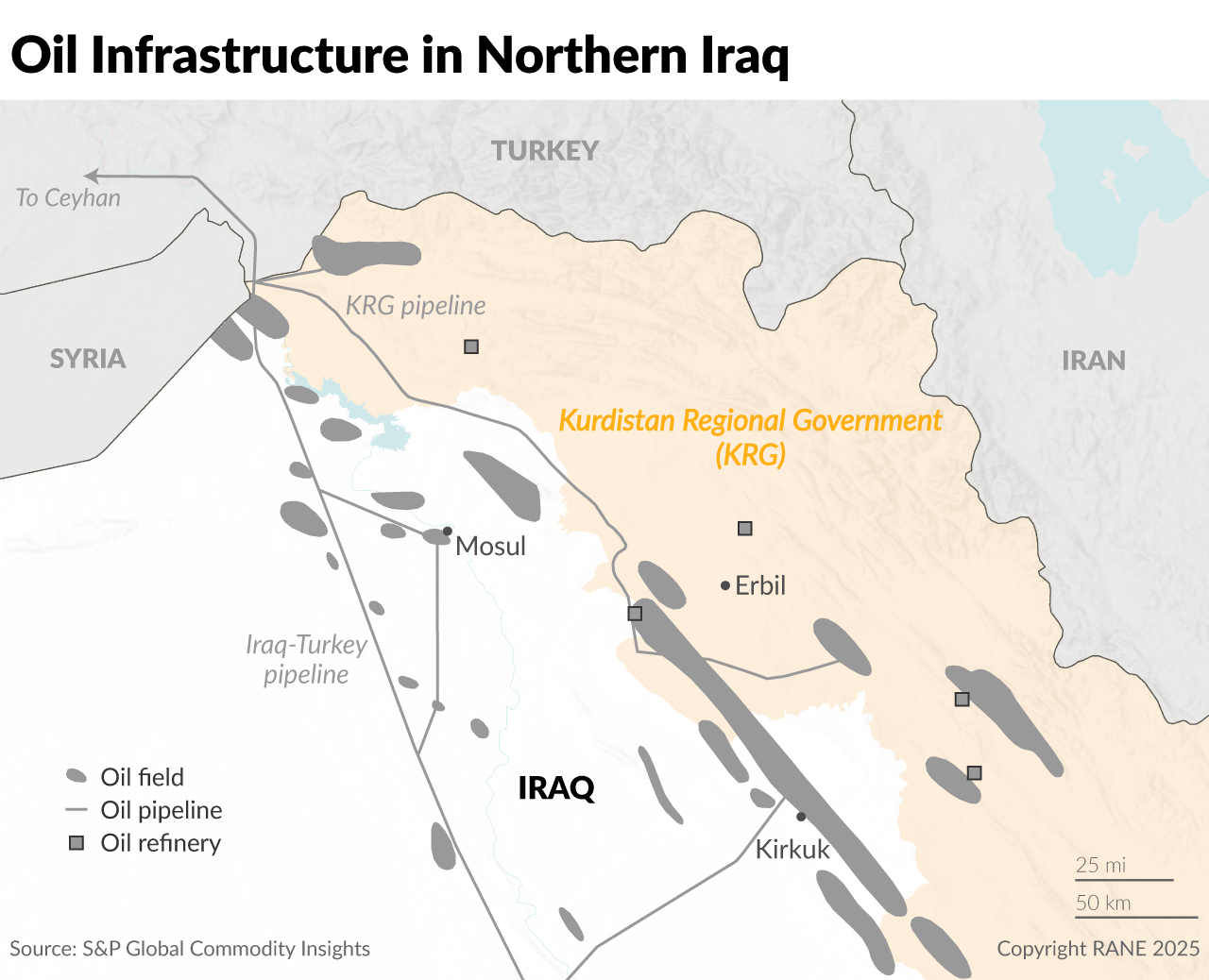
Despite the deal, the impasse between oil companies and the federal government persists, creating uncertainty around the immediate resumption of oil exports, but Iraq's greater leverage means production will likely eventually restart. While the deal is the most robust reached thus far, Arbil and Baghdad have reached similar agreements on oil revenue and transportation-related issues in the past, and the dispute with oil companies has been a major hindrance to the resumption of flows. While the Association of the Petroleum Industry of Kurdistan hailed the deal, its members' demands for ''written agreements'' will likely remain a complication. Oil companies that signed contracts with the KRG under the invalidated Kurdistan Oil and Gas Law received very generous investment terms compared with companies that have signed technical service contracts with Baghdad. Oil companies have also reportedly expressed concern about compensation for the 50,000 bpd of production that the deal reserves for consumption inside the Kurdistan Region, given the KRG's propensity to delay payments to oil companies and rack up arrears owed to them. Moreover, oil companies are demanding a settlement on a payment plan for the arrears the KRG owes them. Baghdad has shown some flexibility in talks with Kurdish oil producers. In its latest budget, for example, the Iraqi government increased the compensation level for oil producers to $16 per barrel. But Iraq is unlikely to fully honor the contracts signed with KRG and, and is also facing its own financial constraints in offering more generous compensation plans for companies due to low global oil prices. Nevertheless, oil companies are likely to eventually reach a deal with the Iraqi government, as many have few production assets outside of the Kurdistan region. Otherwise, these companies will continue to face financial stress, potentially leading to bankruptcy. This will, in turn, ultimately compel oil companies to ink a deal, even if it means accepting Baghdad's demands for lower compensation and/or a slow repayment period for arrears.
Turkish pressure and Iraqi domestic political dynamics could also delay the implementation of the KRG oil deal, though less so than Iraq's ongoing dispute with oil companies. On July 21, Turkish President Recep Tayyip Erdogan signed a presidential decree announcing Turkey's intent to terminate the 1973 Iraq-Turkey Crude Oil Pipeline Agreement when it comes up for renewal next year. Turkish officials have already submitted a successor agreement to Baghdad for negotiations, signaling that their intent is not to stop cooperation on the pipeline, but rather to reach a new agreement. Still, negotiations over a new deal could complicate matters in restarting oil shipments through the pipeline. Political dynamics in both the Kurdistan Region and Iraq more broadly could also complicate the implementation of the deal. For one, Iraq's November elections could compel Baghdad to take a harder stance in talks with Kurdish oil companies. Additionally, the potential for more widespread power outages in the coming months could force Baghdad to prioritize spending on other issues over budgetary transfers to the KRG — particularly if these outages trigger more protests, similar to those seen this summer. Meanwhile, the KDP and its main political rival, the Iran-backed Patriotic Union of Kurdistan (PUK), have yet to form a needed coalition government in the wake of last year's Kurdish regional elections. The PUK has long argued that the KDP's political dominance in the Kurdish political system — along with its close relationship with oil companies — enables the KDP to expand and amass its large patronage network. This concern will only be augmented by the new oil deal, which grants the current oversight of certain budgetary allocations from Iraq. Against this backdrop, the PUK could seek to impact the agreement's auditing process in an effort to shine more light on these networks for its own political gain, something the KDP would oppose. Finally, the final destination of Kurdish oil exported via Turkey is a political issue that Baghdad will need to address. Prior to the March 2023 suspension of exports, oil traders sold much of KRG-produced oil to Israel. At the time, this was a political concern for Baghdad, which in 2022 passed a law that criminalized forms of normalization with Israel. That concern has only grown since the outbreak of the Israel-Hamas war in October 2023. In theory, since Iraq's State Oil Marketing Organization is marketing the oil, it can sell it to whomever it wants. But the proximity of Ceyhan, the oil transportation hub on the Turkish coast, to Israel means that smuggling and/or ship-to-ship transfers that result in Israeli refiners using Kurdish oil are possible, even if both Baghdad and Ankara protest it.
The agreement, as well as any eventual restart of production, cements Iraq's control over the KRG, permanently clipping its greater autonomy and independence ambitions. This puts Baghdad in a stronger geopolitical position vis-a-vis Turkey and, to a lesser extent, Iran. The deal for KRG to hand over 230,000 barrels of oil per day to Iraq's State Oil Marketing Organization, once implemented, will limit the KRG's (and by extension the KDP's) ability to finance the government, pay salaries and distribute patronage without Baghdad having a say in the disbursement of funds. This leverage will enable Iraq to maintain high demands on auditing public payrolls, which Iraqi officials have long accused Kurdish officials of bloating. It will also restrict Kurdish officials' ability to resume the pursuit of independence and/or another independence referendum. Additionally, the deal strengthens Iraq's control over territory it asserts as its own (specifically areas beyond what Iraq officially recognizes as the Kurdistan Region), which provides Iraq with greater leverage in territorial disputes. Even if the KRG were to forgo budgetary transfers from Iraq and resume smuggling oil regionally to pursue independence or resolve territorial disputes, it could not replicate smuggling at a scale sufficient to offset the loss of funds from Baghdad. This would inevitably lead to unpaid salaries and a return to the economic crisis that has plagued the region for the past two years. It is also unlikely the KRG can persuade Turkey to disregard the March 2023 arbitration ruling and permit KRG oil exports via Turkey. This is because, unlike a decade ago, Turkey now strongly supports Iraq's efforts to centralize power and has sought to restore ties with Baghdad for economic reasons. Consequently, Iraq will likely insist that the successor to the 1973 pipeline agreement include provisions, if not explicit language, requiring the Iraqi government to be involved in any transportation of Iraqi crude oil through the system. Additionally, Baghdad's success against the KRG will further deter other Iraqi areas, such as Basra, from seeking autonomy and establishing themselves as independent regions like Kurdistan, despite this being permissible under Iraq's constitution. A stronger central government will also enhance Iraq's resilience against external influence from regional actors that have historically exploited the country's internal divisions, including Turkey (which has a long-standing relationship with the KDP) and Iran (whose influence in Iraq remains extensive). Nevertheless, Iraq's internal problems, such as ethno-sectarian and tribal fragmentation, will continue to hinder its ability to re-establish itself as a regional powerhouse,
- If the deal is finalized, not only will it result in Iraq having more overall oil export capacity, but it also will make it easier for Iraq to develop new oil production capacity in the northern areas of the country it controls, like the supergiant Kirkuk field. Higher production capacity will give Iraq leverage in inevitable OPEC+ negotiations to extend (or end) production cuts that are currently set to expire at the end of 2026 and push for a higher quota level, which OPEC+ typically sets proportionally based on production capacity.
