
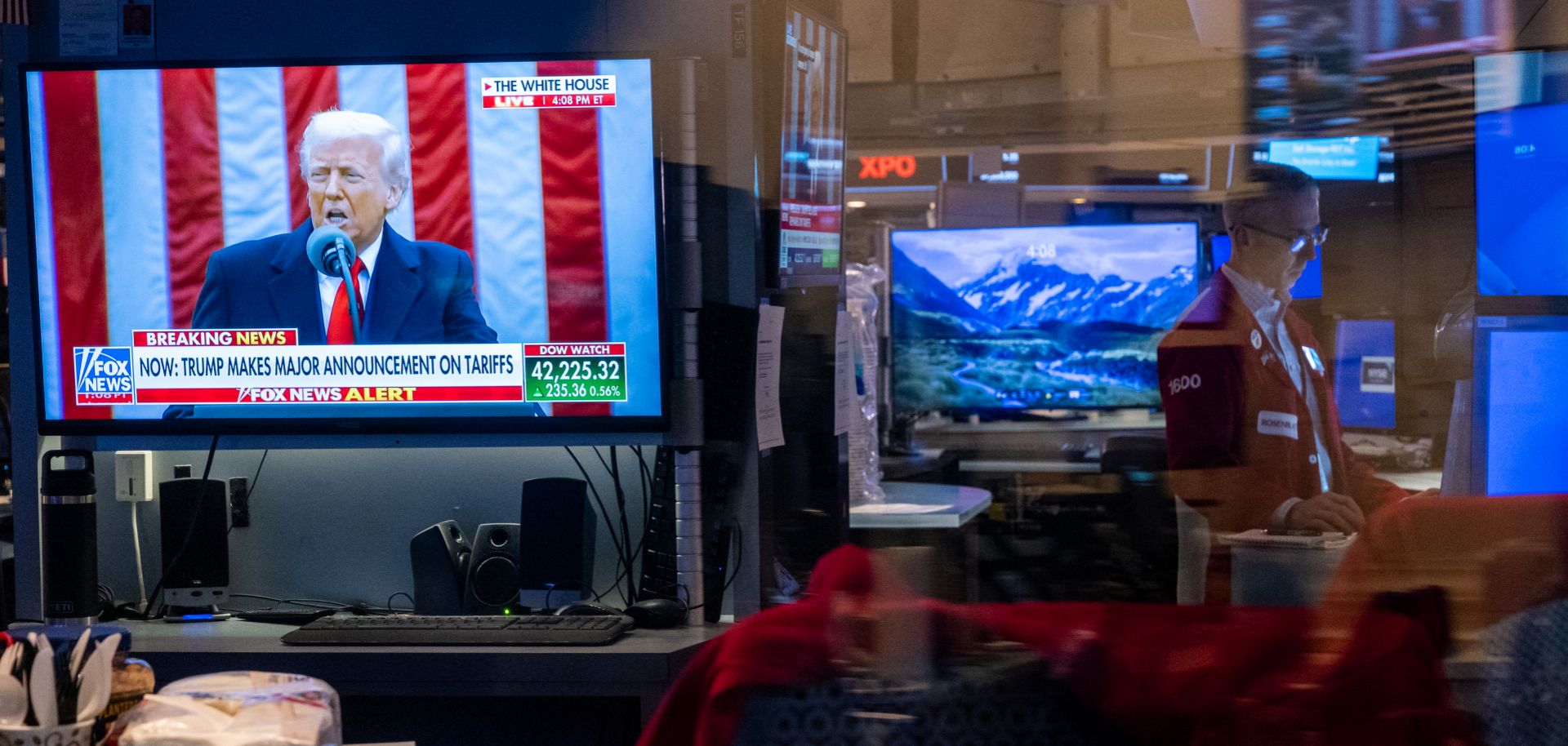
U.S. President Donald Trump's wide-ranging tariffs announced on April 2 constitute one of the biggest changes in U.S. economic policy in recent history. They also represent what is effectively the single largest tax increase on Americans since 1968, and are sending U.S. average effective tariff rates to levels not seen since before World War I.
As I argued in a column published last month, the Trump administration's tariff strategy appears to be aimed at boosting U.S. manufacturing — and specifically jobs in the sector, which has fallen from a peak of employing about 19.5 million Americans in 1979 to 12.7 million in February 2025. The White House also seems to believe this strategy will improve wages from the bottom up, with less educated Americans finding higher-paying jobs in the manufacturing sector.
However, Trump's tariffs will likely ultimately fail to accomplish these goals due to myriad constraints, and could fundamentally undermine U.S. economic competitiveness for years to come if they remain in place in their current form.
A Litany of Constraints
First, Trump's tariffs will likely significantly increase manufacturing costs in the United States, which will constrain his stated goal to revive the sector. In the short term, the U.S. manufacturing sector simply does not have the spare capacity to ramp up production of the intermediate goods and raw materials that are now subject to tariffs, which means companies will likely still have to import many of those goods, thereby forcing them to eat much of the costs of Trump's tariffs. Any new investments into U.S. manufacturing — if they occur at all — will also take months or years to increase output. And even if U.S. manufacturing capacity were to increase in some areas, most intermediate goods produced in the United States will still be more expensive than imported goods were before the tariffs took effect. This risk is already being illustrated by Trump's tariffs on imported steel and aluminum — which he expanded in March to include many products made with either metal — as companies are complaining about long lead times and higher prices for specialized steel and aluminum products from U.S. manufacturers. Moreover, while the tariffs will likely support the U.S. steel industry, they are also resulting in higher domestic steel prices, with U.S. steel benchmark prices now roughly double global prices. In the modern U.S. economy, which is much more centered around services, there are far more industries dependent on steel than there are domestic steel producers. Indeed, the U.S. Chamber of Commerce estimates that ''for every job in steel production, there are roughly 80 Americans employed by manufacturers that use steel as an input.'' This means that as raw materials like steel go up the value chain, price increases affect numerous goods and parts of the economy.
Second, the U.S. labor force is not currently positioned to quickly expand manufacturing. Many companies across U.S. industries have been struggling to find skilled and unskilled workers. In ManpowerGroup's 2025 U.S. Talent Shortage survey, some 71% of U.S. employers said that they were facing difficulties in finding the skilled workers that they need, more than twice the 32% rate the survey found in 2015 and 2021. This shortage was present throughout the entire U.S. economy, with 70% of small- and medium-sized enterprises saying they were struggling to find skilled workers. However, many of the industries that Trump is seeking to boost, like the industrials & materials and automotive sectors, showed particularly high levels of scarcity, as these manufacturing sectors increasingly need skilled workers (even if not necessarily college graduates due to automation and robotics). Moreover, highly specialized trade jobs often held by non-college-educated workers — like electricians and plumbers — are routinely cited as areas facing acute shortfalls as well. If Trump's tariffs motivate companies to quickly ramp up their manufacturing operations in the United States, it will only exacerbate these labor shortages — especially as the administration's stricter visa and immigration policies are also further winnowing the pool of potential manufacturing workers.
Third, the high economic uncertainty created by Trump's policies will continue to deter companies from making long-term investment decisions, particularly large greenfield investments. Currently, there is little market confidence in where U.S. tariff policy will go over the next few months, much less the next few years. Following the April 2 announcement of Trump's sweeping new tariffs, the Bloomberg Economics Global Trade Policy Uncertainty Index (where a lower number indicates less uncertainty) exceeded 10 for the first time since the index was created. For comparison, the index stood at just 0.4 a year ago, and never exceeded five during Trump's first term. While this uncertainty complicates contingency planning for companies in the short term, it also creates long-term investment challenges. For many industries — including those that Trump wants to expand, like the automotive sector and the heavy machinery and appliance industries — new production capacity and facilities cannot be built overnight. Indeed, it could take several years before the first products come off the assembly line, and even longer for investments in new U.S. manufacturing operations to pay off. This means most companies will not base their investment decisions on what U.S. tariffs are in place today, but rather where tariffs will be in the long run (including after Trump exits the White House), as those that invest heavily in expanding domestic production now risk being burned in the future if the tariffs shielding them from foreign competition are removed, which would saddle them with high labor and other costs in the United States.
Finally, in response to Trump's tariffs, some affected countries will likely retaliate by imposing their own tariffs on U.S. goods and services, which could ultimately impede U.S. manufacturing overall. For example, in a March report modeling the long-term impact of Trump's 25% tariff on imported vehicles and vehicle parts, the Yale Budget Lab found that in a scenario with widespread retaliation by U.S. trading partners, U.S. production of cars and car parts would decline slightly in the long run; meanwhile, some U.S. trading partners — including the European Union, the United Kingdom and China — would see an increase in vehicle output, likely due to them shutting out more U.S. competition and being able to export to other markets. Global trade retaliation will also further deter investment into the United States, including in the manufacturing sector, by limiting export opportunities.
Moreover, even if not all U.S. trading partners retaliate, Trump's tariffs will likely further undermine U.S. export competitiveness by applying upward pressure on the dollar, given that the new tariffs will likely apply to a wider range of imports than Trump's previous rounds of tariffs, which have so far been more targeted, covering a smaller range of imports. In a paper published in 2024, the chair of the Council of Economic Advisers, Stephen Miran, proposed a so-called ''Mar-a-Lago Accord,'' which aims to weaken the dollar in a way that reduces the U.S. trade deficit through coordinated action with foreign central banks, similar to former U.S. President Ronald Reagan's 1985 Plaza Accord. Since then, Miran has emerged as one of Trump's top economic advisors, stirring rumors that the White House may pursue such a strategy. This, however, remains highly unlikely given the Trump administration's poor relationship with other Western nations, the larger role of non-Western countries in the international financial system, and the fact that Miran's proposed plan would risk further undermining the dollar's status as a reserve currency. Retaliation by U.S. trading partners against Trump's tariffs will only further deter investment into the United States, including in the manufacturing sector, by limiting export opportunities.
The Risks of Failure
If Trump's strategy fails, the heavy usage of tariffs over the next four years will likely further undermine the U.S. economy and increase wealth inequality in the United States. The United States' typically stronger economic performance than other Western countries could also come under threat. Since the World Trade Organization was created in 1995, U.S. annual real GDP growth has outpaced the European Union by 1.8-2.5%, which, when compounded over the last 30 years, has resulted in 20% more economic growth in the United States than in EU countries. This edge over Europe is due to a variety of factors, including the United States' cheaper energy prices, lower tariffs, lower taxes, deep capital markets, flexible labor market and less interventionist economic policies. But Trump's tariffs and other policies now risk jeopardizing each of these advantages.
One of the biggest risks of Trump's use of tariffs is that, once applied, tariffs tend to be what economists call ''sticky'' in that they are politically difficult to remove, especially the longer they remain in place and industries become accustomed to them. History shows that if tariffs prompt even a handful of investors or companies in certain industries to pivot their businesses to the United States, they will lobby for those tariffs to remain in place since they may no longer be able to compete without them. One example of this is the 25% tariff on light trucks that then-U.S. President Lyndon B. Johnson put into place in 1964 in response to French and West German tariffs on U.S. chicken exports. The so-called ''Chicken Tax'' remains in place to this day, thanks to lobbying efforts by truck producers and auto worker unions, and has since forced out essentially all foreign light trucks from the U.S. market. Even more recently, former President Joe Biden lacked the political capital to remove most of the tariffs Trump enacted during his first term, as evidenced by him keeping Trump's steel and aluminum tariffs and other restrictions in place — and even slightly expanding tariffs on China. Even if Trump's tariff strategy largely fails, as Johnson's did against France and West Germany, it is unlikely that Trump or his successor will be in a political position to remove all of the tariffs and other restrictions. And even if all of the trade barriers were removed, the economic damage already done would be hard to quickly reverse
As foreign countries seek to de-escalate trade tensions with the United States, their adoption of voluntary export restrictions or acceptance of U.S. import quotas on certain goods could hurt American businesses as well. The 1986 U.S.-Japan Semiconductor Agreement offers a cautionary tale on how such restrictions may ultimately benefit foreign producers and hurt domestic ones. In that agreement, Japan agreed to restrict exports of DRAM chips to the United States, leading DRAM prices to spike. However, instead of supporting the growth of DRAM producers in the United States, high prices led to South Korean firms not covered by the restrictions capturing market share. Even Japanese companies affected by the restrictions benefited, because high prices led to high profits, allowing them to reinvest those profits into R&D. Ultimately, the restrictions largely further cemented Japanese and Korean leadership in memory chip production — which remains to this day — and hurt U.S. companies dependent on DRAM chips, like IBM. While the circumstances will be different with Trump's tariffs, negotiations to reduce tariffs in exchange for quotas, which occurred during Trump's first term for the steel and aluminum industry, could lead to a similar situation where prices remain high but foreign companies securing export opportunities to the United States enjoy high profit margins that can be reinvested into innovation and expansion opportunities.
Lengthy tariffs will also lead to a structural increase in the price of raw materials and intermediate goods in the United States relative to other countries with comparatively lower tariffs. The impact of tariffs on U.S. inflation is expected to largely be a one-time hit of around 1-2 percentage points, mainly concentrated in goods and not services. However, in the long run, prices will be higher overall, undermining U.S. competitiveness and productivity growth as long as the tariffs remain in place. This will make the United States a higher cost environment and, coupled with the above challenges, could result in the United States' previous strong economic performance over other advanced economies evaporating or reducing significantly, since more optimal capital allocation and higher prices have been commonly cited as key drivers of previous U.S. economic growth. While other economies would also be somewhat affected if U.S. tariffs remain in place for a prolonged period, they will not have as many trade barriers and will, over time, restructure their economy to export to other markets.
Finally, the Trump administration's strategy of using tariff hikes to pay for tax cuts could pose long-term challenges for the U.S. government's fiscal outlook and debt accumulation. Ahead of the tariff announcement, Trump's trade advisor Peter Navarro claimed without evidence that the tariffs would generate $600 billion in tax revenue per year and $6 trillion over the next decade, thereby enabling the United States to implement more income tax breaks for Americans. However, shifting the tax burden in the United States from income taxes to tariffs would be extremely ambitious and risky. This is because it is uncertain whether Republicans in Congress will be able to agree on new tax cuts large enough to offset the tariffs.
In the United States, high tariffs will also eventually reduce the volume of imported goods by making them more expensive — a stated goal of the Trump administration. But this will cause severe challenges if the United States becomes dependent on tariffs for a high proportion of its government revenue, since high tariffs will shrink this revenue base (i.e., imports) in the long run by deterring companies in the United States from purchasing imported products.
Trump officials, like Navarro, have largely only cited static and not dynamic estimates of the amount of revenue that tariffs could increase to justify them in exchange for tax cuts. In practice, the dynamic impact, which would incorporate shrinking import volumes, could see that revenue decline significantly, particularly as some of the tariffs are at very high levels, like the 46% tariff on Vietnam. In an April 2 study, Yale's Budget Lab estimated that the tariffs Trump has so far enacted since taking office in January, including the new ''reciprocal'' tariffs, could raise $3.1 trillion in U.S. government revenue over the next decade, far below the $6 trillion that Navarro claims. If tax cuts are large — especially if the Republicans zero out the cost of extending Trump's tax breaks beyond their 2025 expiration under current law in budget reconciliation (which would enable the Republicans to pass larger tax cuts with a simple majority) — and tariff revenue generation is below what the White House expects, it could result in a much worse U.S. debt-to-GDP ratio and fiscal deficit five years from now. This would risk higher borrowing costs for the United States and pressure on the government to rein in spending (particularly if Democrats win the 2028 presidential election).
Putting the U.S. on the Back Foot
Ultimately, Trump's strategy is unlikely to succeed in boosting U.S. manufacturing jobs and replacing imports with domestic production for a large array of goods. Instead, it risks undermining U.S. economic and innovative competitiveness, which will invariably aid many of the United States' largest economic rivals, including its top strategic rival, China.
The United States' low dependence on trade, large and diverse population, highly innovative workforce and lax regulations in most sectors will still enable it to avoid a more significant economic decline that many countries would likely experience if they adopted a similar tariff and trade strategy. However, Trump's plans risk making it easier for foreign countries to leapfrog the United States in the future by harming American competitiveness at a crucial time for the green technology and AI industries. Any U.S. restrictions that hurt the development of these nascent industries today — coupled with Trump's tariffs and his disdain for the renewable energy sector — could have an outsized impact on U.S. economic competitiveness, much like how previous U.S. attempts to protect its DRAM market ultimately benefited its competitors. Thus, rather than sparking a manufacturing renaissance, Trump's tariff policy risks putting the United States on the back foot in the coming decades.
