
Egypt's reliance on foreign aid and its efforts to strengthen economic ties, especially with the United Arab Emirates and Turkey, will limit its foreign policy and ability to project influence in the region, likely leading Egypt to take a more mediating and peacekeeping role in regional conflicts. In recent months, Egypt has elevated its diplomatic engagement in conflicts in Africa and the Middle East. In mid-January, Egypt hosted technical discussions with a Somali delegation about contributing peacekeepers to a multilateral force countering jihadists in the Horn of Africa; weeks later, the Somali Ministry of Defense said it completed these technical discussions and "looks forward to [Egypt's] contribution alongside other troop-partner nations." The same month, Egyptian and Qatari negotiators brokered the phased Hamas-Israel ceasefire that took effect on Jan. 19. Egypt also established a command center in Cairo to implement the agreement, which largely held until widespread Israeli attacks on the Gaza Strip resumed on March 18. Since then, Egyptian and Qatari mediators have pushed for an emergency truce and return to the ceasefire framework. Furthermore, Egypt has promoted the Arab vision for post-war Gaza, drafting an alternative framework to U.S. President Donald Trump's proposal to resettle Palestinians from Gaza in Egypt and Jordan, which Cairo vehemently condemned.
- Technical discussions about Egypt's participation in the peacekeeping mission in Somalia come amid strained relations between Egypt and Ethiopia after years of impasse over the Grand Ethiopian Renaissance Dam, which threatens Egypt's control over Nile River waters critical to the country's agricultural sector. Egypt's role in a peacekeeping mission would increase Egyptian political influence in the Horn of Africa at Ethiopia's expense.
- Since the Oct. 7, 2023, start of the Israel-Hamas war, Egypt has acted as a mediator, along with Qatar, to reach a ceasefire agreement and negotiate hostage releases. Egypt has also increased security measures near its border with Gaza and has facilitated humanitarian aid flows through the Rafah border crossing, though a lack of coordination between Israel and Egypt has at times disrupted these deliveries.
Egypt's approach in Somalia and Gaza highlights that Cairo's foreign policy has tempered amid economic concerns and increased reliance on other countries. Historically, Egypt has been more assertive in regional conflicts, even when this assertiveness has pitted Cairo against regional power players and key allies. For instance, Egypt backed the eastern Libyan National Army during the Libyan civil war, burning through significant economic and military resources and setting itself in opposition to some members of the United Nations, including Turkey, the United States and Qatar. However, Cairo made very few political or strategic gains in Libya, a pattern that has proven true in several other prolonged regional conflicts in which Egypt has intervened. Other instances of Egypt's assertive foreign policy positions, such as its support for the Saudi-led multi-year blockade against Qatar, strengthened Cairo's ties with regional powers such as Saudi Arabia and the United Arab Emirates but made Egypt susceptible to their economic and political influence. Additionally, regional conflicts have forced Egypt to invest significant resources in border security to prevent migrant inflows, further straining the country's economy, which was already struggling due to the effects of the COVID-19 pandemic and the Russian invasion of Ukraine. These economic hardships have forced Cairo to focus on recovery efforts and longer-term economic stability, goals that favor foreign policies aimed at calming conflicts, rather than prolonging them. Egypt is also increasing its economic and military ties with other countries, further disincentivizing divisive foreign policies. For instance, the European Union agreed in March 2024 to provide Egypt a 7.4 billion euro ($8 billion) aid package in exchange for Cairo's efforts to limit northward migration from the Middle East and Africa. Egypt also signed a $35 billion development deal with an Emirati sovereign wealth fund in February 2024 and expressed interest in increasing the volume of bilateral trade with regional countries, including former rival Turkey. Besides these bilateral deals, Egypt has been implementing International Monetary Fund reforms to stabilize its economy.
- Regional instability from the Israel-Hamas war has had spillover effects on Egypt's economy. Although initial drops from tourism revenues during the pandemic have rebounded, Houthi maritime attacks in solidarity with Palestinians in Gaza resulted in persistent shipping diversions from the Red Sea, decreasing Suez Canal revenues. This income is a key source of state revenue for the Egyptian government, accounting for around 2% of the country's GDP. On March 17, Egyptian President Abdel Fattah al-Sisi said the regional "situation" resulted in a monthly loss of $800 million in Suez Canal revenues.
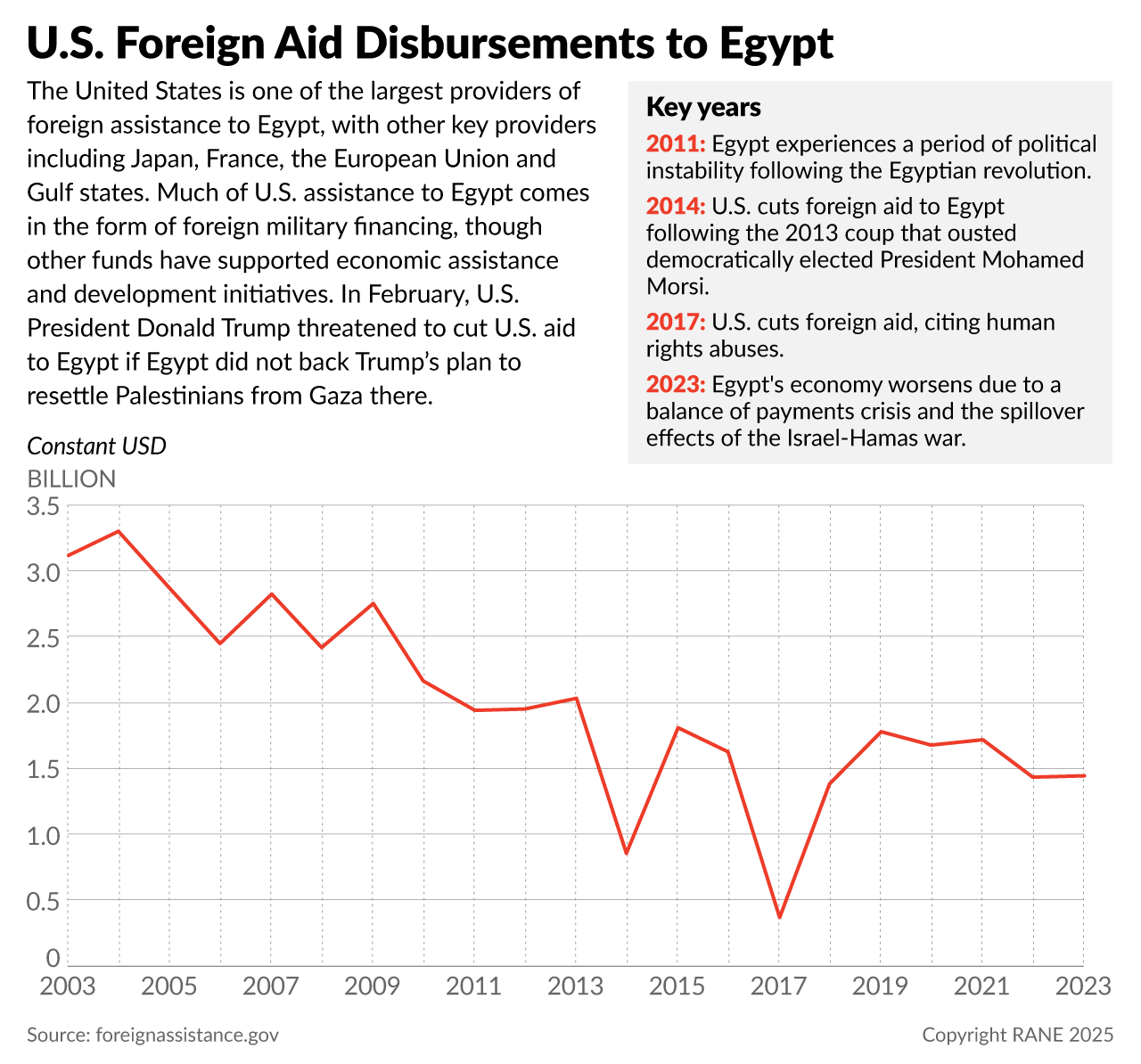
Egypt will likely continue to leverage its role in stemming northward migration and in mediating the Israel-Hamas conflict to maintain funding inflows from the European Union and the United States, though this reliance will make Egypt vulnerable to EU and U.S. foreign policy priorities. European countries, especially Germany and France, face increasing domestic pressure to curb migration flows from sub-Saharan Africa, which have risen amid the destabilizing impacts of conflicts like the Sudanese civil war. Egypt will likely take advantage of this pressure by continuing to leverage border security in aid negotiations with the European Union. Similarly, the U.S. Trump administration's desire to end the war in Gaza will likely enable Egypt to maintain economic and military aid flows from the United States as long as Egypt continues to mediate the conflict, though as fighting winds down in the Gaza Strip and post-war plans grow more prominent, diverging visions for Gaza's future will likely strain ties. Regardless, deals with the European Union and the U.S. Trump administration will make Egypt vulnerable to their foreign policy priorities. For instance, the European Union could reduce aid if Egypt diverges from the IMF plan, although Egypt's role in curbing migration may be more important to European foreign policy than strict adherence to economic reforms. Additionally, the Trump administration could cut aid to Egypt to coerce policy changes in Cairo regarding the Israel-Hamas war. If the European Union and/or the United States cuts funds, Egypt could increasingly look to Gulf Arab countries for support, but this would likely increase Saudi and Emirati influence over Egypt. Over time, this dynamic could embroil Egypt in a regional rivalry between the Gulf Arab states, especially as Saudi Arabia and the United Arab Emirates compete with each other for economic and regional influence.
- On March 26, Egypt's planning minister said Egypt and the European Union were expected to sign a 4 billion euro memorandum of understanding in the second half of 2025. The financing deal would be part of the previously agreed upon 7.4 billion euro deal, of which 1 billion euros have already been disbursed. The delivery of these funds would strengthen Egypt's foreign currency reserves and ability to increase imports of goods like liquified natural gas.
- During the Trump administration's 90-day funding freeze on foreign assistance, Egypt was one of two main exemptions for foreign military financing (Israel was the other) to support Hamas-Israel ceasefire efforts. However, even as the Trump administration has reportedly decreased pressure on Egypt to accept resettled Palestinians from Gaza, Trump publicly threatened in February to cut aid to Egypt and Jordan if they did not agree to his plan. Trump may resurrect this tactic against Egypt in the future, jeopardizing U.S. aid to Egypt.
Egypt's efforts to increase trade with regional countries, including Turkey and the United Arab Emirates, will further constrain Cairo's ability to take assertive foreign policy stances. Over the last several years, Egypt has built robust trade ties with Turkey and the United Arab Emirates, with plans for further growth going forward. However, several recent regional conflicts have situated Egypt in opposition to these key trade partners. For example, Egypt has deepened military cooperation with Somalia amid their respective tensions with Ethiopia, while Turkey brokered a December 2024 deal to end Ethiopia and Somalia's port dispute and later hosted technical talks. Additionally, in the Sudanese civil war, the United Arab Emirates has supported the paramilitary Rapid Support Forces, while Egypt has reportedly provided logistical support to the rival Sudanese Armed Forces. In both of these conflicts, Egypt has been careful to limit support, avoiding economic backlash from its trade partners, and this pattern will likely persist as Cairo aims to further expand trade ties with Turkey and the United Arab Emirates. This cooperation will be particularly important as Egypt diversifies its weapons suppliers, with Turkey well positioned to fill that role as Ankara works to develop its domestic military sector. Turkey will be a particularly promising weapons supplier for Egypt due to its NATO membership, which makes Turkey a less controversial source than Russia or China, as well as its general lack of concern over weapons' end uses. However, Turkey would take issue with Egypt deploying Turkish weapons in a conflict against Ankara's interests, likely further constraining Egyptian involvement in regional disputes.
- After al-Sisi ousted Egypt's democratically elected President Mohamed Morsi in a 2013 military coup, Turkey and Egypt severed diplomatic relations. Turkey, which had long supported political Islamist movements, such as the Muslim Brotherhood, rejected al-Sisi's presidency, and Turkey and Egypt's support for opposing factions in the Libyan civil war and the Saudi-led blockade of Qatar further strained relations. However, in 2021, the countries began to increase their volume of trade and, in 2023, they restored diplomatic relations. They later conducted reciprocal state visits and signed agreements on cooperation and trade.
- On March 26, Turkish defense company Havelsan announced that it and Egypt's Kader Factory for Developed Industries will produce unmanned ground vehicles in Egypt. This announcement comes more than a year after Turkey agreed to sell drones to Egypt following their rapprochement.
- Turkey and Egypt aim to raise their bilateral trade to $15 billion over the next several years, more than doubling 2023's trade volume valued at around $6.9 billion.
- Similarly, Egypt has ambitions to expand bilateral trade with the United Arab Emirates, its largest trading partner in fiscal year 2023-24, with a value of $9.3 billion.
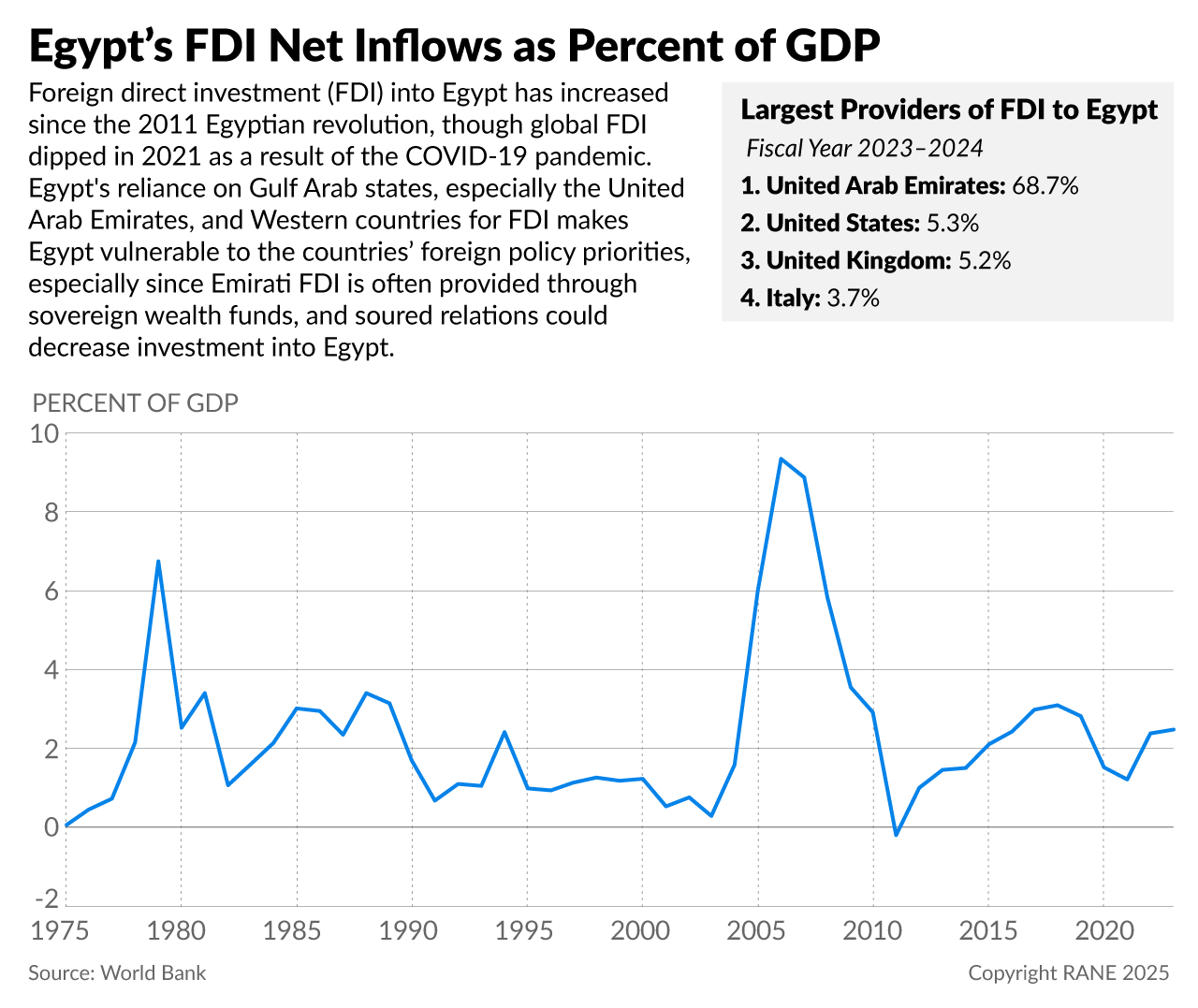
Egypt will continue to lean on low-cost, low-risk foreign policy tactics such as mediation, moderate peacekeeping and logistical support amid the government's economic concerns, although a stronger Egyptian economy would provide Cairo more flexibility. Egypt's prioritization of economic growth will constrain Cairo's projection of external regional influence over the next several years. For instance, Egypt will likely avoid costly interventions, particularly amid expensive border security improvements and domestic desire for the government to prioritize meeting citizens' needs, such as by increasing energy imports to prevent power outages. In addition, Egypt's weak economy will prevent Cairo from asserting its influence abroad through economic means, such as increased foreign direct investment, as the Gulf Arab states do. Therefore, Egypt will likely continue to implement low-cost, low-risk measures to project its influence in foreign conflicts, including providing logistical support, aiding negotiating efforts, hosting peacemaking talks and providing troops to the multilateral peacekeeping force in Somalia. These measures would also be unlikely to result in significant popular and international backlash against the Egyptian government or in diplomatic and trade relations. However, if Egypt's economy improves over the long term, Cairo's options would multiply. In such a case, not only would Egypt be less vulnerable to the foreign policy imperatives of other countries, but the Egyptian economy would be able to withstand deteriorating relations with regional powers, enabling Egypt to take more assertive positions in regional conflicts.
- While initial African media reports indicated that Egypt could provide around 5,000 troops to the peacekeeping force in Somalia, which would comprise nearly half of the African Union's deployment, Egypt's actual contribution may be smaller or delayed due to the Somali government's improving relations with Ethiopia over the past several months.
