
While India has shown renewed interest in finalizing free trade agreements, or FTAs, particularly in response to U.S. threats of reciprocal tariffs, its protectionist stance and other obstacles will likely delay the completion of deals. On March 16, India's Commerce and Industry Minister Piyush Goyal and New Zealand's Trade and Investment Minister Todd McClay announced that negotiations for an India-New Zealand FTA will begin in April. This followed the 10th round of India-EU FTA negotiations on March 10-14 and European Commission President Ursula von der Leyen's visit to India on Feb. 27, which yielded an announcement from von der Leyen that both sides had agreed to finalize an FTA by the end of 2025. Meanwhile, on Feb. 24, India's Goyal and the United Kingdom's Business Secretary Jonathan Reynolds announced the resumption of negotiations for a proposed India-U.K. FTA.
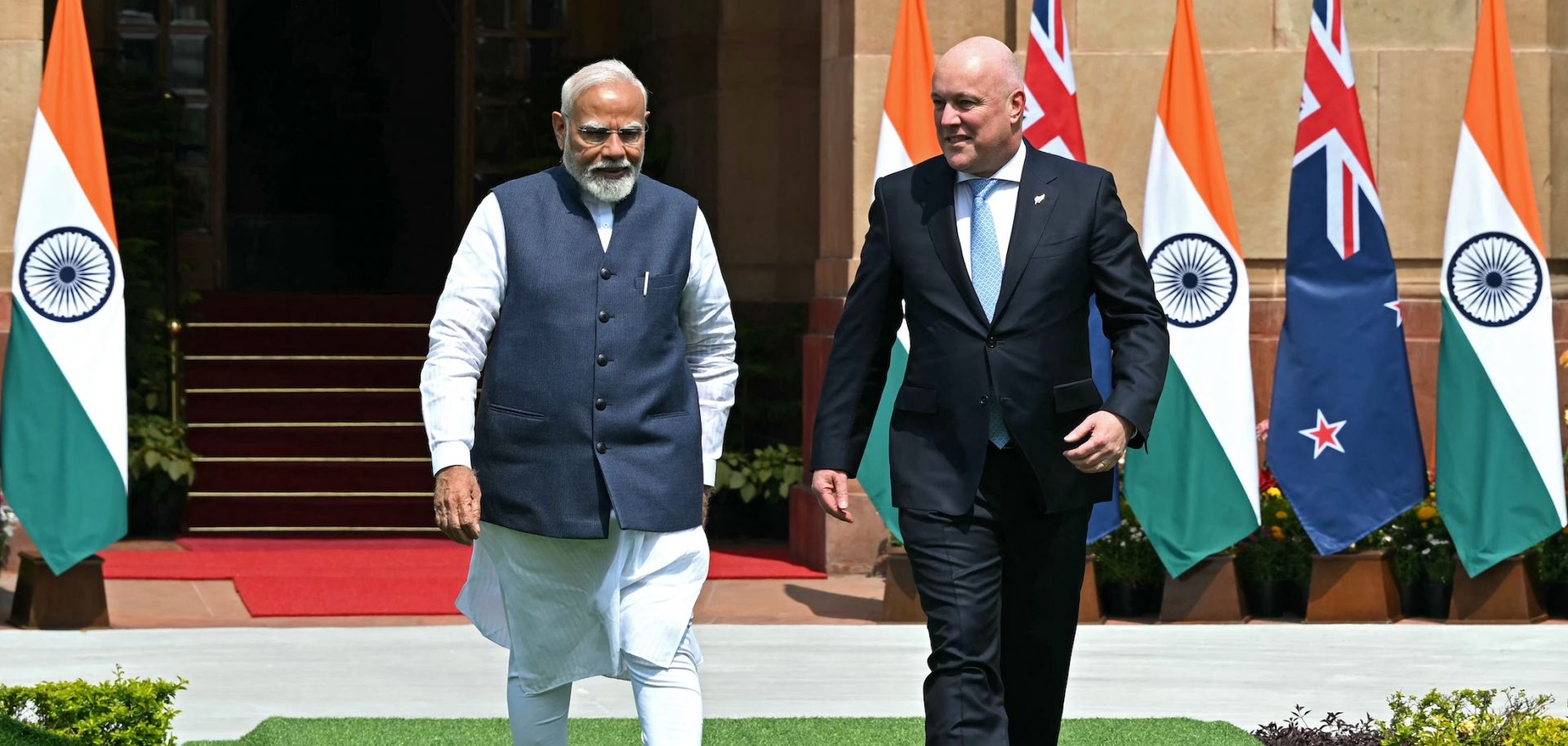
- New Zealand's Prime Minister Christopher Luxon visited India on March 16-20 and signed cooperation agreements on defense, pharmaceuticals, renewable energy and critical minerals. India-New Zealand FTA negotiations initially began in 2010 but stalled after multiple rounds.
- India-EU FTA negotiations began in 2007 but have struggled to reach a final deal. To revitalize frozen talks, India and the European Union launched their Trade and Technology Council in April 2022 as a high-level coordination platform to deepen bilateral cooperation in strategic areas such as trade, technology and security.
- The India-U.K. negotiations are resuming after a gap of over eight months. The talks were launched on Jan. 13, 2022, and have led to 14 rounds of talks. Two days after taking office as British prime minister in July 2024, Labour leader Keir Starmer affirmed that London was ''ready to conclude'' a trade deal with New Delhi ''that works for both sides.''
Renewed high-level engagements and the urgency created by impending U.S. tariffs have rejuvenated India's FTA negotiations over the last several months amid the country's broader shifts in trade policy. Recent high-level engagements, including von der Leyen's visit to Delhi in February and Luxon's visit in March, have spurred India's FTA negotiations after years of incremental talks. Additionally, India's concerns over the U.S. Trump administration's impending reciprocal tariffs, which are expected to take effect in April, are further motivating New Delhi to prioritize trade with other partners. U.S. reciprocal tariffs are expected to match not only the tariffs of other countries but also nontariff barriers, such as foreign digital services taxes and value-added taxes, compounding their effect. Additionally, U.S. President Donald Trump announced on social media on March 24 the imposition of 25% tariffs on all imports from countries that purchase Venezuelan oil and gas, including India. Amid these external developments, India's renewed FTA negotiations reflect a broader internal shift in domestic trade policy that balances protectionism with market access to safeguard key domestic industries and promote global trade opportunities. For instance, India has taken steps to ease tariffs that have long been contentious in its trade relations with the United States, including reducing the basic customs duty on luxury cars from 150% to 70% and lowering tariffs on high-end motorcycles in February. These concessions directly responded to U.S. demands for improved market access, reflecting a pragmatic effort to strengthen bilateral ties.
- The United States is one of India's largest trading partners, with two-way trade exceeding $118 billion in 2023-24 and India posting a $32 billion surplus. Trump has repeatedly criticized this trade imbalance, and India's Prime Minister Narendra Modi visited the United States on Feb. 12-13 to negotiate a resolution to the alleged disparities. After their meeting, Trump hinted that resolution would involve increased U.S. energy and materiel exports to India, and Modi said bilateral trade would reach $500 billion by 2030.
- The European Commission reports that the European Union is among India's largest trading partners for goods, with trade reaching nearly $126 billion in 2024. Key EU exports to India include machinery, transport equipment, chemicals and pharmaceuticals, while India's exports to the bloc primarily consist of textiles, agricultural products, engineering goods, and iron and steel products.
- Bilateral trade between India and New Zealand reached $1.7 billion in the 2023-24 financial year. India's primary imports from New Zealand include wool, iron and steel, fruit and nuts, and aluminum. Meanwhile, India exports pharmaceuticals, mechanical machinery, textiles, pearls, and precious stones and metals to New Zealand.
Despite India's renewed push for trade deals, negotiations will likely encounter sticking points on market access for agricultural products, carbon tariffs and visa liberalization for Indian workers, delaying the finalization of FTAs. While the resumption of negotiations signals India's intent to finalize trade agreements, long-standing structural and domestic constraints will likely limit significant deviations from protectionist policies. In particular, India has continued to deny greater market access for foreign dairy and agricultural products, a sector it shields to protect its vast farming community. This will likely remain a major sticking point in negotiations with the European Union, the United Kingdom and New Zealand, all of which are pushing for lower agricultural tariffs. Another emerging challenge will be the European Union's and United Kingdom's Carbon Border Adjustment Mechanism, which imposes tariffs on carbon-intensive imports like steel, aluminum and cement. For India, whose steel and iron exports to these locals are substantial, the mechanism could increase costs by 20%-35%. The European Union will also likely demand stronger commitments from India to reduce nontariff barriers and reform procurement rules — areas where India has traditionally shown limited flexibility. Another key challenge will be visa access for Indian workers, as New Delhi will pressure the United Kingdom, the European Union and New Zealand to ease restrictions on work visas, particularly for IT professionals, skilled workers and business executives. However, these countries are unlikely to offer Indian workers greater mobility provisions amid heightened right-wing nationalism, domestic labor market concerns and stricter immigration policies. These obstacles demonstrate that unless India finds ways to balance domestic interests with external demands, comprehensive trade deals will likely remain out of reach.
- The European Union is also likely to press for tariff reductions on automobiles and wine, two sectors where India maintains high duties to protect domestic producers. Similarly, the United Kingdom will continue advocating for tariff cuts on Scotch whisky, electric vehicles and chocolates. Given India's recent decision to lower tariffs on luxury motorcycles in response to U.S. pressure, New Delhi may prove willing to make similarly selective concessions to the United Kingdom and the European Union, particularly in nonstrategic sectors.
- India will seek broader access for its agricultural exports, textiles and information technology services.
- According to India's Global Trade Research Initiative, iron, steel and aluminium products made up 27% of India's total exports to the European Union in 2022, totaling $8.2 billion. According to the U.S. International Trade Administration, the United Kingdom made up 4.4% of India's total steel exports in 2023.
