
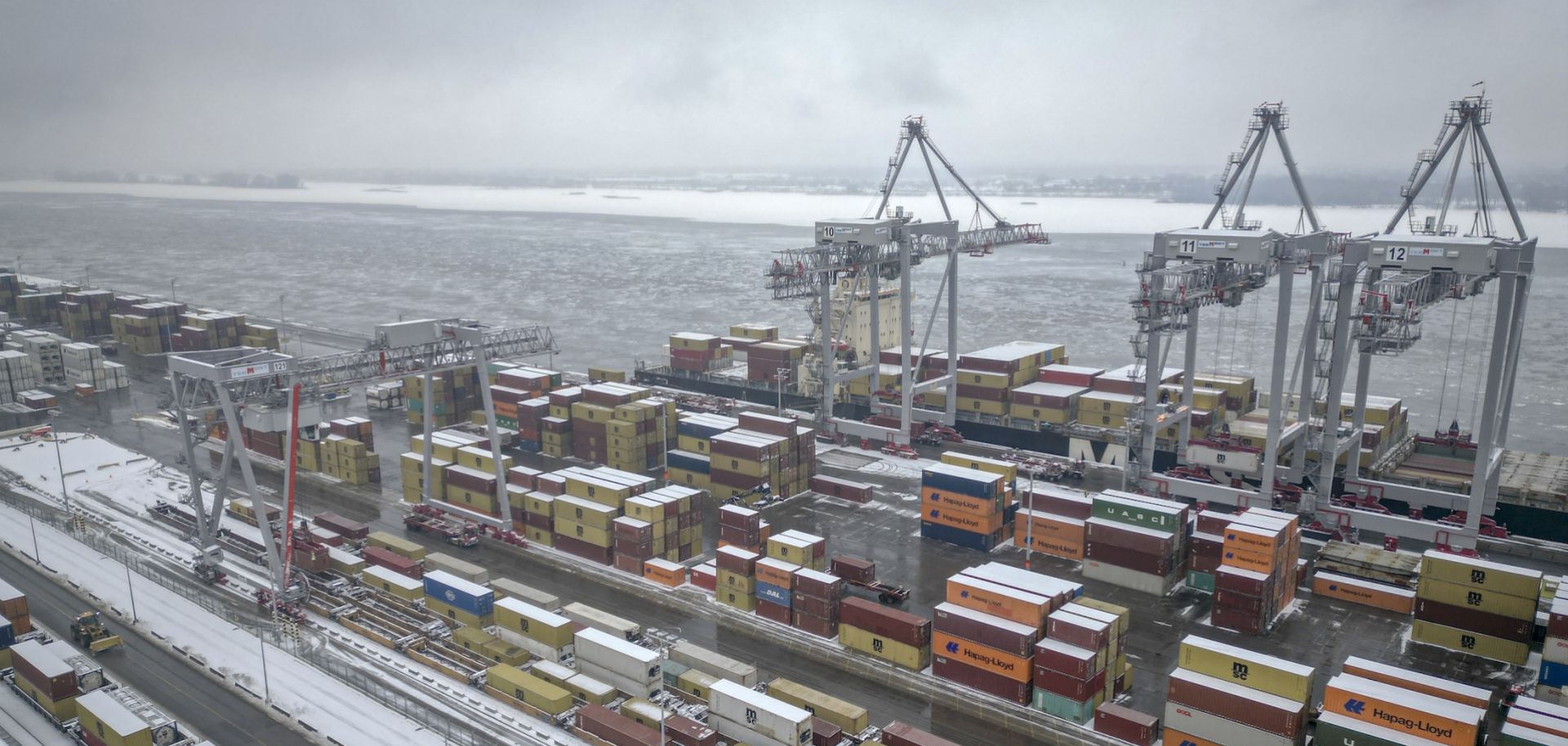
If implemented, sustained U.S. tariffs on Canada and Mexico would undermine North American economic growth and integration, and the White House's apparent willingness to accept these costs increases the likelihood that its other large tariff proposals are implemented, even if Canada and Mexico temporarily avoid them. On Feb. 3, Mexican President Claudia Sheinbaum and U.S. President Donald Trump announced that Mexico City and Washington agreed to pause tariffs on each other for one month. Trump spoke with Canadian Prime Minister Justin Trudeau later on Feb. 3 and may announce a similar deal between Ottawa and Washington before tariffs go into effect at midnight. The last-minute negotiations came after Trump on Feb. 1 signed an executive order imposing 25% tariffs on virtually all Canadian and Mexican goods and 10% tariffs on Chinese goods, effective at midnight on Feb. 4, ostensibly over unauthorized immigration and fentanyl drug flows. In response to the tariffs on Canada, Trudeau announced plans to impose retaliatory tariffs on many U.S. goods, while several Canadian provincial governments also announced plans to restrict U.S. liquor sales and American companies' access to provincial contracts. On Jan. 31, Trump said the United States would ''absolutely'' place ''very substantial'' tariffs on the European Union as well, spurring vows of retaliation from various European officials. He also said he intended to impose tariffs on U.S. imports of aluminum, semiconductor chips, copper, natural gas, oil, pharmaceutical goods and steel, with the tariffs on oil potentially coming as early as Feb. 18.
- Trump's executive order for the tariffs also includes a retaliation mechanism that gives him the right to further raise tariffs if U.S. trading partners retaliate against U.S. tariffs, though Trump has not formally announced plans to do so.
- Canadian energy products only face a 10% tariff.
- Trudeau announced on Feb. 2 that Ottawa would place a 25% tariff on C$155 billion ($107 billion) worth of U.S. goods, with the first C$30 billion coming into effect on Feb. 4 and the rest in 21 days. Ontario Premier Doug Ford announced it was barring U.S. firms from provincial government contracts and canceling a deal with Elon Musk's Starlink.
- As a part of the deal to delay tariffs, Mexico agreed to deploy 10,000 National Guard troops to the U.S.-Mexico border to help stem the flow of drugs and migrants, though it remains unclear if the deployment will actually lead to a decline in drugs crossing the border given the large demand inside the United States.
Although Mexico and likely Canada appear to have received a one-month reprieve, Trump's rhetoric connecting the tariffs to concerns about immigration and drug flows — despite Canada's comparatively small impact on such flows — suggests the threat will persist and that Trump's end goal may be the tariffs themselves, as opposed to concessions on border security. Shortly after winning the U.S. presidential election in November, Trump began threatening to place tariffs on Canada and Mexico as soon as he took office. Since then, the Mexican and Canadian governments have significantly increased efforts on their respective borders to stem the flow of migrants and drugs across the border. But up until recently, officials from both countries warned they were facing difficulty in reaching out to their American counterparts for negotiations to avert the tariffs. This — combined with Trump's ongoing focus on Canada (which, compared with Mexico, contributes a minuscule fraction of the illegal immigrants and drugs entering the United States) — suggests that stemming fentanyl and immigration flows is not the only focus of Trump's strategy, but rather a justification in pursuit of a larger goal. Since at least the 1980s, Trump has consistently supported large tariffs as an effective economic strategy to help bring manufacturing back to the United States and generate revenue. However, there are only a limited number of legal mechanisms that enable the U.S. president to move forward with large tariffs on a country without congressional approval or a formal investigation into their trade practices — and the main mechanism, the International Emergency Economic Powers Act, requires declaring a national emergency over an issue to legally implement tariffs. Trump's threat to move forward with large tariffs on the European Union, which would likely require a different national emergency than the fentanyl and immigration one, as well as a wide range of other tariffs, further suggests that his end goal may be the tariffs and trade restrictions themselves, which he believes will help boost U.S. domestic industry. If this is the case, there would then be few non-trade concessions that Canada and Mexico – or any other U.S. trading partner — could offer the White House that would permanently diffuse the tariff threat. Even if Mexico and Canada avoid tariffs on Feb. 3, this means the United States raising duties or exiting the U.S.-Mexico-Canada Agreement could still be on the table next year when the trade pact comes up for a formal review.
- Trump is the first U.S. president to use the International Emergency Economic Powers Act, or IEEPA, to justify imposing tariffs on another country. Whether he has the authority to do so will almost certainly be challenged in court, as the IEEPA has typically been used to enact sanctions against U.S. adversaries and non-state actors, like terrorist organizations.
- U.S. Customs and Border Protection (CBP) encounters with migrants at the U.S.-Mexico border dropped from a record 301,981 in December 2023 to 96,048 in December 2024. This dramatic drop in illegal border crossings is largely due to more active efforts by the Mexican government to relocate migrants away from the U.S. border since early 2024. By contrast, the CBP only recorded 11,816 encounters at the U.S.-Canada border in December 2024, and in 2023 there were more illegal border crossings reported going from the United States into Canada than vice versa. Fentanyl trafficking from Canada is also significantly lower than from Mexico, with only about 1% of the fentanyl entering the United States traveling across the Canadian border, Trudeau said in a speech on Feb. 2.
- Both Canada and Mexico have increased border security measures since Trump initially threatened 25% tariffs in November. Canada announced a $900 million increase in border security funding in December and has increased surveillance along its southern border, including with Black Hawk patrol helicopters, K9 units, and drones. Mexican authorities have similarly cracked down on trafficking tunnels in recent weeks, filling a 300-meter tunnel in the Ciudad Juarez area. Authorities are also preparing facilities to accept an increased number of both Mexican and non-Mexican deportees from the United States.
If the United States eventually imposes tariffs on Canada and Mexico and they remain in place for months, inflation would increase in all three countries, which would hit import-reliant manufacturing sectors particularly hard, while stymying economic growth across North America and weakening the region's global competitiveness. Given the close economic ties between the United States, Canada, and Mexico, any U.S. tariffs and retaliatory tariffs by Canada and Mexico would significantly increase prices for a range of products across North America. This would include electronics products, meat, agricultural products, wood products, chemical products, pharmaceuticals and other medical products, and petrol products. Canada and the United States would also likely see increased prices on fresh food products, for which they depend more heavily on Mexico during the northern hemisphere winter. The automotive industry, in particular, would face significant negative impacts if the tariffs last beyond the coming days, as the industry is highly dependent on the fast and inexpensive transfer of component parts between manufacturing facilities in Canada, Mexico and the United States. Other multinational companies similarly dependent on manufacturing in two or more countries in North America would face a sharp rise in production costs as well. In addition, the construction sectors in all three countries would likely be affected due to the increasing cost of wood, cement, metal and other materials. This means prices would increase across effectively all areas of life in the three countries, likely triggering a spike in inflation within months. If any tariffs and retaliatory tariffs remain in place for several months, these challenges will risk slowing economic growth in all three countries. However, Canada and Mexico are more likely to slip into recessions due to the potential reduction in exports to the United States; this is because while Canada and Mexico are the biggest destinations for U.S. exports, they account for much smaller portions of total U.S. exports compared with Canada and Mexico's total exports to the United States. Finally, more broadly, tariffs would undermine the overall competitiveness of North American businesses — including U.S. businesses — by hampering their ability to take advantage of trade and economic integration in the region (which, for example, helps most U.S. companies through access to low-cost labor in Mexico), in turn benefiting global competitors in Europe and Asia.
- In 2022, products from the United States accounted for 56.2% of Canadian imports and 55.6% of Mexican imports. That same year, the United States received 74.5% of Canadian exports and 75.8% of Mexican exports. However, only 15.8% of U.S. exports went to Canada, and 15.1% of U.S. exports went to Mexico.
- In 2024, $844 billion worth of U.S. imports (28% of all U.S. imports) came from Mexico and Canada, according to the U.S. Census Bureau.
Trump threatening levies on Mexico and Canada — the United States' two most important trading partners — demonstrates his high risk tolerance, which significantly raises the likelihood of large U.S. tariffs being placed on many other countries and goods, and suggests the White House will maintain this aggressive tariff strategy until it faces Republican, business leader and/or economic blowback. Contrasting most mainstream economists, Trump has long argued that tariffs do not cause inflation and that placing large levies on U.S. trading partners would help the U.S. economy because those partners have taken advantage of the United States. In recent remarks, Trump has admitted that there could be ''pain'' from the tariffs and that he ''can't guarantee anything'' on them not causing inflation, which suggests he may have a high tolerance for a short-term economic slowdown. As such, an initial worsening of U.S. economic activity or a rise in inflation may not necessarily prompt the White House to quickly abandon its tariffs, as Trump believes the levies will ultimately benefit the United States in the medium and long term. This means any economic blowback may have to last longer than just a few months before the Trump administration rethinks its strategy. Additionally, if Trump is willing to accept the relatively high economic pain of tariffs on Mexico and Canada, then he almost certainly would be willing to accept the comparatively lower economic pain of tariffs on virtually all other U.S. trading partners, like the European Union, and on various specific goods, like semiconductors and metals. This high risk tolerance also suggests that pushback from Republican lawmakers, large Republican donors and Republican constituents hurt the most by tariffs, as well as from the U.S. business community, may be needed to convince the Trump administration to considerably scale back its tariff ambitions. However, while most U.S. businesses and voters oppose the tariffs, a sizable amount of Americans who are ardent supporters of Trump support them. Republicans have also largely remained silent on trade matters since Trump signed the executive order to place tariffs on Mexico and Canada, further suggesting the White House will, for now, continue to pursue its aggressive strategy.
- A December 2024 Quinnipiac survey found that 51% of Americans opposed Trump's threatened tariffs on Mexico, Canada and China while 38% supported them.
