
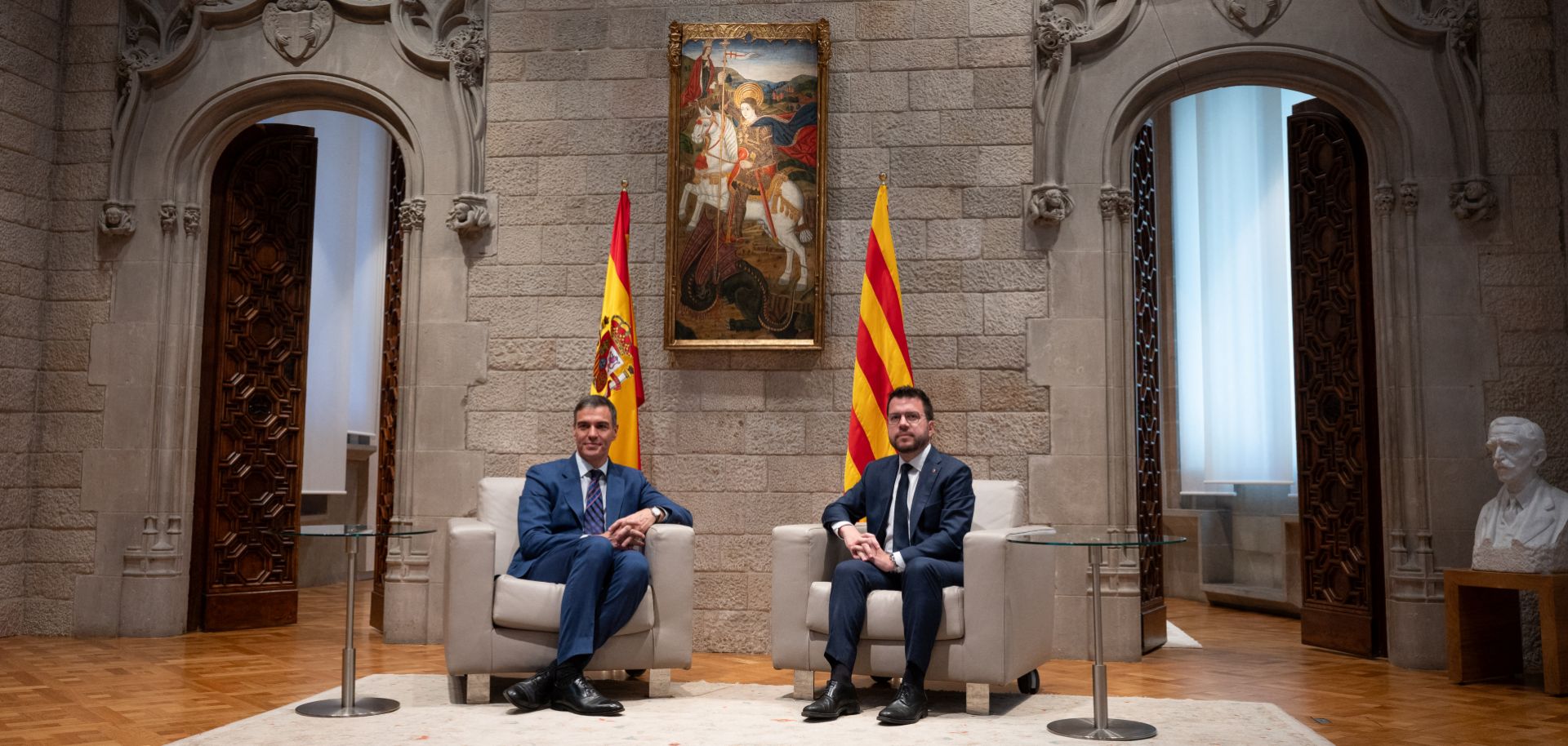
In Spain, a proposal to grant Catalonia's regional government full control of its taxes would, in the short-to-medium term, appease secessionist sentiments in the region, but over time it would make a future Catalan independence drive easier, as well as deprive the central state of a substantial source of revenue and generate a right-wing backlash. On July 30, the Socialist Party of Catalonia (PSC), which is the Catalan branch of Prime Minister Pedro Sanchez's Socialist Party, and the pro-independence Republican Left of Catalonia (ERC) announced an agreement to give Catalonia full control of all the taxes collected in the region. The pact establishes that starting from 2025, Catalonia will fully collect and spend income tax in the region, with other national taxes transferred to the region in successive years. The ERC will hold an internal vote on this pact, and the results will be announced on Aug. 2. Spain's Congress of Deputies is currently in summer recess, which means that a formal vote at the national level on this issue will only happen after the chamber reopens in September.
- The PSC won the highest number of seats in Catalonia's parliament in regional elections in May, but this was not enough to form a government. The party needs support from ERC lawmakers to appoint PSC leader Salvador Illa as regional president. In exchange for this support, the ERC demanded granting Catalonia full control of the taxes collected in the region, which has been for decades one of the main demands of pro-independence parties in Catalonia.
- Catalonia repeatedly denounces that it contributes more in taxes to the Spanish state than what it gets back from it. According to the Catalan government, in 2021, it collected taxes representing around 19% of the region's GDP, while it received spending from the Spanish state representing around 13% of its GDP.
- The agreement between the PSC and the ERC comes after the Spanish parliament in May approved an amnesty law benefiting hundreds of Catalan nationalists involved in the region's push for independence over the past decade. On July 31, Sanchez said the PSC-ERC agreement was a step toward the ''federalization'' of Spain.
The pact involves a substantial reform of Spain's tax regime, and could face resistance from some of Sanchez's allies in the Congress of Deputies. If the tax deal is implemented, it will remove Catalonia from Spain's common tax regime, according to which most major taxes are shared between the central government and the autonomous communities, and tax revenues are redistributed from wealthier to less wealthy regions to ensure a more balanced provision of services across the country. The pact would give Catalonia a separate status, similar to that of the Basque Country and Navarre, which were given control of their own taxes in Spain's 1978 constitution. To implement this change, Spain's government has to reform the Organic Law on the Financing of the Autonomous Communities (LOFCA), which requires an absolute majority in the Congress of Deputies, the lower house of parliament. This means that the Socialist Party will need support from its junior coalition partner, the left-wing Sumar, as well as from the parties that currently back Sanchez's government — namely, Catalonia's ERC and Junts parties, the Basque Country's EH Bildu and Basque Nationalist Party (PNV) parties, Galicia's Galician Nationalist Bloc (BNG) party, and the Canary Islands' Canary Coalition (CC) party. Support from the latter two parties, the BNG and the CC, could prove particularly difficult, as Galicia and the Canary Islands would be among the Spanish regions that may be negatively impacted by the drop in state revenue that would result from losing access to Catalan taxes. Even if Sanchez manages to overcome this obstacle and reform the LOFCA, opposition parties will almost certainly take the issue to Spain's constitutional court, as the reform may violate the constitution. Moreover, accusations that Sanchez has ended inter-community solidarity in Spain will become a core topic for the conservative opposition and will feature prominently in Spain's next general election (which does not need to take place until 2027, but could happen sooner if Sanchez's fragile multi-party coalition collapses).
- On July 30, the Socialist Party's regional leaders in Castilla-La Mancha and Aragon criticized the PSC-ERC deal, claiming that it destroys inter-regional solidarity in Spain. The fact that these are Socialist Party members confirms that Sanchez's party is not fully united behind the plan.
- On July 30, Isabel Diaz Ayuso, the conservative president of the Community of Madrid, said that the PSC-ERC deal ''breaks the common fund of all Spaniards.'' Also on July 30, a spokesperson for the Community of Madrid said that the ''à la carte'' financing for Catalonia is ''illegal'' because ''it does not fit into the constitution and breaks with the principle of solidarity between regions.''
- According to the draft pact between the PSC and the ERC, after the reform, Catalonia will make unspecified ''solidarity contributions'' to the rest of Spain. This is probably meant to appease resistance to the pact from other autonomous communities. Catalonia would also continue to make payments to the central state for issues like defense and foreign representation, which are handled by the central government.
If implemented, the reform would appease pro-independence parties in Catalonia, but it would also make a future secessionist drive easier and force the Spanish government to revise its fiscal policy to address the consequent drop in state revenue. Giving Catalonia full control of its taxes would improve the region's financing, increasing the room for infrastructure works and other policies to create business and investment opportunities. However, it would also deprive the Spanish state of a major source of revenue (Catalonia represents around 20% of Spain's tax revenue), which may force the central government to reduce spending or hike taxes in the future. This would be a significant policy problem for a country whose sovereign debt stands at over 108% of GDP and is required by the European Union to reduce its fiscal deficit. Moreover, other regional governments that contribute more in taxes than what they receive from the state (most notably, the Community of Madrid) would demand a similar treatment. Giving Catalonia full control of its taxes would have political repercussions as well. On one hand, such a deal would eliminate one of the main reasons behind secessionist sentiments in the region. But it would also involve significantly expanding the staffing and resources of Catalonia's regional tax agency, which would put the region one step closer to independence, as Catalonia would now have one of the essential features of a sovereign state (total control of taxation). In the short-to-medium term, this would unlikely result in a renewed push for independence in Catalonia, where the pro-independence camp remains internally divided, and where less than 50% of the population currently supports independence. But should such a push eventually restart, Catalonia's control over its taxes would make it easier for the region to secede from Spain. Finally, if conservative parties take over the Spanish government in the future and abolish Sanchez's deal with Catalonia, it would almost certainly reignite the region's push for independence, severely increasing political and territorial uncertainty in Spain after years of relative calm.
