
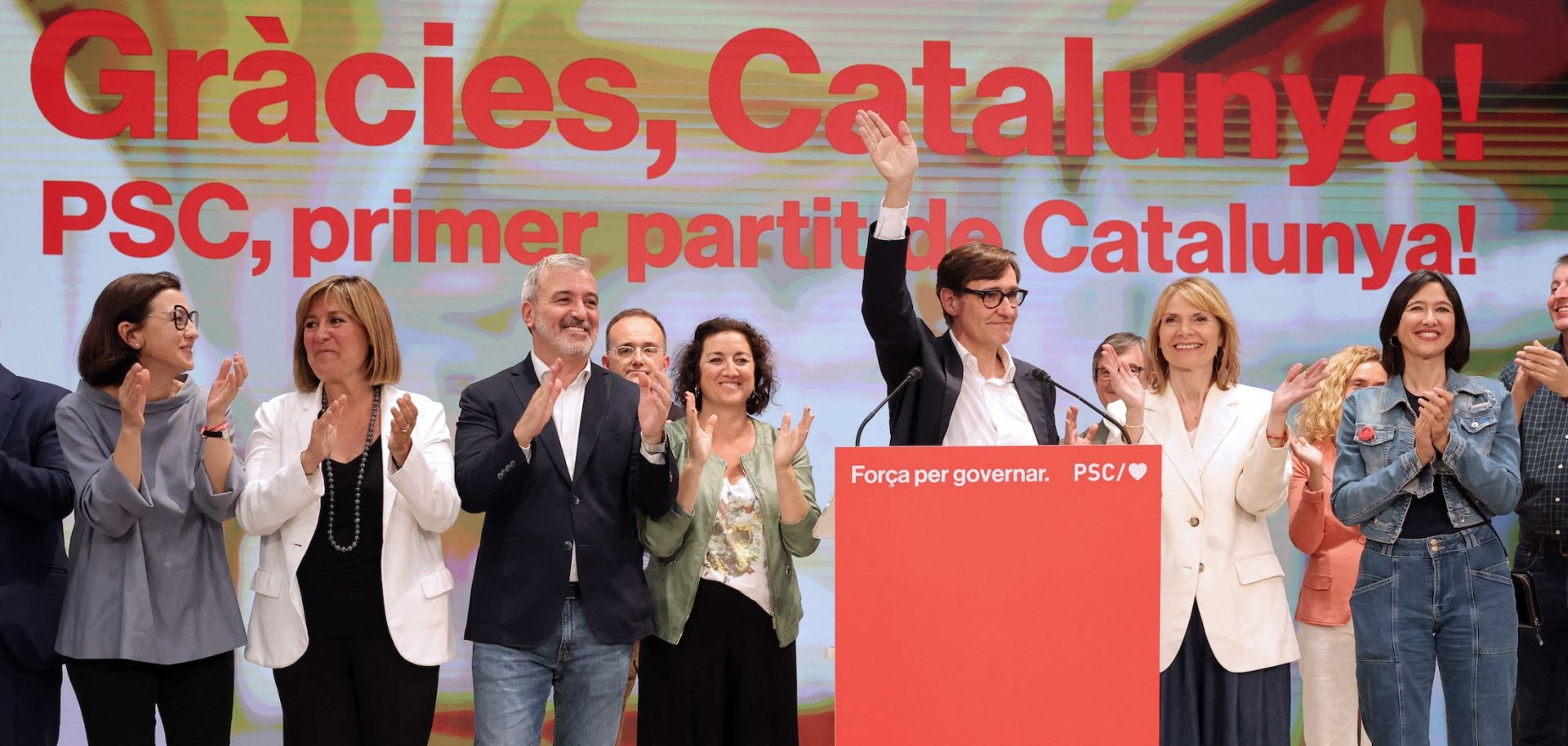
While the result of Catalonia's regional election reduces the risk of another push for independence in the short to medium term, it also increases uncertainty regarding the stability of the Spanish central government and its ability to pass legislation. The Catalan Socialist Party (or PSC, the Catalan branch of the Spanish Socialist Party) won Catalonia's regional election May 12 with 28% of the vote and 42 of the 135 seats in the regional parliament. The right-wing pro-independence Junts party came next with 21.6% and 35 seats, followed by the left-wing pro-independence Republican Left of Catalonia, or ERC, with 13.7% and 20 seats. Shortly after the election, both PSC leader Salvador Illa and Junts leader Carles Puigdemont said that they will try to form coalitions to become the region's next president, while current Catalan regional president and ERC main candidate Pere Aragones announced his resignation and exit from politics.
- PSC significantly improved its performance from the last regional election, which took place in 2021, when the party obtained 23% of the vote and 33 seats. Junts also slightly improved its performance compared to 2021, when it obtained 20.1% and 32 seats. By contrast, ERC performed considerably worse than in the last election, when it obtained 21.3% and 33 seats, which explains Aragones' decision to quit politics.
The regional election confirms that the push for Catalan independence is losing steam, which lowers the threat to Spain's territorial integrity. Total support for pro-independence parties, which along with Junts and ERC also include the far-left CUP and the far-right Catalan Alliance parties, was 43%, a decrease from 2021 when it obtained roughly 50% of the vote. This is the result of several factors, including the failed unilateral independence declaration in 2017, a significant improvement in relations between the central government and the regional government, and Catalan voters' increasing focus on issues such as housing costs and climate-related droughts, which the PSC emphasized during its campaign. This means that the risk that the region poses to Spain's territorial integrity, which peaked in the mid-2010s, is now considerably lower.
- After Socialist leader Pedro Sanchez became prime minister in mid-2018, he has made substantial efforts to improve ties with Catalonia to decrease tensions and shore up the stability of his government. In 2021, his government pardoned the Catalan politicians and activists jailed after the 2017 illegal declaration of independence. In late 2023, Sanchez transferred the Rodalies commuter train system from the Spanish state to the Catalan government and forgave some 15 billion euros (about $16 billion) in debts from the Catalan regional government to the Spanish central government. And in early 2024, the Socialist Party and its left-wing coalition allies, Sumar, together with Junts and ERC passed an amnesty law covering hundreds of Catalan politicians and activists involved in the independence movement, including Puigdemont (who fled Spain in 2017 to avoid arrest).
- In exchange for this support, Junts and ERC supported Sanchez's investiture to a new four-year term in late 2023. The Socialist Party and Sumar only control 147 of the 350 seats in Spain's Congress of Deputies, meaning they rely on support from Junts and ERC (which have seven seats each in the chamber) to pass legislation.
While a left-wing coalition in Catalonia would result in continued cordial ties between Barcelona and Madrid, it could also incentivize Junts to withdraw its support for Sanchez's government, slowing policymaking or even precipitating the collapse of the Spanish central government. Catalonia's new parliament will hold its first session in early June, and two government coalitions are possible. The first involves a coalition between PSC, ERC and the left-wing Comuns Sumar. This coalition would control 68 of the 135 seats in the regional parliament, just enough to appoint a government and pass legislation. This would result in a left-wing government with a relatively coherent agenda on issues such as taxes, welfare and climate change that seeks to maintain good ties between Barcelona and Madrid. This scenario, however, involves the ERC effectively abandoning its push for independence, something that would be hard for the party to accept. After its very weak performance May 12, ERC may decide that abandoning independence to focus on other issues may further reduce its popularity, resulting in even worse results in the next election. As a result, ERC may choose not to support PSC, blocking the formation of a left-wing government. A coalition between PSC, ERC and Comuns Sumar could also destabilize the central government in Madrid if Junts decides to withdraw its support for Sanchez. Excluded from the regional government in Catalonia and seeing ERC abandon the push for independence, Junts could seek to capitalize on an anti-Madrid stance, leaving the informal pact with Sanchez and radicalizing its pro-independence rhetoric. This would not necessarily result in the collapse of the Spanish government, but it would leave Sanchez without an effective majority in parliament. As a result, the Spanish government would struggle to pass key legislation, including a budget for 2025. In this scenario, Sanchez could decide to hold an early general election to break the stalemate in parliament.
- When Aragones announced his decision to quit politics on May 13, he also said that ERC will "move to the opposition" and will not "facilitate the investiture" of a Socialist government in Catalonia.
Alternatively, a pro-independence government would eventually result in a renewed push for an independence referendum, eventually threatening the fragile and informal pact between Junts, the ERC and Sanchez. Should ERC decide not to support the PSC, it could seek to enter a pro-independence governing coalition with Junts, CUP and Catalan Alliance. With the exception of their common push for independence, this coalition would be ideologically heterogeneous, as it would include both the far-left CUP and the far-right Catalan Alliance, both of which have said they would not cooperate with each other. As a result, this government would be at constant risk of collapse. Moreover, it would only control 61 seats, which means that it would not win a first vote of investiture, which requires at least 68 votes. It would then need the PSC to abstain from a second vote of investiture, where only more votes in favor than against are needed to appoint a government. The PSC would be reluctant to abstain and so help the formation of a pro-independence government considering that it does not support independence and actually won the election and so feels it should lead the new Catalan government. The odds of a pro-independence government will increase if the PSC agrees not to try and form a Catalan government in exchange for agreement from Junts and ERC to continue supporting Sanchez's government in Madrid. While such a broader deal would temporarily extend the current pact between Sanchez, Junts and ERC, a pro-independence government in Catalonia would sooner or later lead to new confrontations between Madrid and Barcelona because of a renewed push for a legally binding independence referendum. While ERC and Junts both support Sanchez in the Spanish parliament, they have not given up on the idea of an independence referendum, which means that the topic would reemerge and create friction between Madrid and Barcelona.
- Because of the complexities connected to the formation of a Catalan government, another election is possible if the parties fail to form a coalition by mid-August. This election would take place by early to mid-October.
