
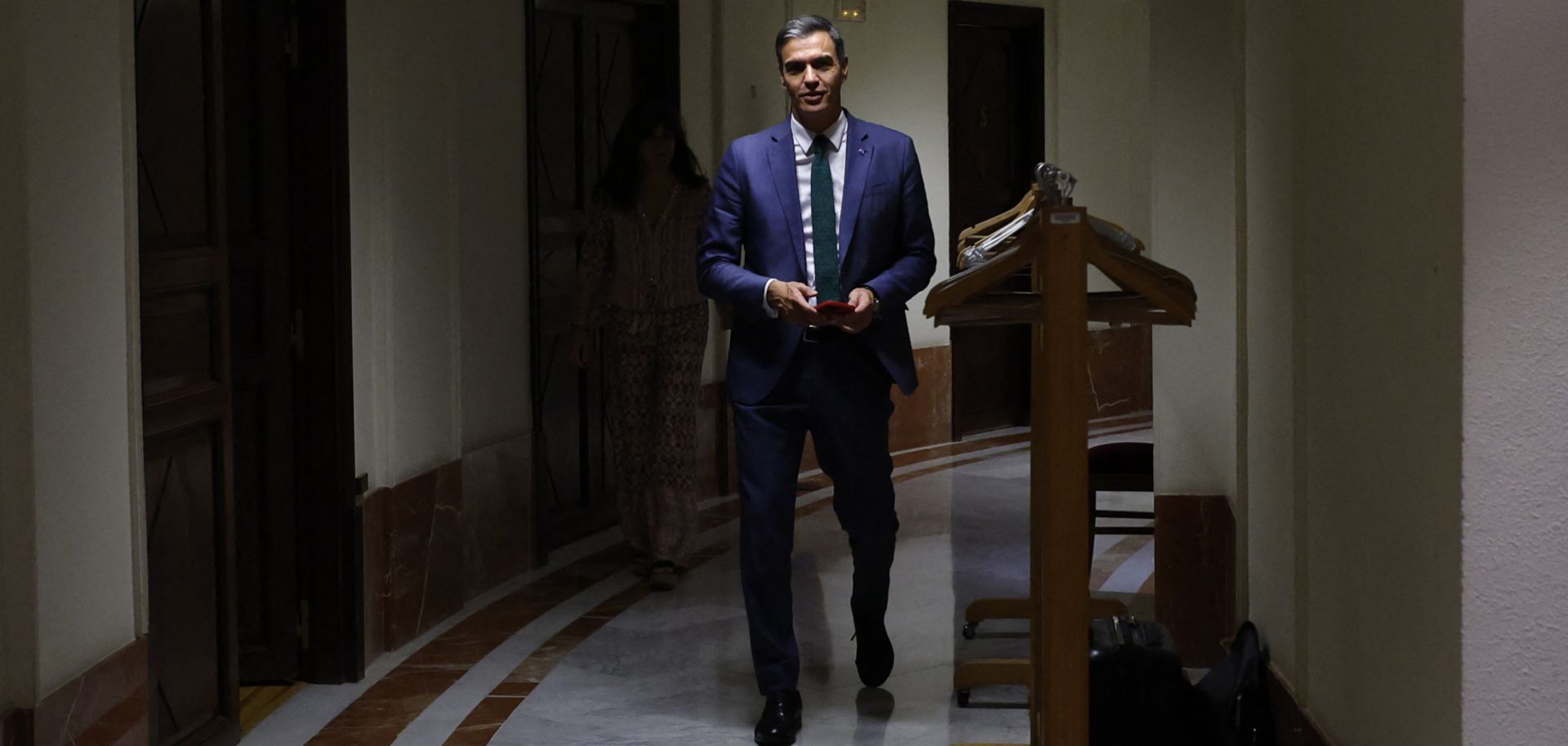
In Spain, Prime Minister Pedro Sanchez's re-appointment would end months of political uncertainty and result in policy continuity, along with cordial ties between the central government and Catalonia. But this would come at the cost of deeper political polarization and a right-wing backlash in future elections. On Sept. 27, Spain's Congress of Deputies voted against appointing conservative leader Alberto Nunez Feijoo as prime minister, with 178 votes against and 172 votes in favor. A second investiture vote will take place on Sept. 29, but a similar outcome is likely because Feijoo will probably not obtain the support he needs to win it. Notably, the Sept. 27 vote has triggered a 60-day period to appoint a prime minister, or else a general election must take place in January. Acting socialist Prime Minister Pedro Sanchez will seek re-election in a new investiture vote in the coming weeks. In the likely case that the same number of lawmakers who voted against Feijoo support Sanchez, he will be re-appointed. The acting prime minister is already in negotiations with lawmakers from smaller political parties to secure a victory.
- Spain held a general election on July 23. Feijoo's People's Party (PP) obtained 137 seats in the Congress of Deputies, followed by Sanchez's Socialist Party (PSOE) with 121 seats. The right-wing Vox party obtained 33 seats, while the left-wing Sumar obtained 31 votes.
- On Aug. 23, Spanish King Felipe VI formally asked Feijoo to try to form a government. While Vox and two small parties promised to support Feijoo, political parties from Catalonia and the Basque Country said they would not support a nationalist government in Spain. This configuration of forces was confirmed in the Sept. 27 vote.
- Sanchez is currently holding informal negotiations with Catalan and Basque parties to secure his victory in a vote of investiture. Negotiations are particularly complex with the pro-independence Together for Catalonia (JxC) party, led by former Catalan president Carles Puigdemont. Puigdemont fled Spain to avoid arrest following the illegal declaration of Catalan independence in 2017 and currently resides in Belgium.
- In exchange for supporting Sanchez, Puigdemont demands an amnesty for the Catalan politicians and activists who were criminally charged for their involvement in the 2017 events. Sanchez already pardoned nine jailed Catalan leaders in 2021 (meaning that their crimes were forgiven), but Puigdemont now demands an amnesty (which means that the crimes are abolished, the involved individuals can run for office again and, in Puigdemont's case, he can return to Spain without the risk of being arrested). Puigdemont is also demanding a legally binding independence referendum in Catalonia. The pro-independence Republican Left of Catalonia (ERC) party supports JxC's demands.
To secure another term, Sanchez will likely offer an amnesty for Catalan leaders, but a legally binding independence referendum is unlikely. While both of JxC's demands are controversial, an amnesty law is legally easier to pass than an independence referendum. Should Sanchez reach a majority in the Congress of Deputies to be re-appointed by the end of the year, that same majority could approve an amnesty law in the early weeks of the new government. This would still be problematic for Sanchez because some members of his own party are against amnesty, which means the vote could be very tight, but strict party discipline suggests it will still pass. A legally binding referendum would be considerably more difficult to approve because it would almost certainly require a reform of Spain's constitution (which explicitly protects Spain's territorial integrity). A constitutional reform requires a three-fifths majority in the Congress of Deputies, which is impossible without PP's support. This means that a pact between Sanchez and Puigdemont will likely include an amnesty and some additional concessions to Catalonia (such as extra financing for the region), but probably not an independence referendum (though Sanchez may make vague promises to look for alternatives in the future).
- On Sept. 13, the president of the Castilla–La Mancha region and prominent PSOE member Emiliano García-Page said that PSOE should not grant amnesty to the Catalan leadership. Other lower-ranking members of the party have expressed similar views in recent weeks. If the Congress of Deputies fails to pass the amnesty law because some PSOE members vote against it, the new Sanchez government could collapse only weeks after its appointment.
A pact between PSOE and JxC would end political uncertainty and generate policy continuity, but it would come at the price of an increasingly polarized country and a more hawkish right that organizes disruptive protests. If Sanchez is re-appointed thanks to a pact with Puigdemont, the results would be a mixed bag for Spain's political risk. On the one hand, Sanchez's re-appointment would end the period of political uncertainty that started in May, when he announced an early general election after his party's weak performance in regional and municipal elections. Another Sanchez term would portend continuity in the left-wing policies that began when he first took office in June 2018, including high taxes and generous welfare spending and constructive ties with the European Union. Madrid's ties with Barcelona would also remain cordial. Sanchez's pardons in 2021 and the likely eventual amnesty in late 2023 or early 2024 would continue to prevent an escalation of Catalonia's push for unilateral independence, providing political and policy continuity in the often restless region. However, another Sanchez term that happens because of a pact with Catalan secessionists would spur protests among conservative and right-wing voters. While widespread violence is highly unlikely, such demonstrations would be disruptive in the areas they take place. More importantly, granting amnesty to Catalan secessionists would prolong, or even deepen, Spain's political polarization and result in the PP and Vox (and most of their electorate) moving further to the right. This could help both parties perform strongly in the June 2024 elections for the European Parliament, contributing to the European Union's broader nationalist turn.
- On Sept. 24, between 40,000 and 60,000 people protested in Madrid against reports that Sanchez could offer amnesty to Catalan separatists. Prominent PP leaders, including Feijoo and former Prime Ministers Mariano Rajoy and Jose Maria Aznar, participated in the demonstration.
- According to media reports, in addition to their political and legal demands JxC and ERC are asking Sanchez for a reduction of Catalonia's fiscal contributions to the Spanish state, greater control of taxes, and the total transfer of control over regional railways and the Barcelona airport. While Sanchez is unlikely to concede in all of these areas, financial and fiscal concessions are likely to convince JxC and ERC to support another Sanchez government even in the absence of a legally binding independence referendum.
