
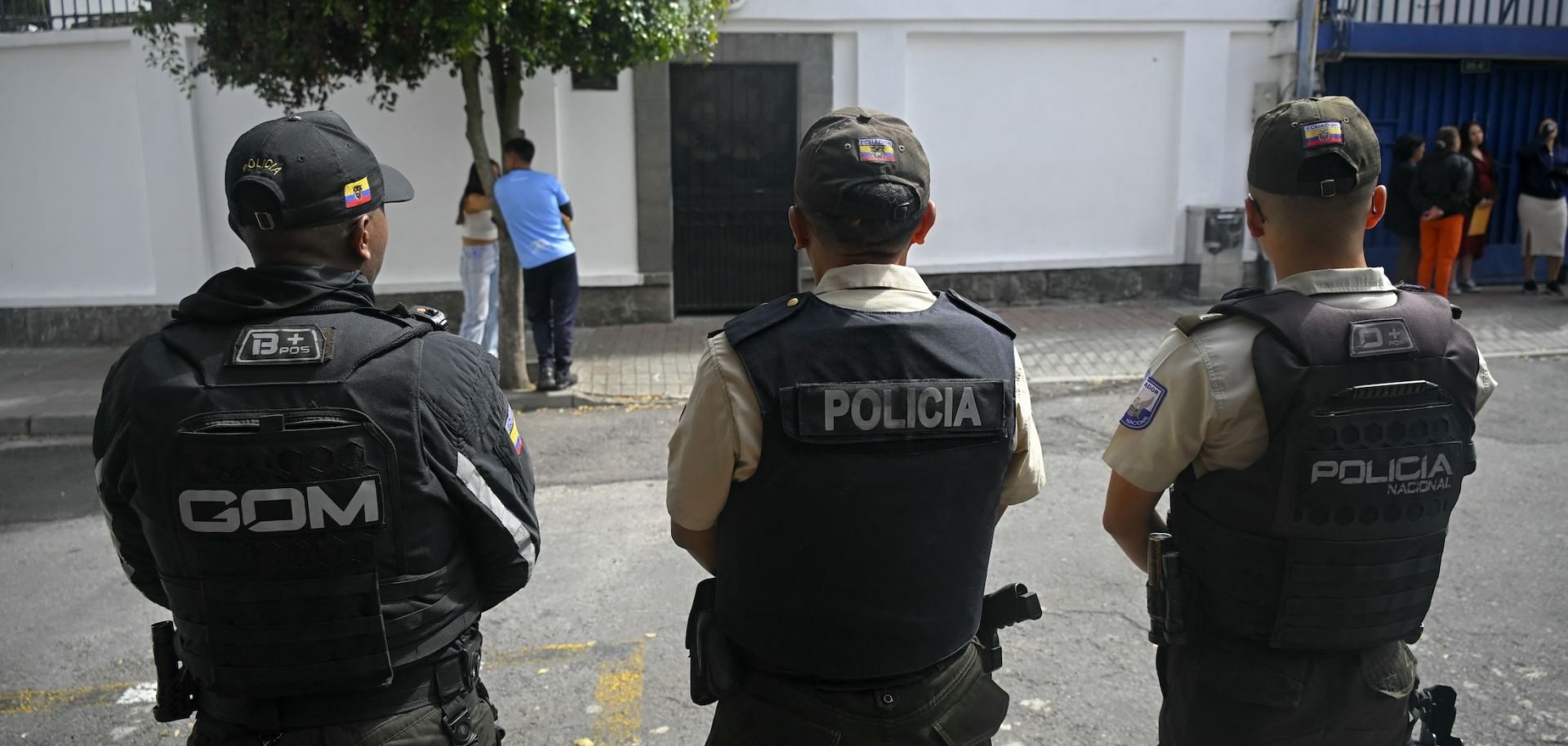
Ecuador's raid on the Mexican embassy will increase tensions between the two countries, harm Ecuador's international reputation, create domestic political instability, increase policy uncertainty, and further destabilize Ecuador's security situation. Late in the evening on April 5, Ecuadorian police officers and military members raided the Mexican embassy in the capital Quito and arrested former Ecuadorian Vice President Jorge Glas, who had taken refuge in the embassy since December to avoid arrest after being indicted on corruption charges. The raid occurred hours after the Mexican government under President Andres Manuel Lopez Obrador formally granted Glas asylum and requested that the Ecuadorian government give him safe passage to leave the country. According to Ecuador's foreign ministry, Ecuadorian President Daniel Noboa justified the raid by claiming that Glas was an ''imminent flight risk,'' and also argued that it was not legal to grant asylum to people convicted of crimes. In response to the raid, the Mexican government announced an immediate break of diplomatic relations with Ecuador, and Mexican embassy staff returned to Mexico on April 7. Mexico's Minister of Foreign Affairs said the government plans to file a complaint with the International Court of Justice over the raid. The European Union, along with countries in South America and elsewhere — including the United States, the United Kingdom, Argentina, Colombia and Honduras — condemned the raid. The U.S. State Department also condemned the violation of the 1961 Vienna Convention on Diplomatic Relations and called on both countries to resolve the dispute.
- Jorge Glas served as vice president to former Ecuadorian President Rafael Correa from 2013 to 2017. In 2017, he was found guilty of receiving over $13.5 million in bribes. In 2020, he was also found guilty of accepting money in exchange for issuing public contracts, in a case that also included the conviction of Correa. The current charges are over alleged irregularities in Glas' management of reconstruction efforts following Ecuador's deadly 2016 earthquake.
- Following Glas' arrest, authorities relocated him to the Attorney General's office, then moved him to a maximum security prison in the port city of Guayaquil. Glas' attorney reported that Ecuadorian police forces beat Glas during the arrest to the point that he was unable to walk.
- Nicaragua announced its decision to sever ''all diplomatic relations'' with Ecuador on April 6 over the raid, and is so far the only country other than Mexico to have done so.
- Despite Noboa's justification that Glas was a wanted criminal, the raid represented a significant violation of international norms, enshrined in the Vienna Convention on Diplomatic Relations (to which almost every country in the world, including Ecuador, is a party) that states ''The authorities of the receiving State shall not enter that part of the consular premises'' without the consent of the head of the consular post. This agreement secures governments' ability to effectively operate diplomatic missions, so any violation of it is a violation of international norms, triggering an outcry.
Noboa likely hoped the raid would increase his popularity ahead of Ecuador's 2025 presidential election by showing his government's commitment to combating corruption, but the move was likely a miscalculation and is already imperiling key domestic political alliances and diplomatic relations. The raid followed an increase in tensions between Mexico and Ecuador after Mexican President Lopez Obrador criticized the way Ecuador's 2023 snap elections were conducted, which led Noboa to declare the Mexican ambassador ''persona non grata'' on April 4. The raid, however, was still an unexpected move from the Noboa administration, which has largely focused on improving Ecuador's economic situation, combatting extreme gang violence and stamping out government corruption since taking office in November 2023. As part of Naboa's anti-graft crackdown, dozens of government officials have been arrested on corruption charges since December. Given that Glas was wanted on corruption charges and had already been convicted of graft, Noboa likely calculated that the operation would be politically beneficial by demonstrating his government's commitment to anti-corruption efforts and subsequently bolstering his popularity ahead of Ecuador's regularly scheduled elections in early 2025. Somewhat confirming this, much of the Ecuadorian public appears to approve of the raid, according to pollster Alvaro Merchante. However, others have opposed the move, including members of Correa's left-wing Citizen Revolution Movement (RC) party. With 51 of 137 lawmakers in the unicameral National Assembly, the largest cohort in Congress, the RC party had aligned itself with Noboa's center-right government since November, giving the government a majority of 85 seats in the assembly and the ability to pass legislation to address Ecuador's compounding economic and security crises. However, after the raid, the RC party declared itself in open opposition to the government, and demanded that the president resign. The RC's departure from the coalition has left Noboa without a majority in the National Assembly.
- Successive governments in Ecuador have pursued anti-corruption campaigns, which leaders attribute as one of the causes of the growing problem of criminal violence in the country. Former President Correa has faced charges over alleged corruption and other crimes and, despite remaining widely popular in Ecuador, he is currently living abroad in exile.
- During an interview with France24 on Apr. 6, Correa called the raid an ''invasion'' and ''a cause for war'' and said that Glas was being ''politically persecuted.'' High-ranking RC party member Luisa Gonzalez, who lost to Noboa in the second round of last year's snap presidential election, called on Noboa to resign.
- Raids on embassies by host governments are extremely rare, with the majority of attacks on diplomatic facilities conducted by non-state groups or other governments. Even in instances of wanted criminals claiming asylum in embassies, host governments tend not to enter embassies without permission and arrest them, which would violate international norms. Demonstrating this, Julian Assange took refuge in the Ecuadorian embassy in the United Kingdom for years before Ecuador allowed U.K. officials to enter the facility and arrest him. Elsewhere in Latin America, the Nicaraguan embassy in Panama is currently providing former Panamanian President Ricardo Martinelli asylum while he is facing corruption charges in his home country.
Tensions between Mexico and Ecuador will persist in the coming months and potentially longer, undermining trade and cooperation on migration and crime. Despite the significant violation of international norms, governments are unlikely to take notable action to punish Ecuador for raiding the embassy. Economic sanctions, for example, would only risk further destabilizing Ecuador's already poor economic and security situation — creating spillover threats to neighboring countries, while leaving Ecuador in greater need of external support from the United States and other nations. However, without significant international pressure, Noboa is unlikely to back down on the decision to arrest Glas. And Mexican President Lopez Obrador is also unlikely to resume his country's diplomatic relations with Ecuador, which would prove politically problematic ahead of Mexico's June 2 general elections, as opposition groups could criticize him for being weak in response to the violation of Mexican sovereignty. Mexico-Ecuador relations are thus poised to remain tense for at least the next few months, if not longer. While such tensions may hinder bilateral trade, this is only a minor concern as the two countries are not major trading partners. The greater risk will instead stem from potential disruptions to collaboration on regional migration and organized crime. Reduced communication between the Ecuadorian and Mexican governments, for example, could make it more difficult to combat criminal activity in Ecuador, where Mexican cartel involvement in the country's gang war remains a major driver of insecurity.
The domestic political fallout could also challenge President Noboa's ability to govern and hurt Ecuador's attractiveness to foreign businesses. Politically, the RC party's move to join the opposition will risk returning Ecuador to the political instability experienced under former President Guillermo Lasso (2021-2023), who faced multiple impeachment attempts and under whom the government was unable to pass legislation to respond to worsening economic and security conditions. Noboa may similarly struggle to pass legislation with the loss of his majority in the National Assembly, leading to governing challenges. Opposition parties may even attempt to impeach Noboa, and such a rallying cry would likely only gain traction if the international community moves to punish Ecuador for the raid. In addition, increased political instability will hinder Ecuador's ability to attract international investment and cast doubt on the government's ability to follow through on its promised policies, hurting the country's business operating environment. On the other hand, Glas' arrest could bolster support for Noboa among his base ahead of regularly scheduled general elections in early 2025, during which he is expected to run for another term. The outcome of Ecuador's April 21 constitutional referendum, which includes economic reforms and measures aimed at expanding the government's ability to combat organized crime, will serve as a potential indicator of the raid's effects on Noboa's popularity. Many of the measures are believed to be popular, but if a significant portion of the motions fail to pass, it would demonstrate broader opposition to the Noboa government.
- Ecuador's president is elected by popular vote, and can only be removed through impeachment. To launch an impeachment attempt against an Ecuadorian president, a third of the National Assembly needs to request the impeachment process, with a ruling of admissibility required by the Constitutional Court. Following the ruling, at least two-thirds of the legislature — 92 of the National Assembly's 137 lawmakers — must vote to impeach the president. The RC party's control of 51 seats in the National Assembly gives it enough votes to launch the impeachment process alone, but additional parties' support would be needed to actually remove Noboa from office.
