
A multitude of financial and technical barriers will keep the European Union from building a self-reliant semiconductor industry, but the bloc's attempts to realize that vision will nonetheless help bolster Europe's resilience against supply shocks in case a crisis in Asia takes Taiwan's chips offline. On July 25, the European Council approved the European Chips Act, paving the way for 43 billion euros ($47.5 billion) in subsidies aimed at helping the European Union achieve its goal of producing 20% of the world's semiconductors by 2030 (up from 10% in 2020). As a part of these plans, Germany's economy ministry announced on July 25 that it would provide about 20 billion euros ($22 billion) in aid by 2027 in an effort to boost the country's semiconductor industry and the production of chips. The announcement comes after Berlin inked an agreement with U.S. chipmaking giant Intel in June that will see the company invest 30 billion euros ($33 billion) into leading node fabs in Magdeburg. As a part of the deal, Germany will provide more than 10 billion euros ($11 billion) in subsidies — nearly double what Berlin had originally offered Intel.
The European Chips Act aims to boost Europe's resilience and strategic autonomy in the semiconductor industry as global competition over the sector intensifies and European leaders try to find ways to insulate the Continent from another potential chip shortage. Without an increase in public support, the European Union's already small share of semiconductor manufacturing was poised to continue shrinking due to China's efforts to expand its own share of the market, along with U.S. efforts to court companies to build new fabrication plants in the United States. In recent years, European countries' reliance on U.S. technology has also left the Continent's limited semiconductor industry highly exposed to U.S. sanctions and export controls aimed at curbing China's technological rise, creating a strategic liability as the U.S.-China rivalry heats up. In October, for example, Washington imposed restrictions that effectively forced the Netherlands' ASML to stop exporting some of its most advanced chipmaking machines to China due to the amount of U.S. technology used in those machines. Additionally, the pandemic-induced global semiconductor shortage in 2020-22 hit the European Union particularly hard, as the chips used in cars and industrial applications were among the most affected. The chip shortages quickly reverberated through the bloc's manufacturing and automotive industries, forcing a number of European carmakers to reduce production levels as they struggled to find enough chips to power the various computers in their vehicles. Finally, the energy transition and the growth of AI will only make semiconductors more important in the future, exposing the European Union's limited domestic industry even further. The automotive industry itself will become increasingly computerized thanks to higher levels of AI driver assistance and the expanded production of electric vehicles, which typically have 2-3 times the number of semiconductors chips compared with fossil fuel vehicles.
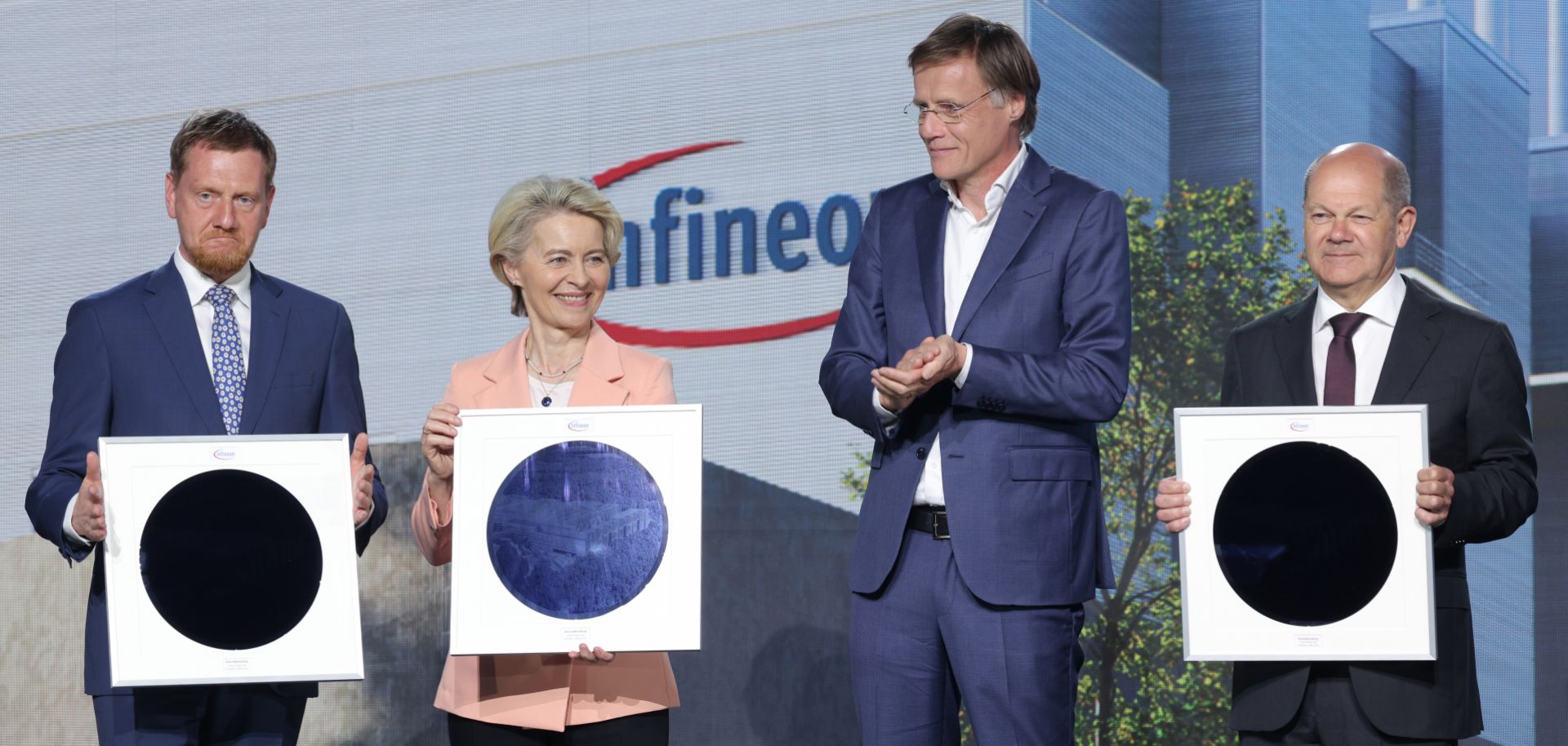
The new plan comes as Europe's chip industry is seeing a surge in investor interest. Intel has said that its investment over the lifetime of the new fabrication plants it's building in Germany could top $100 billion. In June, Intel also announced plans to invest 4.6 billion euros ($5 billion) to build a semiconductor assembly and testing plant in western Poland, which would presumably handle many of the semiconductors produced at its fabs in Germany (along with Intel's plant in Ireland). Other chipmakers have recently announced plans to boost production in Europe as well. In February, Wolfspeed announced it would build a new facility in Saarland, Germany, focused on manufacturing silicon carbide semiconductors, which are often used in power management chips. In May, German chipmaker Infineon — which primarily manufactures industrial- and automotive-focused semiconductors — broke ground on a new 5 billion euro ($5.5 billion) fab in Dresden. In June, GlobalFoundries and STMicroelectronics finalized an agreement to build a new manufacturing facility in France that will see 7.5 billion euros ($8.3 billion) worth of investment. Together, this wave of new semiconductor projects fits perfectly into the EU Chips Act target of boosting investment into first-of-its-kind chipmaking capacity.
- Intel is planning to equip its new fabrication plants in Magdeburg with its cutting-edge "Angstrom-era" technology — a term Intel uses to describe advanced chip manufacturing processes as the node size continues to decline and chip measurements are described in angstroms rather than nanometers (nm).
- Chipmaking giant Taiwan Semiconductor Manufacturing Co. (TSMC) has also been negotiating with NXP Semiconductors Infineon and Robert Bosch GmbH on a potential $7 to $10 billion facility in Germany. Thus far, TSMC has said that no decision will be made until a board of directors meeting in August, but if it moves forward with building a project in Germany, the Taiwanese chipmaker is expected to receive some of the support that Germany announced on July 25.
But in attracting these semiconductor projects, Europe is also competing with many other territories, which could impede the Continent's ability to secure the massive amount of investments needed to achieve its goals. According to forecasts published by McKinsey & Company and other consultancies, the global semiconductor industry is expected to reach $1 trillion by 2030, with an annual growth rate of around 7%. In order for the European Union to hit its goal of doubling its share of global semiconductor production capacity by 2030, this means the bloc has less than seven years to roughly triple its global semiconductor production capacity in absolute terms. While the new Intel, Infineon, GlobalFoundries, Wolfspeed and STMicroelectronics plants are all multi-billion investments, this is just a drop in the bucket in the amount of capital spending seen in the industry. Last year, the Dutch chip design company NXP Semiconductors warned that reaching the European Union's target of producing 20% of the world's chips by 2030 would require 500 billion euros ($550 billion) worth of investments, which would likely require more state support than the 43 billion euros ($47.5 billion) in subsidies outlined in the European Chips Act. Further complicating matters is the fact that the European Union is far from the only player pouring billions of dollars into its chip industry. The United States, Japan, South Korea and Taiwan have all also announced their own mechanisms to boost their semiconductor sectors. The United States, in particular, enacted its own CHIPS and Science Act last year that includes $52 billion in subsidies for the chips industry, which Washington hopes will unlock $400 billion worth of investments overall by incentivizing more firms to manufacture semiconductors in the United States. But even before introducing these subsidies, the United States had been more successful than Europe in getting companies to invest in fabrication plants within its borders, with TMSC currently constructing two fabs in Arizona, Samsung building a new fab in Texas, and Intel announcing plans in 2022 to build a potential $100 billion mega-site in Ohio (on top of numerous similar announcements from companies like Wolfspeed, Micron, Texas Instruments and GlobalFoundries in recent years).
- TSMC is already constructing one advanced fab in Japan and is considering building another in the country as well.
Europe also faces a number of constraints that may make it a less attractive destination for semiconductor investments. Critics of the European Chips Act question whether boosting investment into first-of-its-kind or leading node technologies is the best use of Europe's resources. For one, investments in high-end chips — which are often used in applications like AI and advanced computing devices (such as smartphones, PCs, GPUs and CPUs) — require significant capital expenditures, which has fueled questions about funding limitations in reaching Brussels' ambitious goals. The European Union's focus on boosting its production of advanced chips — for which there is relatively little demand by European chip design companies or device makers — has also cast doubt on the overall strategy behind Brussels' plan. Many of the world's leading chip design companies, particularly for leading node chips, are in the United States or Asia; Asia is also home to virtually all of the companies that put finished chips into electronic devices are in Asia. This means Europe does not have a large chip design industry where juggernauts are placing massive orders with contractors (like TSMC) to build high-end semiconductors, nor does it have a large base of consumers seeking to put those kinds of chips into devices. Given this reality, critics have argued that the European Union should focus more on securing more investment for power management, automotive chips and other chips that are more consistent with Europe's needs. European carmakers, for example, are increasingly using highly advanced chips in their vehicles, which could help fuel the development of Europe's AI industry. But it's unclear whether the Continent's AI sector will become competitive with the United States, which comparatively has much laxer restrictions when it comes to AI development. In addition to these issues, the EU suffers several other significant constraints in securing the level of investment needed to fulfill its chip ambitions:
- Lack of skilled labor: One of the most significant challenges that Europe will face is securing the talent necessary to expand its semiconductor industry. To address this skills shortage, the European Chips Act aims to increase investment and support for training programs and universities. But engineers and technicians, which are needed in the industry, are among the largest areas that the European Labor Authority says there is a shortage of in the bloc. Even in the United States, TSMC has repeatedly complained about skilled worker shortages affecting the construction of its $40 billion fab in Arizona; on July 20, the Taiwanese chipmaker said the shortages had forced it to delay the start of production at the plant to 2025, and that it planned to start sending engineers to the United States to help train workers.
- Lack of full supply chain investment: The semiconductor industry is heavily globalized, with a high degree of specialization and many different components produced by companies around the world. These components include precursor materials (like specialized chipmaking tools), design software, chip design, special chemicals, chip-testing equipment, packaging technologies, silicon (and other material wafer production), etching equipment and photoresists. Europe has a presence in several of these areas, including through Dutch firm ASML's dominance in chipmaking equipment and the German firm BASF's extensive production of chipmaking chemicals. But the European Chips Act is primarily focused on providing public support for fabs, not the entire supply chain, which would be nearly impossible to uproot given the high degree of specialization. This may make it more difficult for fabs that are constructed in Europe to remain competitive and avoid sourcing challenges for materials traditionally supplied to North America or Asia. Many of the semiconductors made in European fabs may also ultimately be shipped to Asia before being sold to end consumers, like people buying smartphones or electronics devices, or even installed in industrial plants or automobiles.
- Water, energy and environmental challenges: The semiconductor industry is also likely to face energy, environmental, water and permitting challenges in Europe. Electricity can cost up to 30% of a fab's operating costs. And although the intensity of Europe's energy crisis has eased since peaking last year, electricity prices across the Continent will likely remain structurally higher than they otherwise would have been before Ukraine-related disruptions to Russian gas supplies forced Europe to start purchasing much more expensive LNG. This will increase the operational costs of maintaining a fab in Europe. Moreover, a fab uses millions of gallons of water a day to maintain its operations. For companies operating these plants, this need for water can increase the cost of doing business — both from a financial and reputational standpoint — as European countries often have vibrant environmental groups, as well as higher water and other permitting costs compared with most other places vying for semiconductor investments (such as the United States and Malaysia).
- An ambitious timeline: The European Union's 2030 goal is also extremely ambitious as the semiconductor industry plans in long-term investment cycles. Constructing a state-of-the-art fab usually takes 3-5 years, and even then, ramping up production can take months. Moreover, chip designers and fabs often also work on a 2-3 year cycle of a certain generation of technology. This means that right now, companies are designing or already rolling out initial production for chips that will go into mass production in 2026 or 2027. The European Union's 2030 goal is thus really only one or two chip generations away, a fast time horizon in the industry.
Given these myriad constraints and challenges, the European Chips Act will likely fail to create a self-sufficient semiconductor industry. The need to source technology or materials from North America or Asia will keep Europe's semiconductor industry highly connected to the rest of the world, even if the European Union somehow fully realizes its 2030 production target. This means that if a crisis (like a potential conflict over Taiwan) creates another semiconductor shortage, the impact on Europe would remain large. Moreover, many semiconductors are designed to spec with a high degree of specialization, which means that if a disruption occurred in Taiwan, European chipmakers would not be able to quickly start building the same chips that had their production disrupted. There is often also little interchangeability of logic chips, such as those that Intel will be building. Beyond boosting semiconductor production capacity, the European Chips Act does include emergency measures in case of a supply shortage, such as joint procurement and stockpiling. But even those measures may not be enough to offer more than limited resilience. This is because semiconductors are made to certain specifications, which makes it difficult to stockpile logic chips and jointly procure them. Europe will thus largely remain beholden to the global trends of the semiconductor industry, barring a massively larger and more costly program that dwarfs the current European Chips Act and plays out over a longer period of time (which is unlikely due to the financial and political barriers to such a program). In addition, Europe's strategic autonomy from the United States will also see only marginal improvement under the Chips Act, since many European companies are co-developing technology with U.S. companies, which will leave them exposed to U.S. export controls and sanctions.
But if there's a conflict in Taiwan, Europe's efforts to boost its chipmaking capacity could nonetheless help mitigate the massive supply shocks. The global semiconductor industry is highly dependent on Taiwan, which is home to TSMC — the world's largest and most advanced contract chipmaker to which there is no alternative. The West is coming to terms with the stark reality that this reliance is a major liability should Beijing move to invade the island. Reunification could either result in a conflict damaging Taiwan's fabs, disrupting the global economy, or giving China control of them. This is why the European Union's investments cannot be viewed in isolation, as while the rest of the world's push to boost semiconductor investment will make it more difficult for Europe to achieve its ambitions, the greater global push for production capacity will more rapidly reduce Taiwan's role in the industry, even if that process takes decades.
