
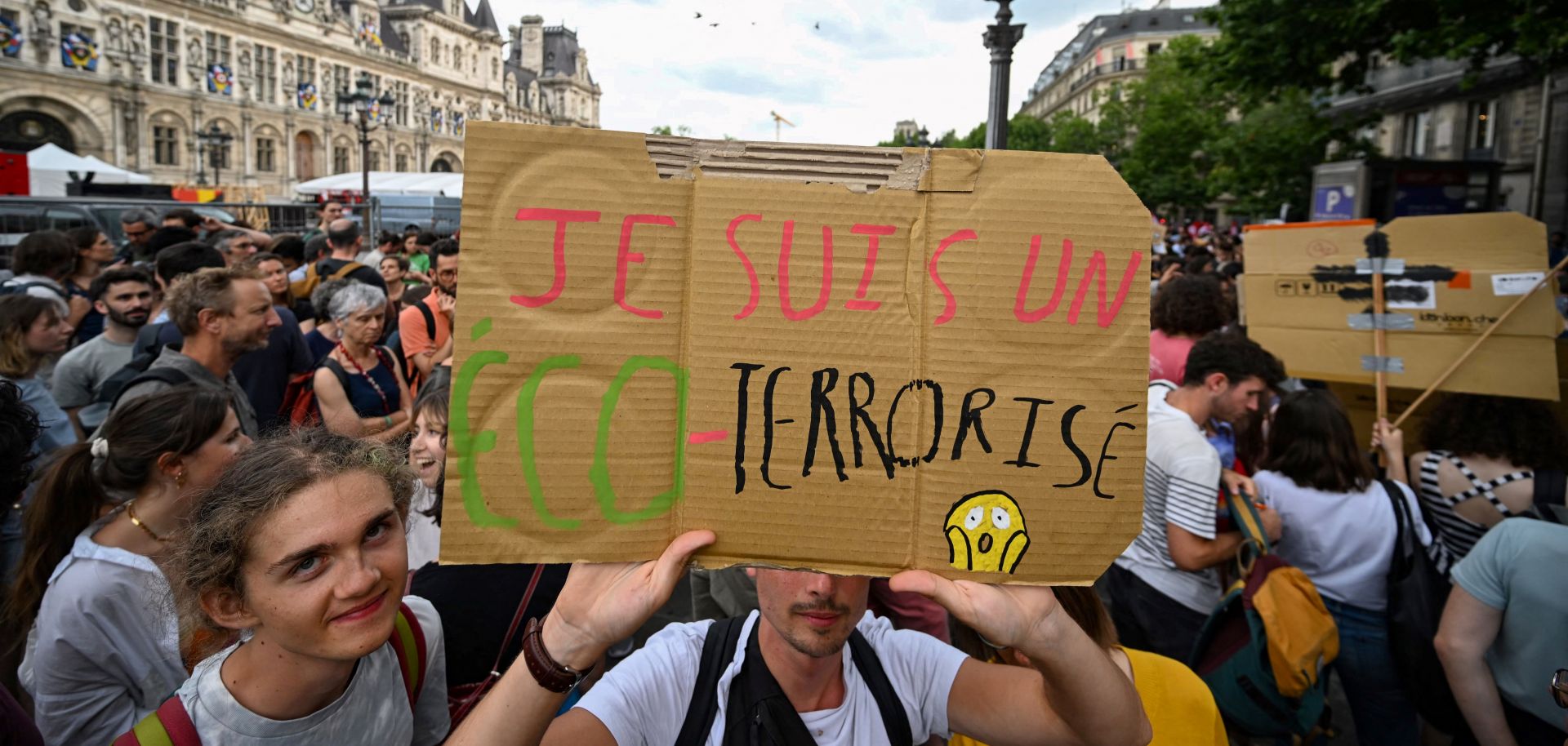
Climate activists are well-known for their attention-grabbing activities, ranging from blocking traffic on major roadways to throwing paint at famous works of art. While these protests may disrupt daily life and shock the public, they have largely been peaceful since the turn of the 21st century. Recently, however, authorities across Europe have begun to crack down on what they see as increasing trends toward violence. Among other moves, France issued a decree on June 21 banning Les Soulevements de la Terre (Uprisings of the Earth), a group whose acts of civil disobedience have regularly left scores of participants (and police officers) injured. Additionally, Germany's security services recently warned that extremists are infiltrating the mainstream climate activist movement. While these developments do not mean that a wave of environmental extremist attacks is imminent, they do suggest the emerging contours of a new eco-terrorist threat.
What Is Old Is New Again
The concept of eco-terrorism dates back to the 1970s, 1980s and 1990s when decentralized groups like Earth First!, the Earth Liberation Front and the Animal Liberation Front (whose members had significant overlap with the radical environmental movement) conducted a wave of attacks across the West in response to what they saw as environmental degradation. Using tactics like arson, sabotage and even bombings, members of these groups (as well as individuals acting independently) led an unstructured movement that during this time period was the FBI's top domestic extremist threat — even though the violence was directed at property, not people.
But eco-terrorism rapidly declined in the early 2000s, the product of a major law enforcement crackdown (with authorities using new powers gained in the wake of the 9/11 attacks) and a failure to generate significant public support compared with the mainstream environmental movement. Since then, there has been sporadic news coverage of eco-terrorist plots — often targeting oil and gas infrastructure like pipelines — but the vast majority have either been disrupted or failed to cause any meaningful damage. By contrast, peaceful climate activism has dramatically expanded in participation and influence in the West, bolstered by greater public awareness of the quickening pace and harmful impacts of climate change. In this environment, groups like Extinction Rebellion and Just Stop Oil — which have attracted significant attention for their disruptive, but largely peaceful, protests centered in the United Kingdom — have grown in prominence.
Revolution Over Evolution
As with all protest movements, however, there is always a subset of people who view peaceful activism as too timid and believe that more aggressive action is necessary. For these radicals — be they Islamists, anarchists or, in this case, environmental extremists — incremental change is not enough; instead, a larger and faster transformation is the goal. While such people do not always automatically resort to bombs and other weapons, the belief that a situation is untenable enough to merit combative action often leads to violence. In fact, in part inspired by the book and now movie "How to Blow Up a Pipeline," some environmental extremists already consider violence to be an act of self-defense.
The drivers of politically-motivated violence, already seen on the margins of contemporary environmental activism, will only grow in the coming years as the harmful impacts of climate change become more apparent and the world fails to hit major emissions reduction targets. In this respect, the year 2030 may be a turning point. To keep global warming from rising by no more than 1.5 degrees Celsius, the landmark 2015 Paris Agreement calls for the world to cut emissions by 43% by 2030 in order to reach net-zero emissions by mid-century — and almost all countries (as well as most private companies) have set intermediate targets for their emissions reductions plans around that year. Nonetheless, monitoring groups are growing increasingly pessimistic about the world's odds of coming anywhere close to achieving that goal, and a steady stream of scientific evidence suggests that the deleterious impacts and severity of climate change will become ever more evident by 2030. In fact, projections suggest that the planet will likely break the 1.5 degrees Celsius threshold at some point later this decade, meaning a turning point could come even sooner.
In the meantime, the pace of climate change overall and specific extreme weather events could push some already aggressive activists toward a belief that violence is necessary. While it remains challenging to conclusively blame an individual event like a hurricane or wildfire on climate change, the scientific community is clear in its assessment that both the frequency and intensity of extreme weather events overall will increase as climate change accelerates. Moreover, analytic methodologies are quickly improving and enabling the growing field of attribution science to make stronger assessments about the likelihood that climate change plays a role in extreme weather events. For instance, researchers assessed that climate change increased the likelihood and intensity of the 2022 flooding in Pakistan that killed at least 1,700 people — an event that is otherwise hard to evaluate because seasonal monsoon rains vary significantly from year to year.
Similar determinations about high-profile events, such as major droughts, heatwaves or floods, in Western countries where climate activism is already concentrated could convince some activists to escalate their protests by becoming violent. While a single extreme weather event is unlikely to be the catalyst that pushes otherwise peaceful activists to immediately take up violence, one can imagine how, over time, breaking the 1.5 degrees Celsius threshold and a succession of major climate-related disasters — especially those that lead to deaths — may convince already committed campaigners of the need for radical action. To take just one recent example, the ongoing wildfires that have ravaged central Canada and in early June temporarily gave New York City the worst air pollution of any city in the world have already drawn intense debate over the role of climate change in sparking them. Even if it is impossible to definitively prove causation, the incident undoubtedly reinforced already committed climate activists' belief that more aggressive mitigation measures are needed, and the 24/7 press coverage of New York City shrouded in smoke assuredly made the realities of environmental harm tangible to millions of people.
Terrorism, but With Environmental Characteristics
If the incentives for violence are thus increasing, what would a new eco-terrorist threat look like? First and foremost, the main targets for attacks would likely be different from those associated with other forms of terrorism, like jihadism or right-wing extremism, as most eco-terrorists would likely focus on attacking infrastructure, not individuals — at least not directly or with lethal intentions. While other extremists certainly also attack infrastructure (including in some places oil and gas sites), their core grievances are with people they see as enemies based on their ethnicity, race, religion or other part of their identity. As a result, their main motivations are to cause direct physical harm to other individuals. By contrast, most eco-terrorists would presumably aim their violent direct action at the inanimate targets they blame for climate change, such as oil and gas pipelines, industrial field sites, corporate offices, and other infrastructure and industries (ranging from agriculture to aviation). Eco-terrorists could also try to attack more ambitious targets like coal-fired power plants, offshore oil and gas terminals, high-emissions factories, and other locations where a violent disruption would have a bigger practical and symbolic impact. But as the scope of eco-terrorist attacks widens, so would the risk of harm to people — even if unintended — either at the targeted location or as a secondary consequence of any disruption.
Outside of physical violence, it is also possible to imagine a version of digital eco-terrorism. Nation-states and advanced cybercriminal groups have already shown it is possible to shut down or otherwise interfere with industrial control systems (ICS), and the diffusion of advanced hacking tools means this strategy is becoming more accessible. For example, future environmental extremists could conduct ransomware, data wiper or other disruptive cyberattacks against oil and gas pipeline operators. The May 2021 Colonial Pipeline hack that led to days of fuel shortages in the southeastern United States offers a precedent for how these sorts of cyberattacks can have real-world impacts. But even less dramatic attacks — such as a January 2022 ransomware attack against two fuel suppliers in Germany — show that environmental extremists could also use ransomware attacks against oil and gas companies to pursue their goals. Even more aggressively, cyberattacks deliberately intended to cause physical destruction — such as those seen in Israel's and Iran's ongoing cyber campaigns against each other — would give eco-terrorists an opportunity to sabotage infrastructure without necessarily having to physically access the target. While ICS malware is harder to develop, the technical know-how will presumably diffuse in the coming years, and there also will probably be more opportunities to purchase such ICS malware on the dark web, albeit for a high price.
Organizationally, eco-terrorists would probably avoid forming hierarchical, centralized groups, instead favoring decentralized, cell-like structures to avoid law enforcement detection, as did environmental extremists in the 1980s and 1990s. Such a leaderless resistance model would also be a big help, especially in the formative years of a new eco-terrorist threat, in enabling geographically disparate environmental extremists (who are unlikely to agree on a common strategy) to conduct their own operations relatively, if not fully, independently of each other. Like other dispersed extremist movements, eco-terrorists could also take advantage of encrypted communications, niche corners of the internet and emerging technologies to spread their message, exchange advice and raise funds. Finally, such a decentralized structure would dovetail with the ideology of many environmental extremists who have a far-left aversion to centralized authority.
Such a non-hierarchical organizational model also opens the door to attacks by individuals wholly unconnected to others. Notably, in recent years most plots involving violence against fossil fuel infrastructure have involved lone actors or small sets of two to four people. This trend will likely continue because, at least at first, public support for violence will be low and established environmental activist groups will condemn attacks, leaving the most committed extremists to act on their own. This is notable because, whereas most eco-terrorists acting in larger cells will likely primarily focus their violence on physical infrastructure, lone actors may be the most at risk of physically attacking (or at least personally threatening) specific people like oil and gas corporate executives. After all, in acting on their own, they have less capability to conduct a major attack against a secure location and fewer constraints on attacking people — a line that most larger cells likely would not want to cross.
Finally, extremists with completely separate (and in many cases, wholly divergent) ideological beliefs from left-wing eco-terrorists may also increasingly incorporate environmental grievances into their operations. For instance, a subset of right-wing extremists dubbed eco-fascists hold minority groups to be responsible for environmental degradation and believe ethnically- and racially-motivated violence against them is a necessary response. This belief is not simply part of a niche fringe, but in fact has already helped to motivate some of the most lethal attacks in recent years, including the March 2019 mosque shootings in Christchurch, New Zealand, and the August 2019 Walmart shooting in El Paso, Texas, (where both shooters called themselves "eco-fascist"). Eco-fascists also see private companies — especially foreign ones — as part of the problem, meaning large multinationals may be at particular risk of attack. In short, as climate change accelerates, so will the risks of eco-fascism. There may even be incentives for some nation-states to incite such attacks in rival countries, similar to how Russia has amplified far-right narratives in the West as a form of asymmetric destabilization.
Similarly, jihadist groups like al Qaeda and the Islamic State have for years exploited environmental damage in their areas of operation to propagandize and recruit, suggesting that they could easily find new ways to exploit the intensifying impacts of climate change for their own benefit. These and other Islamist groups already aspire to attack energy infrastructure, so it is easy to imagine how they could try to portray themselves as environmental stewards. Furthermore, a range of ethno-nationalist militant groups already aggrieved at what they perceive as foreign influence in their homelands may increasingly find that attacking oil and gas infrastructure is not only in line with their goals but also can support their messaging by making them look like defenders of the planet. For example, the Balochistan Liberation Army in Pakistan, which seeks a separate Baloch homeland, has repeatedly attacked regional Chinese oil and gas projects, portraying its actions in part as pushing back against foreign environmental exploitation.
A Risky Strategy
Of course, the key question is how effective a new wave of eco-terrorism might be, and on numerous fronts, the outlook does not look promising. Already, there is significant societal pushback against climate activists' more aggressive disruptions to daily life, such as blocking roads to vehicle traffic, suggesting that anything involving violence (even if precisely directed against physical infrastructure), would not receive significant public support and would attract a swift crackdown by authorities. Moreover, the violent actions of other extremists who target people could tarnish ecoterrorists' causes, even if their attacks remain nonlethal. Finally, and above all else, environmental extremists would need to conduct what would be an impossibly long and expansive campaign to irreparably destroy high-emissions infrastructure across the globe to come anywhere close to achieving their goal of slowing down, let alone stopping or reversing, global warming.
The irony is that forces outside of eco-terrorists' control are much more likely to determine the trajectory of global warming than any campaign of violence ever will. Advances in technology, government regulations, financing incentives and what happens in the halls of power in places like Beijing, New Delhi and Washington are truly what will shape future emissions. Like other forms of terrorism past and present — be they anarchism in the late 18th or early 19th centuries, new-left terrorism during the Cold War, or contemporary jihadism — eco-terrorists will presumably find that the transformational change they seek will be decided by forces far greater than their own actions.
