
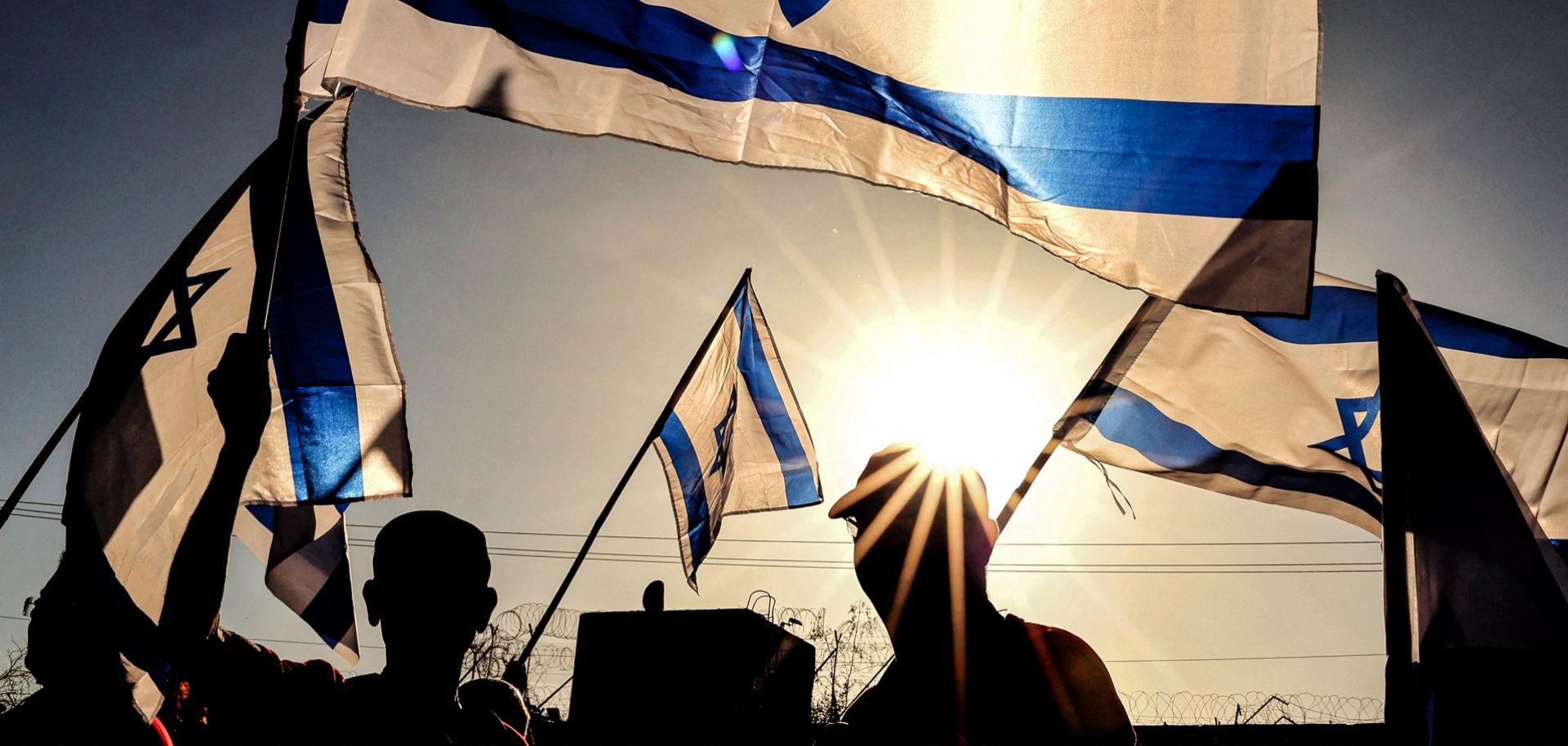
Israeli military veterans wave national flags during a rally against the government's judicial reform bill along a highway near Netanya on March 28, 2023.
Israel is having an identity crisis. As the country reels from nationwide protests over the right-leaning government's proposed judicial reforms, which primarily aim to increase the Knesset's control over the Supreme Court, long-simmering culture wars are boiling over in the streets and parliament. Some politicians, like Israeli President Isaac Herzog, warn of impending civil war; others, like Israeli author David Grossman writing in The Atlantic, say the country is sliding into dictatorship. Many media outlets have warned the country could become an "illiberal" democracy akin to Turkey or Hungary, where elections are still free but rarely fair, and where cultural conservatives often push policies that target ethnic and sexual minorities. For them, Israel's secular, liberal and democratic national identity is about to be supplanted by something entirely different.
National identity — the core political and cultural values that drive a country's policies and affect its geopolitical strategies — always shifts alongside historical events and changes to strategic interests. An increasingly multipolar world and shifting allegiances on the global stage are forcing Israel to recalibrate its national identity, as expressed through the current unrest and political battles that have captured international attention. Is Israel's traditional liberal democracy, as structured today, suited to face the challenges of a global environment shaped by great power competition? For at least some within Israel, the answer is no.
How Israel's identity shaped its national strategy
When Israel was founded in 1948, its early settlers were mostly European, particularly Eastern European, and they built the early Israeli state explicitly to avoid repeating the authoritarianism of the countries and empires they had fled. This deep aversion to authoritarianism continues to underpin support for Israel's democracy — in fact, the government's supporters argue that they're making the country more democratic by increasing the popularly elected Knesset's oversight of the technocratically appointed judiciary.
But the early settlers' European origin also meant they had cultural and political connections with Europe — and later, the United States. This eased the path by which Israel tied itself to the West, though these connections did not necessarily define the relationship. In fact, because so many early Israelis were from the former Soviet Union, Israelis openly debated their place in the Cold War in the late 1940s, only to later find the Soviets were more interested in strategic ties with bigger Arab states like Egypt instead. Spurned by the Soviets, some early Zionist ideas — like socialist-inspired collective settlements called kibbutzim — fell out of fashion with the public. As Israel aligned itself more and more with the West, its national identity increasingly centered around the idea that Israel was itself a Western nation. That led to some geographically absurd yet culturally relevant developments, like Israel's inclusion in Eurovision in 1973; for Israelis at the time, their pop culture had more in common with Europeans than with their fellow Middle Easterners.
Israel's place in the Cold War served as a backstop to cultural change. Because Israel was a pro-Western state, the Soviet Union blocked millions of Jews with different social and political attitudes from emigrating there. And as Israel was reliant on Western (and specifically American) military aid, its citizens and politicians were always aware that should they drift too far from mutual values, they risked isolation from key allies. Therefore, when the United States pushed Israel to trade away land in return for peace with Egypt and Jordan in 1979 and 1994, respectively, Israel acquiesced. And when Israel was more reticent to try the formula with the Palestinians in Oslo, Norway, in the 1990s, the United States under President George H.W. Bush resorted to indirect threats to cut U.S. aid to Israel at a time when there were no replacements for American power.
But Israel's context in 2023 is different, and its youngest citizens grew up with a different historical background. As a result, the liberal democracy built in the 1940s and refined through the rest of the 20th century is no longer always seen as suited to the strategic challenges of the present. Fueled by increasingly differing views between Israel and the West on regional challenges (like the Palestinians and Iran), this rightward shift has been years in the making.
Israel First — as much as it can be
It's become a trope to describe a country's national strategy with a spin on former U.S. President Donald Trump's "America First" slogan. But as nationalism surges and the multipolar global environment enables once-constrained domestic interests to assert themselves on the national level, it's clear that many countries are both willing and able to put themselves first. Israel is no different. In this case, it's the story of how Israel manages its changing population with different attitudes.
Much of the alarm around the country's judicial reforms — which Prime Minister Benjamin Netanyahu announced on March 27 would be paused, but not scrapped, pending a dialogue with opponents — stems from a fear that without the Supreme Court's ability to effectively exercise the power of judicial review, a right-wing or far-right Knesset will be able to impose illiberal policies on the country. Many Israelis believe this would spark capital, personnel and investment flight, and even Israeli-on-Israeli violence between secular and religious communities. Some even warn that Israel could alienate key allies like the United States. Critics argue that none of these outcomes are in the interest of anyone but the current Israeli government.
But this criticism overlooks another key imperative: the integration of the ultra-Orthodox into Israel's body politic. The ultra-Orthodox once sat on the margins of the country's economy and defense establishment, since they were so small in population that they could carve out an apolitical space studying the Torah and refraining from military service. Now they are gaining such demographic heft that the Israeli state needs a strategy to integrate them into both the economy and defense establishment. The debate over what this strategy should be is playing out in the political sphere. Some secularists argue they should be forced to assimilate through conscription and cutting back on their subsidies. But ultra-Orthodox counterarguments imply that if they are to take a greater role in the state, they should also have a greater say in its social mores — hence their demands for more gender segregation and restrictions on LGBTQ individuals.
For Western allies, like the current U.S. Biden administration, the issue is relatively straightforward: a liberal democracy should not impose religious values on its citizens, and neither should Israel. But for Israel, which must live with a growing ultra-Orthodox population, its traditional liberal democracy is not, at least for some politicians, worth the unrest and pushback that comes with resisting ultra-Orthodox demands, such as a weaker Supreme Court. In this sense, Israel, or at least its current government (which must have religious support to stay in power), is putting itself first.
Then there is the issue of West Bank expansionism. Again, critics charge this will transform Israel into an apartheid state, dictatorship or both. But within Israel, many citizens do not see the current state of affairs with Palestinians as sustainable. Many younger Israelis have lived through enough Gaza wars and violence in the West Bank that they have come to believe expansionism might bring them security. Additionally, several Middle Eastern countries have normalized with Israel despite its lack of a peace agreement with the Palestinians, driven by mutual fear of Iran and economic incentives. Meanwhile, the ultra-Orthodox themselves also demand new settlements, in part for religious reasons but also because settlements help ease the acute housing shortage within Israel. There is little public discussion about what to do with the 7 million Palestinians living in the West Bank and Gaza; that Israeli expansionism requires Israel either to tighten its military occupation on these millions or to give at least some of them the vote is often overlooked.
Toward a Middle Eastern identity?
It's important to note that these debates over identity are taking place against a backdrop of global change. There are no clear world-dividing blocs as there were during the Cold War, as illustrated by the fact that even with Russia's invasion of Ukraine, Israel maintains working economic and military relations with Moscow. Israel has also invited Chinese investment into its ports, and it is looking to regional partners, like Turkey and the Gulf Arab states, for economic opportunities and security against Iran as the United States signals its increased restraint in the Middle East. In other words, Israelis are thinking less and less about what the West — and the United States — might think, as they address localized, rising challenges in which the West is increasingly uninterested.
Israel is not the only country shifting away from the West: Turkey, Saudi Arabia, the United Arab Emirates, Egypt, Qatar, Iraq and even Jordan are all reassessing their national strategies as the United States turns its focus from the region. In the absence of ideological blocs of powers, these countries are cutting deals with China and Russia, looking to buy their military equipment, and bringing them in as mediators for their problems. National traits that would have been controversial in the Cold War are thus coming to the fore, from nationalism that sparks unpopular conflicts to mercantilism that leads to Beijing and Moscow.
For Israel, the change is thus not so much an identity shift away from liberal democracy toward authoritarian dictatorship, but rather a shift away from conformity with the West toward conformity with its Middle Eastern neighbors, who are all asserting their national interests as U.S. power ebbs. This will likely mean Israel will include its religious communities and their values more in the public space, and it will impose conditions on Palestinians with fewer considerations for U.S. opinion.
However, this shift in national identity will not assure all of Israel's interests. As seen via weeks of mass protests against the proposed judicial reforms, Israel's large, still Western-leaning population will push back, possibly win elections and try to reverse course. Additionally, concessions to the ultra-Orthodox may do little to integrate them into the economy, and expansionism in the West Bank might only burden the Israeli Defense Forces with more duties as its U.S. ally questions the value of continued aid. But these shortcomings will not change the imperative: Israel's old national identity as a Western-leaning, secular, liberal nation-state no longer directly and fully addresses its challenges both within and without.
At home, this means that even if the Netanyahu-led government collapses before its term is up, the next government will inherit at least some of its mandate to shift the country's political and social identity to the right. That will ensure more years of mass protests, threats of emigration, economic uncertainty and security disruptions, as the declining share of the secular and liberal population tries to slow this process.
As this tug-of-war takes place, Israel abroad will begin to behave more like Middle Eastern nations such as Turkey and Saudi Arabia — transactionally doing business with Russia and China, assiduously avoiding being drawn into great power conflicts that don't concern it, and pushing back, even to the point of a diplomatic crisis, against Western powers like the United States that try to shape its domestic political system. However, this shift means Israel will also have to chart its own future with less protection, as divergences between it and the United States mean not every Israeli challenge will be an American one. In this balancing act, Israel will have much in common with its neighbors, which have long been reshaping their national identities to both create domestic harmony and meet the strategic challenges of their regions. Israel will be able to put itself first more often, but it will also be more alone.
