
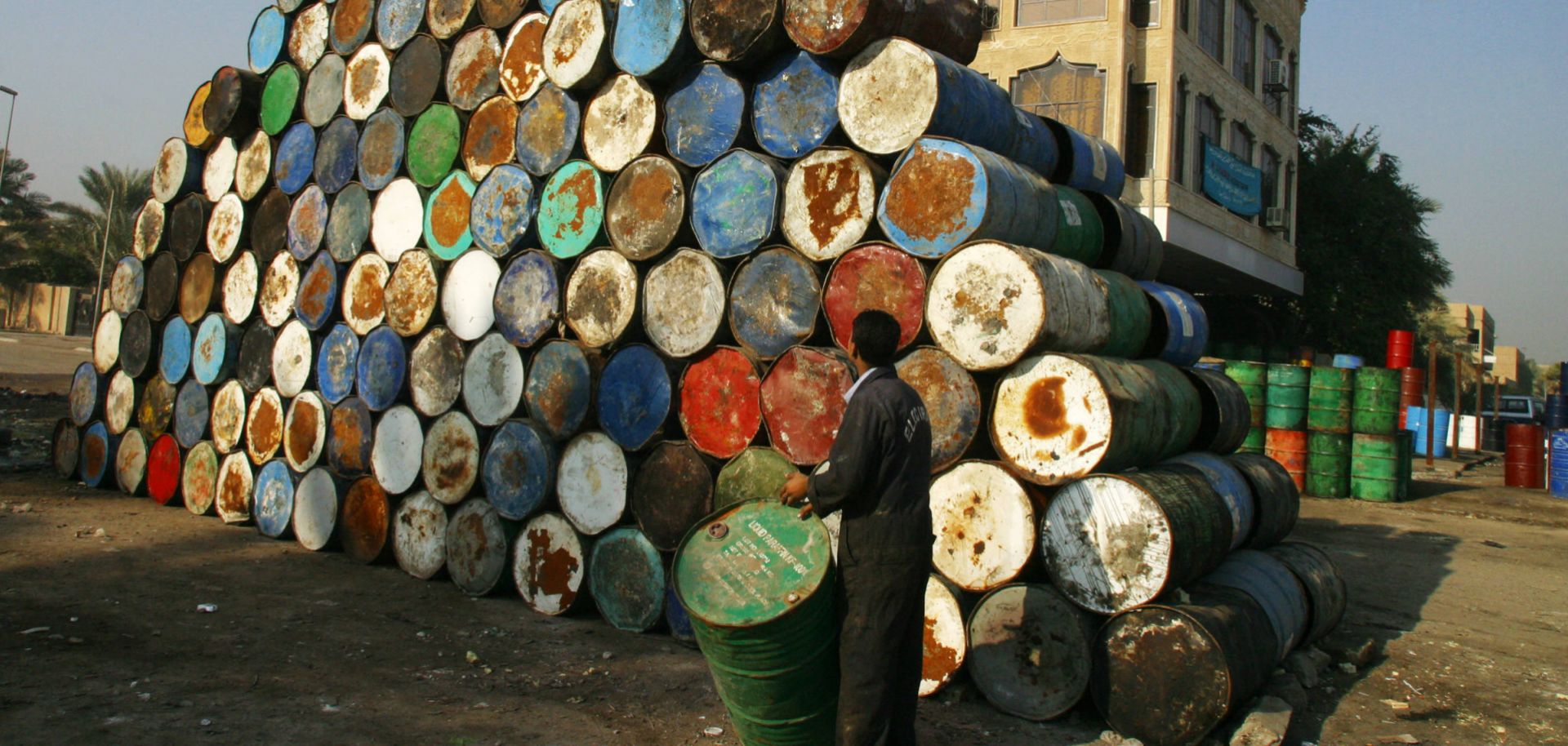
A worker surveys a stack of empty oil drums as he brings another to add to it at a warehouse in Baghdad, Iraq, on Jan. 6, 2004.
An international arbitration ruling against Iraq's semi-autonomous Kurdistan Regional Government (KRG) regarding its independent export of oil will hurt the KRG's oil industry and its investors, and it will give Baghdad enough leverage to make further changes to the region's oil and gas regulatory environment. On March 23, the International Chamber of Commerce's International Court of Arbitration ruled that the KRG could not export oil through a pipeline system that travels through Turkey to the port of Ceyhan on the Mediterranean Sea without Baghdad's approval. On the request of the Turkish government following the ruling, the Kurdistan Pipeline Company stopped oil flows through the pipeline, forcing the largest oil producers in Iraqi Kurdistan — DNO, Genel Energy and Gulf Keystone Petroleum — to divert flows to storage tanks. On March 26, Iraqi and KRG officials began discussing resuming the region's oil exports (450,000 barrels per day), but on March 27, Bloomberg reported that talks fell apart without a deal. The KRG's oil producers are expected to exhaust storage facilities in a matter of days, after which they will be forced to shut in oil production, as DNO announced it would do on March 29. DNO's assets produced nearly a quarter of the KRG's oil in 2022.
The ruling bolsters Baghdad's push to control more of the KRG's oil and gas sector, which will force the KRG to reach a settlement that will likely be weighted in Iraq's favor. The level of autonomy the KRG has in its own oil industry has been a legal uncertainty for many years due to disagreements over the interpretation of several articles in Iraq's 2005 constitution. In 2007, the KRG exploited this ambiguity to pass an oil and gas law, which created the production-sharing contracts that oil producers in the KRG utilize today. Baghdad was able to undermine most of these contracts at the time because it controlled all of the key oil pipeline infrastructure that the KRG could use to export any oil produced, meaning the federal government still had significant leverage over the region. But in 2013, the completion of a new pipeline connected the KRG to Turkey directly, bypassing Iraq's infrastructure and enabling the KRG to export oil independently. In response, Baghdad launched its arbitration suit in 2014 arguing the KRG could not export oil without Baghdad's approval. In February 2022, the Iraqi Federal Supreme Court ruled that the KRG's 2007 law was unconstitutional, resulting in Baghdad threatening legal action against oil companies still operating in the region's oil sector. The March 23 ruling adds the weight of international law to the Supreme Court's domestic ruling, which will give Baghdad enough legal heft to significantly disrupt the KRG's oil sector. At this point, the KRG must reach a settlement with Baghdad that will likely entail significant concessions, up to and including the rights to oil fields themselves.
Greater power over the KRG's oil sector will grant Baghdad more tangible control over the semi-autonomous region that the federal government will use to reinforce its political and economic primacy. In the country's 2005 constitution, Iraq's federal government recognized the semi-autonomous status of the KRG as part of greater Iraq, and the extent of Baghdad's control over the region has been tested in the intervening years. For example, the federal government used military power to exert territorial control over the KRG in 2017 in response to an independence referendum. And Baghdad sought to exert economic control over the KRG via a 2014 oil revenue-sharing agreement struck in the wake of the 2013 pipeline construction, although neither side fully followed or implemented the deal. Baghdad's increased control over the KRG's oil sector following the March 23 ruling will fuel the government's efforts to tamp down any hints of separatism or federalism that have threatened (and will continue to threaten) Iraqi sovereignty across all its geographic regions.
- In the 2017 independence referendum, 90% of Kurdistan region residents voted "yes" to independence from Baghdad, indicating their desire for greater autonomy from the federal government.
- The 2014 revenue-sharing agreement in theory entitles the KRG to 17% of the federal budget (supposedly proportional to the size of the Kurdish population in Iraq at the time of the last census in 1997) in exchange for the KRG marketing all Kurdish oil through the federal government's State Oil Marketing Organization. However, disagreements over how to calculate the share of federal revenue earmarked for the KRG, as well as the aforementioned disputes over whether the KRG has the legal right to sell Kurdish oil, prevented the agreement from functioning as intended.
- The majority of Iraq's oil comes from southern Iraq, where some local leaders in provinces including Basra and Dhi Qar have over the years hinted at a federalist separation of Iraq's provinces from the central government, something Baghdad wants to forestall.
Baghdad's greater economic influence in the semi-autonomous region could undermine the influence of the KRG's main Kurdish political party ahead of the region's upcoming elections. Without the ability to market oil independently and generate oil revenue from Kurdish fields thanks to the February 2022 and March 2023 court rulings, the KRG's economy (and the politicians who run it) have no choice but to remain heavily dependent on federal government budget allocations to pay the region's large public sector wage bill and security forces' salaries. This apparent weakness could hurt the popularity of the ruling Kurdistan Democratic Party (KDP), which negotiated the 2013 pipeline construction and exports with Turkey, as well as the tug-of-war with Baghdad over budget funds. Therefore, an election later in 2023 could see the KDP lose some ground to its main rival, the Patriotic Union of Kurdistan, if Kurdish voters blame the KDP and the Barzani family clan that runs it for the region's likely forthcoming economic strain.
- The assistant to KRG Prime Minister Masrour Barzani has already stated that the distribution of public salaries "will continue," pointing to the priority the KRG places on paying public sector wages, which is necessary to keep the peace and forestall disruptive protests.
Eventually, Iraq's federal government may have the power to dictate new investment terms for international oil and gas companies (IOCs) operating in the Kurdistan region. Successive Iraqi governments have long asserted that the KRG's production-sharing contracts, which are largely viewed as internationally competitive, are illegal. Under Iraqi law, production-sharing contracts are forbidden, and the federal government has instead offered its oil reserves through more restrictive technical service contracts. As Baghdad's influence in the Kurdistan region's oil sector grows, it is likely that the federal government will try to convert or push out foreign oil companies operating in the sector under the KRG's model. While this would be disruptive for companies currently operating in Kurdistan, as they would have to accept less competitive terms or withdraw from the region, Iraq's oil and gas reserves are relatively cheap to exploit, and several oil and gas majors (like TotalEnergies and ExxonMobil) have already invested using the federal government's model. This suggests that while the Kurdistan region's investment landscape will shift following increased federal control, investors will remain interested. Additionally, Baghdad's greater control over the KRG's oil and gas sector will increase IOCs' confidence in the legal framework of oil investment in the region, which could lead to more investment from new companies. And Baghdad's greater control over Kurdistan's oil and gas reserves would also make it easier for the federal government to develop other northern Iraqi oil and gas reserves. However, before Baghdad can access these potential benefits, it will need to negotiate the finer details of a settlement with the KRG, such as changes to revenue-sharing processes. With that being said, Baghdad and the KRG could reach a temporary short-term agreement over the coming weeks to resume production.
