
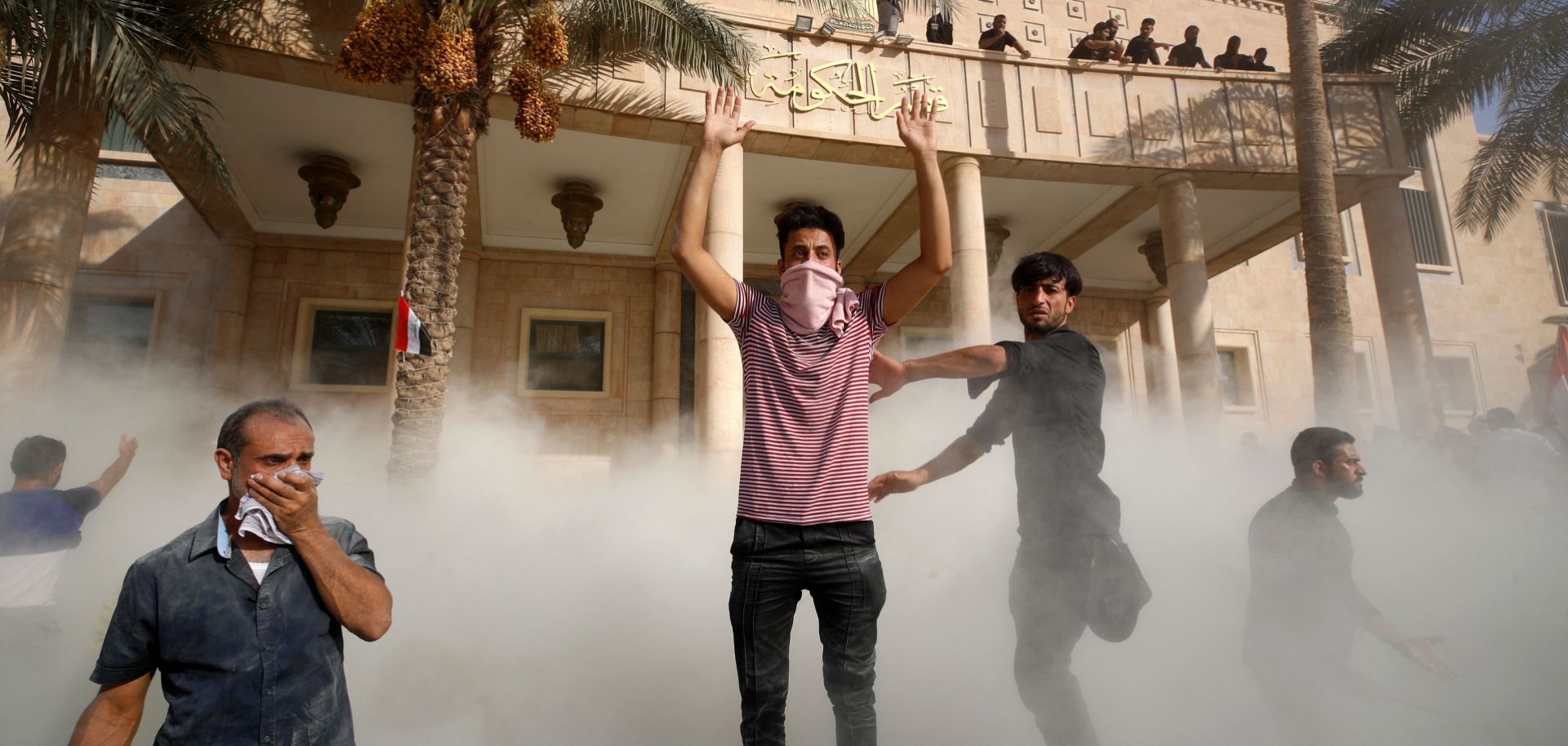
Supporters of Shiite cleric Muqtada al-Sadr gather outside the headquarters of the Iraqi government in Baghdad's Green Zone on Aug. 29, 2022.
The recent violence in Baghdad will add greater impetus among stakeholders in Iraq, including Iran, to finally resolve the country's nearly year-long political crisis. But Iraq's feuding Shiite factions are unlikely to reach a compromise anytime soon, portending more militia violence and unruly protests that could eventually disrupt the country's vital oil exports. At least 30 people were killed and 700 wounded in clashes in Baghdad on Aug. 29 and 30, marking the bloodiest episode of unrest the Iraqi capital has seen in recent years. The violence erupted after influential Shiite cleric Muqtada al-Sadr unexpectedly announced that he was stepping down from politics on Aug. 29, prompting confusion and anger among his millions of followers. In Baghdad, al-Sadr's supporters took to the streets, where they clashed with supporters of the rival Shia Coordination Framework (SCF). Sadrist protesters then escalated their demonstrations by storming the presidential palace in Baghdad's Green Zone, leading to more bloody clashes as Iraqi security forces tried to restore order. In an Aug. 30 address, al-Sadr called on his supporters to retreat and reiterated his decision to exit Iraq's political scene, which has since helped restore relative peace in the capital city. But Iraq's security situation remains precarious — especially given that the political tensions underpinning the recent clashes remain unresolved.
- The clashes come amid tensions between al-Sadr supporters and the pro-Iran SCF over efforts to form a government following October 2021 elections. Sadrists won the most seats, but not enough seats to unilaterally form a government. Their rivals within the SCF won the second-largest number of seats in the election, which they've since used to block the formation of a Sadrist government — leaving Iraq lodged in a political crisis for nearly a year.
The clashes show how violence risks increasingly becoming a go-to answer for Iraqis who are frustrated with their leaders' continued failure to form a new government. The continued lack of progress in government formation talks since last year's election has seen rival political camps increasingly resort to inciting violence by rallying their supporters to take to the streets in anger. Within this context, the Iraqi political system cannot effectively shepherd through a peaceful political transition. The more violence replaces dialogue, the harder it will be for the government to function effectively, which will in turn fuel more social and political unrest by further reducing the probability of structural reforms — highlighting just how unsustainable the current status quo is. Resolving the current political impasse will likely require either Sadrists or the SCF to abandon one of their key demands for the formation of the next government (i.e. who to name for president, or whether to group together in a larger bloc). But it could take months before such a compromise is reached, portending more violence and instability in the interim.
The situation also underscores the limits of al-Sadr's own political brinkmanship. Al-Sadr has mobilized his followers in Iraq by saying he'll step back from politics numerous times in recent years. Calling supporters out into the streets remains his most powerful political card, especially considering he has consistently failed to form a government despite record winnings in the 2021 elections. However, this strategy is becoming less effective. The increasingly violent tactics of his supporters, as evidenced by the recent raiding of the presidential palace, create popular blowback that damages al-Sadr's ability to engage in dialogue with other political stakeholders. This may see al-Sadr remain out of the political spotlight for a time to allow him to focus more on shoring up his religious credentials, which could increase his popular appeal among some of his devout Shiite followers.
- Amid his struggle to form a majority government, al-Sadr forced his followers in parliament to resign in July in the hopes of forcing the SCF to beg for his lawmakers to come back, or potentially trigger a new election in which he'd be able to secure enough seats to unilaterally form a government. The risky gamble has left Sadrists without the most seats in the next parliament. Frustration over al-Sadr's inability to establish a Sadrist government over the past year could reduce turnout among his supporters in a hypothetical new election.
As the most influential external actor in Iraq, Iran is best-positioned to de-escalate tensions by helping broker a political compromise. Over the past year, Iran has pushed its political proxies in the SCF to maintain a strong position in government formation talks. But Iran also does not want to see an extended power vacuum in Iraq, which would threaten Tehran's interests and years of influence-building in the country. To mitigate this risk, Iran might seek to avoid aggravating tensions in the wake of the recent clashes in Baghdad. Tehran could also push the SCF to reach a compromise with Sadrists, which could potentially include holding new elections. In addition, Iran has close ties with the clerical establishment in Iraq, who have so far been silent on the recent surge of violence in Baghdad. But if these religious leaders issue statements calling for peace, it could influence political stakeholders to ask demonstrators to go home and for militiamen to lay down their arms.
- Iran has a vested interest in Iraq's economic and political stability, driven by its deep trade connections to the Iraqi economy. Tehran also uses its close ties with the Iraqi parties and militias in the SCF to shape Baghdad's policies in Iran's favor.
Iraq is unlikely to devolve into another large-scale civil war, but further violent clashes are probable. Individual militias would risk losing their political capital if they waged a broader war against the Iraqi military, which is largely cohesive and increasingly well-trained. The recent increase in political violence thus remains unlikely to spiral into another all-out civil conflict. However, federal Iraqi security forces' failure to control non-state militias and angry demonstrators during the escalation in Baghdad bodes ill for their ability to tamp down on future violent outbreaks — keeping the risk of sporadic violence high in the near term. This will continue to fuel fears among foreign investors that Iraq may be headed for another prolonged period of widespread instability, which will create greater economic uncertainty in Iraq as well.
The growing unrest also risks disrupting Iraq's oil exports. The Aug. 29 protests by al-Sadr supporters also expanded to the southern city of Basra, which is home to the majority of the country's oil industry and hosts a number of foreign-owned projects. The unrest has not yet impacted Iraq's oil exports but could in the future if clashes and demonstrations continue at oil company property. Although initial reports suggested Sadrist protesters had closed oil fields near Basra, sources cited by Reuters on Aug. 30 said the recent violence did not affect Iraq's oil production and ability to export oil. However, future disruptions are possible — especially if protests continue around the country's refineries. Decreased Iraqi oil exports following a prolonged shutdown would exacerbate Iraq's economic problems, depriving the government of a key revenue source. Escalating violence and the potential for road closures could also eventually threaten foreign-owned oil operations in Iraq.
