
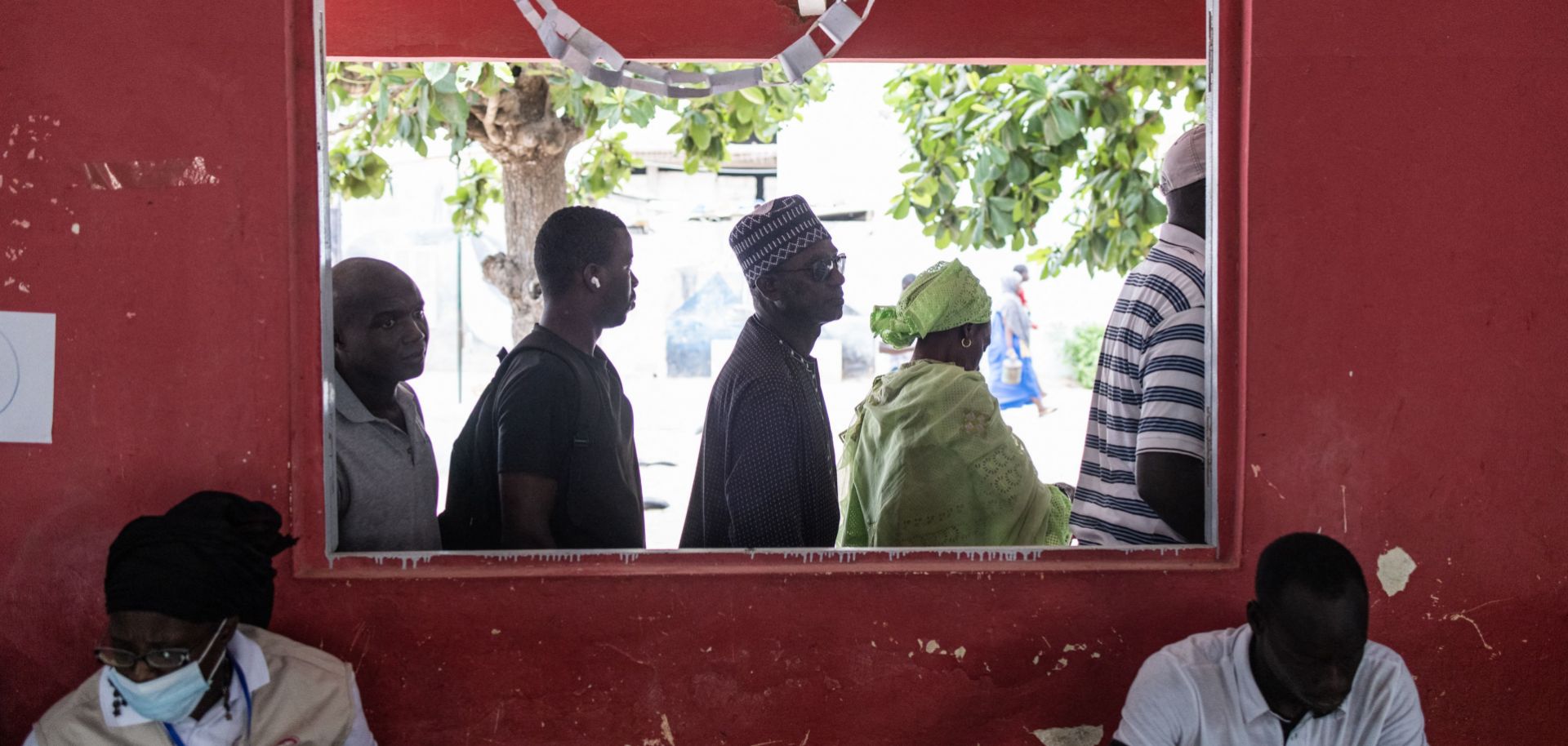
People wait to vote in Senegal’s legislative election outside a polling station in Dakar on July 31, 2022.
Senegal's ruling coalition lost its absolute majority in recent elections, portending a period of legislative gridlock that will reduce the likelihood of President Macky Sall securing an unconstitutional third term. For the first time in Senegalese history, the president's party does not have a majority in parliament. Sall's ruling coalition Benno Bokk Yakaar (BBY) lost control of the National Assembly in elections on July 31, in what was a decisive win for the country's opposition coalition. BBY won only 82 of the unicameral legislature's 165 seats, down from 125 seats won in the 2017 elections. The opposition Yewwi Askan Wi (YAW) coalition and its political ally Wallu Senegal, meanwhile, won a combined 80 seats — bringing both sides just shy of the 83 seats needed to secure an absolute majority. Three smaller parties — Aar Senegal, Book Gis Gis and the Servants — also obtained one seat each.
The opposition coalition framed the legislative polls as a referendum on Sall's economic performance and Senegal's democratic backsliding under his leadership. Opposition parties united to ''cohabitate'' with Sall's BBY coalition in parliament in order to counterbalance what they've described as his administration's economic mismanagement and abuse of power. The opposition's campaign in the lead-up to the legislative vote played heavily into Senegalese citizens' growing frustration with soaring inflation, which has seen prices for everyday goods skyrocket, and their reduced purchasing power amid the country's depreciating currency. Sall's recent moves to suppress the opposition by banning leaders from running for office, cracking down on protesters and allegedly considering running for an unconstitutional third term also likely drove more voters to cast ballots for opposition candidates.
- From January to July, the CFA franc lost 12% of its value against the U.S. dollar as prices for food staples like rice, millet, sorghum and maize spiked.
- In June, Senegal's Constitutional Court banned a list of opposition candidates — including the leader of the YAW coalition, Ousmane Sonko — from running in the July 31 elections, triggering violent protests across the country.
- In June 2021, Senegal's National Assembly passed two counterterrorism laws that enable the government to target civil society leaders and expand police surveillance power by criminalizing political speech and peaceful protest as ''acts of terror.''
The opposition's greater presence in the National Assembly will likely curtail Sall's ability to pass legislation. The BBY coalition's comfortable 125-seat majority in the National Assembly had previously enabled Sall to pass his policy agenda without a threat of a veto. But with the ruling bloc now only commanding 82 seats, Sall no longer has the absolute majority needed to pass legislation, let alone the three-fifths majority needed to veto proposed laws. Even so, the three smaller parties that hold one seat each have the potential to tip the balance in either the ruling bloc or the opposition coalition's favor. In the lead-up to the election, all three parties committed to the opposition's objectives. However, BBY is likely to exert significant pressure in order to garner legislative support from one or multiple parties, which would enable Sall to pass legislation with 83 or more parliamentary votes. If BBY is not able to gain the support of one or multiple parties, the parliamentary deadlock will likely prevent Sall from passing proposed laws on public spending and/or social programs. While this would lead to a more balanced fiscal deficit, it could also result in more social unrest due to perceptions of insufficient state support. Separately, the YAW-Wallu Senegal coalition appears to remain unified following the legislative election, but its ability to block BBY legislation is contingent on staving off party splits.
In the longer term, the opposition's recent gains will hamper Sall's odds of running for an unconstitutional third term, as such a move would likely require a constitutional referendum and parliamentary vote. This sets the stage for a highly contested presidential election in 2024, portending further political uncertainty and public demonstrations. BBY could increase its odds of winning the race by nominating a presidential candidate other than Sall. But the election may still be tight if the opposition continues to gain momentum after its resounding victory in the recent legislative election. If the opposition wins the presidency, a peaceful transfer of power from BBY to the new ruling party would serve as confirmation of Senegal's commitment to democratic processes, whereas BBY resistance and/or violence would jeopardize the country's political stability.
