
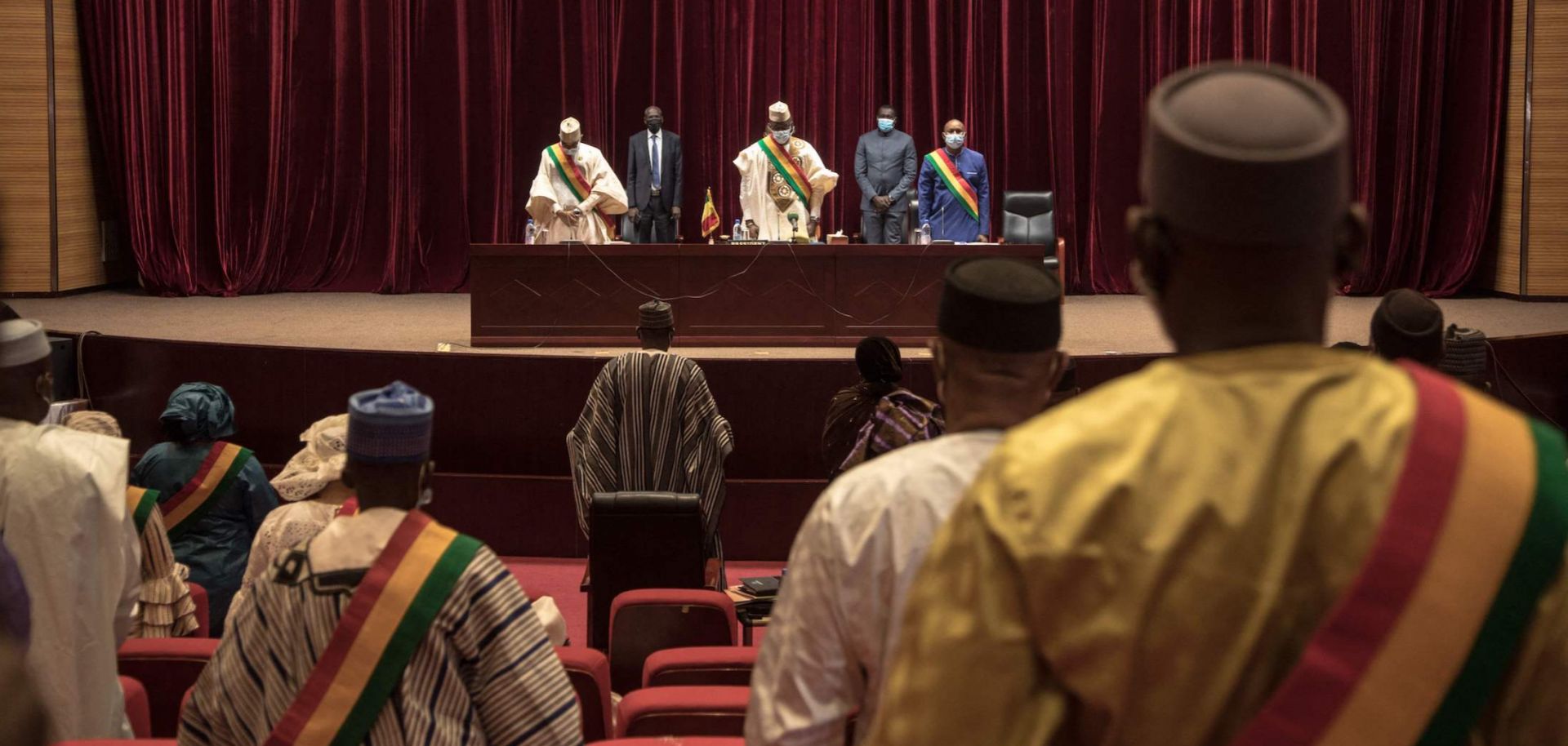
Members of Mali’s National Transitional Council hold a vote in Bamako on Feb. 21, 2022.
In Mali, a new law paving the way for elections could prompt regional powers to ease the harsh sanctions that have crippled the Malian economy since last year's coup, but will also likely deepen the military’s control over the West African country. The Malian military government adopted a new electoral law on June 25 that sets the legislative groundwork for general elections in 2024. The electoral law is the first legal framework for elections passed since the May 2021 military coup that ousted the civilian government. The legislation creates a single election management body to be created and overseen by the executive, simplifying the steps to hold an election. Crucially, Article 155 of the law allows members of the military to run in future elections as long as they resign or retire from the security establishment six months prior to elections (although this period is reduced to four months during transitional periods).
- The National Transitional Council (known by its French acronym CNT), Mali’s legislative body, passed the law on June 17 with a total of 92 amendments to the original draft. Many of the amendments are related to the establishment of the Independent Authority for the Management of Elections, which is the body that would oversee the 2024 elections.
- Prime Minister Choguel Maiga allegedly opposed the passage of the law with the CNT’s amendments, likely because the amendments reduce the prime minister’s influence over the electoral process. But, Malian President Assimi Goita ultimately signed the law into effect without a second reading.
- The newly mandated Independent Authority for the Management of Elections will oversee all referendum and electoral operations, manage the electoral register, finance political parties, impose a ceiling on election campaign expenses and determine electoral results. While military spokespeople have pointed to the creation of the election management body as evidence of preparations for free and fair polls in 2024, it will actually ensure the military’s influence over future elections, as Goita will appoint three of the 15 members who will make up the body.
The passage of the law supports the junta’s claim that it will hold elections in 2024 and could sway regional blocs toward softening or lifting economic and political sanctions, which could somewhat improve Mali’s dire economic situation. The Economic Community of West African States (ECOWAS) and the West African Monetary and Economic Union (known by its French acronym UEMOA) imposed severe sanctions limiting trade, severing access to financial markets and closing borders in early January after the junta announced a delay to democratic elections originally scheduled for February. Since then, Mali’s economic and political isolation has exacerbated the impacts of the global food, fuel and inflation crises, leading to widespread shortages, harsh reductions in consumer purchasing power and skyrocketing inflation. In turn, Mali’s economic hardship has increased incentives for both the junta and regional blocs to address the worsening humanitarian emergency through negotiations and potential sanctions removal. While ECOWAS has repeatedly expressed dissatisfaction with Mali’s new electoral timetable (with elections being held sometime in 2024), the junta is using the new law as evidence that it is taking concrete steps toward democratic elections. Neither ECOWAS nor UEMOA has commented on the passage of the law, but delegations from both blocs will attend a July 3 convention in Accra, Ghana, where they are expected to announce a decision on the future of sanctions against Mali. Given some West African countries’ desire to mitigate Mali’s humanitarian crisis (made worse by sanctions) and the subsequent regional fallout, ECOWAS and UEMOA may point to the electoral law as sufficient progress toward elections in order to warrant reduced sanctions.
- ECOWAS is West Africa’s main regional bloc that typically leads coordinated diplomatic, political, economic and security initiatives. ECOWAS and UEMOA also imposed sanctions against the junta in Guinea following the September 2021 coup in that country.
- After the 2021 coup, ECOWAS suspended the country’s membership in the bloc and also froze assets of transitional authority, imposed travel bans, closed borders and halted financial flows into Mali. Mali’s imports from its two top trade partners, Senegal and Ivory Coast, declined sharply as a result of the measures, leading to fuel and medical shortages in the country.
The lifting of ECOWAS sanctions could eventually grant the junta greater legitimacy by enabling it to simultaneously maintain power and reopen Mali’s economy. The electoral law’s Article 55 means that Goita, the country’s current transitional president, will likely run in the 2024 election. Given Malian security forces’ history of violence against civilians, electoral fraud and voter intimidation (in addition to the absence of a highly coordinated and consolidated pro-democracy, civil society resistance movement), the military could very well maintain power under the guise of a democratic process. Further, if ECOWAS and UEMOA ease or lift sanctions against Mali at the July 3 meeting, it would reduce the country’s isolation and, in turn, the political and economic costs imposed on military leaders for failing to hold on-schedule elections. The lifting of such sanctions could enable Mali to reintegrate into regional politics over the next two-to-three years, eventually regaining the political and economic benefits available to ECOWAS and UEMOA members. Alternatively, if the two regional blocs do not ease sanctions, the continued isolation from regional trade would likely worsen Mali’s economic and humanitarian crises by compounding the government’s inability to provide access to food, fuel and medicine. In addition to increasing the number of displaced people in the region traveling north, such political and economic instability would likely also exacerbate the jihadist insurgency in northern and central Mali by reducing the efficacy and coordination of counterterrorism efforts.
- ECOWAS has attempted to utilize sanctions as a deterrent for other would-be coup leaders. But the bloc’s willingness to negotiate with military regimes in Burkina Faso, Guinea and now Mali detracts from whatever deterrent effect ECOWAS previously achieved.
