
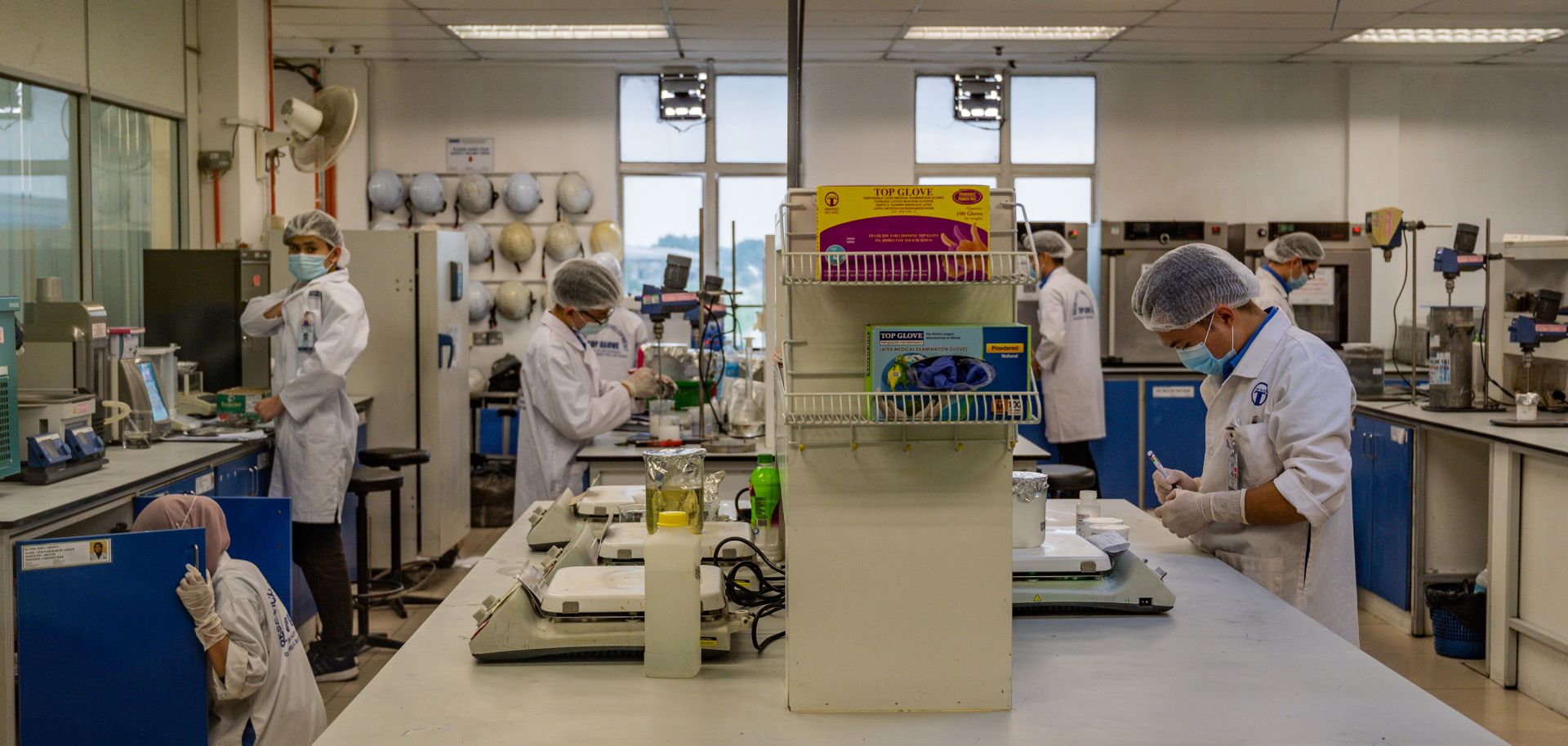
Staff conduct research for Top Glove, one of the world's largest rubber glove manufacturers, in a factory located near Kuala Lumpur, Malaysia, on Aug. 26, 2020.
British home appliance maker Dyson’s decision to cut ties with a Malaysian partner over labor issues does not indicate a larger trend for Kuala Lumpur’s business environment so long as Western pressure remains at a tolerable level. On Nov. 25, Dyson terminated its contract with ATA IMS, a Malaysian manufacturer following a labor audit and complaints regarding working hours, conditions and pay from foreign employees. Foreign workers file the majority of labor complaints in Malaysia, exposing palm oil producers and low-skilled manufacturing to a higher risk of disruptions.
- France’s Sagemcom, which makes communications devices, also cut ties with ATA IMS in 2020 after one year, citing “shortcomings and the inability to meet standards.” But the Malaysian manufacturer still makes parts for Ecobee (a Canadian home automation company) and Cricut (a U.S.-based cutting machine producer), which both have yet to cut ties with ATA IMS despite accusations of forced labor in 2020 and 2021.
- On March 29, U.S. Customs and Border Protection issued a withhold release order requiring agents to seize imports from the Malaysian glove manufacturer Top Glove over forced labor allegations. The order was lifted on Sept. 9 after Top Glove issued over $30 million in remediation payments to workers and improved working and living conditions.
- U.S.-based tire company Goodyear has paid out settlements regarding several labor complaints brought by foreign employees at Malaysia facilities from 2019 to 2021 for violations related to working hours, pay and conditions.
Labor reforms to improve working conditions and reduce hours in Malaysia remain unlikely in the near term. Foreign and domestic firms have proven their willingness to settle labor disagreements rather than take preventative measures. Though the government has investigated prior claims of labor violations, it has neither produced reforms to proactively address these issues nor provided financial incentives to significantly alter this status quo. Reforms remain unlikely in the near term as the government does not face widespread social unrest regarding the matter and Malaysia will prioritize economic growth in 2022, seeking to bolster its post-COVID recovery, especially in manufacturing.
- In 2021, Kuala Lumpur created a reporting app that bypasses employers and goes straight to the government in order to prevent employer interference in the process. But the Malaysian government has not implemented significant labor reform.
- The social labor movements in Malaysia are not currently focused on long-standing issues with working conditions in the country. Labor unions called for change in April 2021, but their grievances were focused on movement restrictions and other government controls implemented due to COVID-19.
However, Kuala Lumpur's calculus could shift if Western regulations surrounding human rights concerns become more stringent, forcing companies to reevaluate their partnerships in Malaysia. The administration of U.S. President Joe Biden has pushed to make human rights a major component of its foreign policy agenda, while Western companies are seeking to reaffirm their supply chains are clean of human rights violations by taking public stances or making public claims decrying any forced labor. However, these claims have not yet manifested into concrete action except for cases where the global media gets a hold of the stories, as has been the case with China’s labor abuses in Xinjiang. This could force the Malaysian government to cave to international pressure and institute labor law reform, such as improved auditing or mandatory government inspections, to prevent further withdrawals of foreign partnerships. If international pressure on Kuala Lumpur to improve labor conditions increases, the country’s economic strategy of relying on cheap labor will be under stress, as low-skilled, labor-intensive companies may seek to relocate elsewhere in Southeast Asia where labor rights have been less scrutinized, such as Vietnam.
- A broad coalition of labor unions in Malaysia called the Labor Law Reform Coalition (LLRC) has been pressuring the government on labor law issues pertaining to working hours and pay. If they are able to successfully gain sufficient domestic support, or if companies like Circut or Ecobee also pull out of Malaysia over labor concerns, Kuala Lumpur may be forced to address the issues proactively with reforms, rather than issuing punishments in a reactionary manner.
