
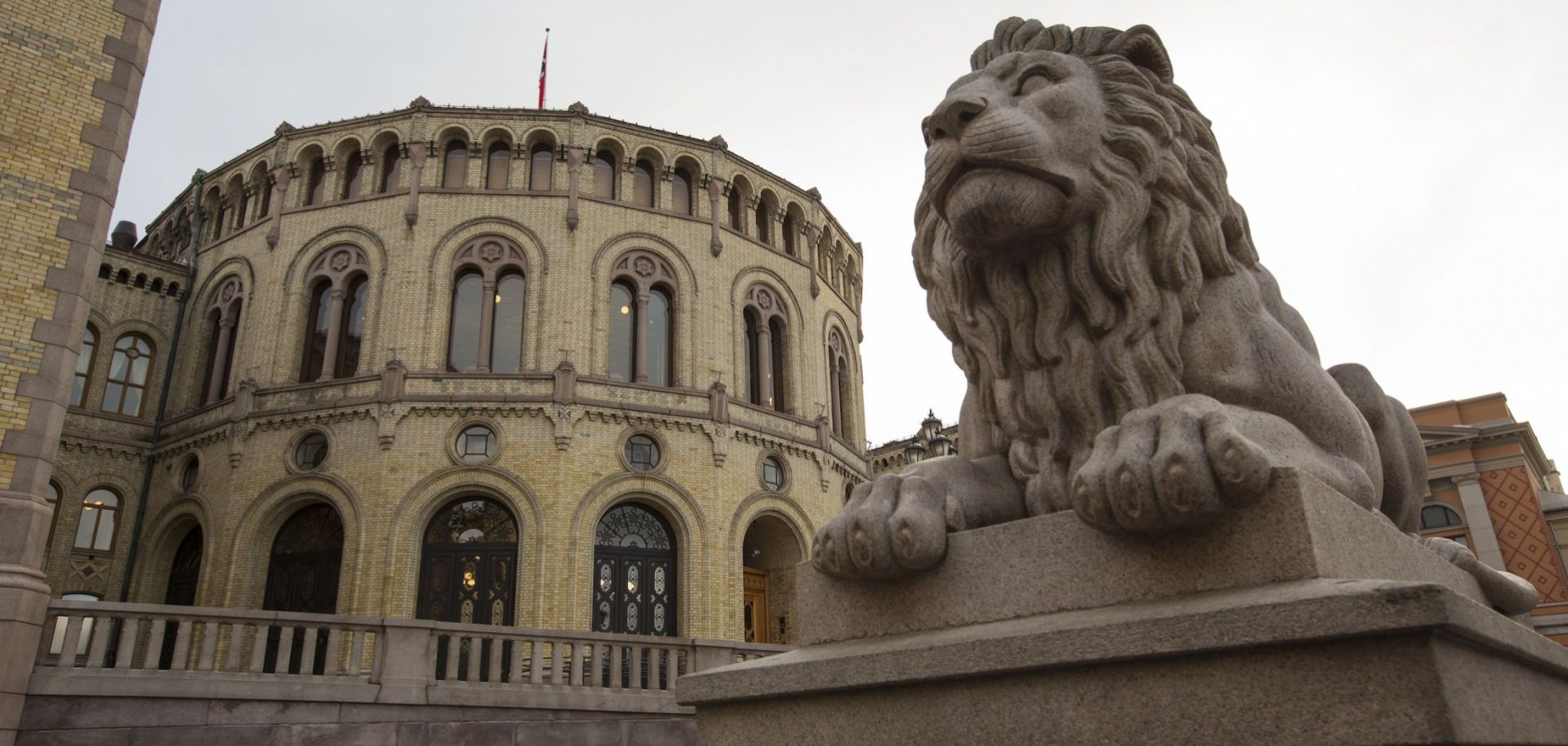
A photo taken in December 2014 shows Norway’s parliament building in Oslo.
The upcoming general election in Norway will increase the influence of small parties that want to ban additional oil exploration and reduce ties with the European Union, which could lead to significant economic changes in Western Europe’s largest energy producer. Norway will hold a general election on Sept. 13 to appoint the 169 lawmakers in its unicameral parliament, the Storting. The country’s multi-party system means that coalitions of several parties are needed to appoint governments, which tend to be center-right or center-left alliances.
- Erna Solberg, the leader of the Conservative Party, has been Norway’s prime minister since 2013. According to opinion polls, the popularity of Solberg’s government and her center-right allies is in decline and may not remain in power after the upcoming election.
- Polls suggest that the Labour Party, Norway’s main center-left party, is on the rise and could win the election. The polls also suggest that small progressive parties — including the agrarian Center Party, the center-left Socialist Left Party, and left-wing Red Party — could all play a significant role in the formation of a center-left government after the election.
While Norway is unlikely to take extreme measures against its hydrocarbon industry, a center-left government could reduce the number of concessions for additional exploration and lift tax subsidies for the sector. Norway is Western Europe’s largest oil and gas producer. The sector employs roughly 200,000 people and is the cornerstone of the country’s $1.4 trillion sovereign wealth fund, the largest in the world. In recent years, the country has drastically increased the use of renewable energy and has promised to cut carbon emissions by 95% by 2050. But while the conservative government has banned hydrocarbon exploration in some areas (such as the Lofoten islands), it wants the sector to remain a central part of the Norwegian economy for decades to come. The Greens, on the contrary, want to ban all new exploration altogether and phase out the entire industry in 15 years, while other center-left parties want to ban exploration in areas such as the Barents Sea in the Arctic, which experts believe to host most of Norway’s undiscovered oil and gas reserves. Labour defends the hydrocarbon sector and will push against the most extreme demands from the smaller parties, but may have to make concessions such as reducing tax subsidies and granting fewer license awards to oil companies in order to form a government. A change in government could also influence the Norwegian sovereign wealth fund’s investment decisions to further reduce the fund’s exposure to polluting activities.
- Norway’s oil production has fallen by around 12% since its peak in 2004, and the collapse of oil prices in 2020 has destroyed some 50,000 jobs in the country.
- In mid-May, the International Energy Agency (IEA) said all countries should stop investing in new oil and gas exploration if the world wants to reduce carbon emissions to zero by 2050.
- In mid-July, Solberg told the Financial Times that while she acknowledges that the country’s hydrocarbon sector is in decline, her government does not want to “speed up the process politically.”
While Norway is unlikely to exit the single market, relations with the European Union could become tenser under a center-left government and generate long-term uncertainty for businesses. Norway is not a member of the European Union but it has very close connections with the bloc through its membership in the European Economic Area (EEA). As a result, Norway participates in the EU single market and in most of the bloc’s initiatives (with a few exceptions, such as the bloc’s common agricultural and fisheries policies). While most conservative parties support the status quo, the Socialist Left Party and the Center Party want to renegotiate parts of Norway’s membership in the EEA. Norway is unlikely to exit the single market because most of its trade partners are members of it, but a serious push to renegotiate the EEA deal could result in increased business uncertainty about the future economic ties between Norway and the European Union.
- The Socialist Left Party is critical of the membership fees that Norway pays to the European Union in order to participate in the single market (which reached some 2.7 billion euros for the 2014-2021 period).
- The Center Party wants Norway to exit the EEA and sign bilateral trade deals with the bloc. The party has also called for Norway to exit the European Union’s Third Energy Package (which unbundled energy supply from the operation of transmission networks) and the Agency for the Cooperation of Energy Regulators (which seeks to further integrate the energy markets in the bloc).
