
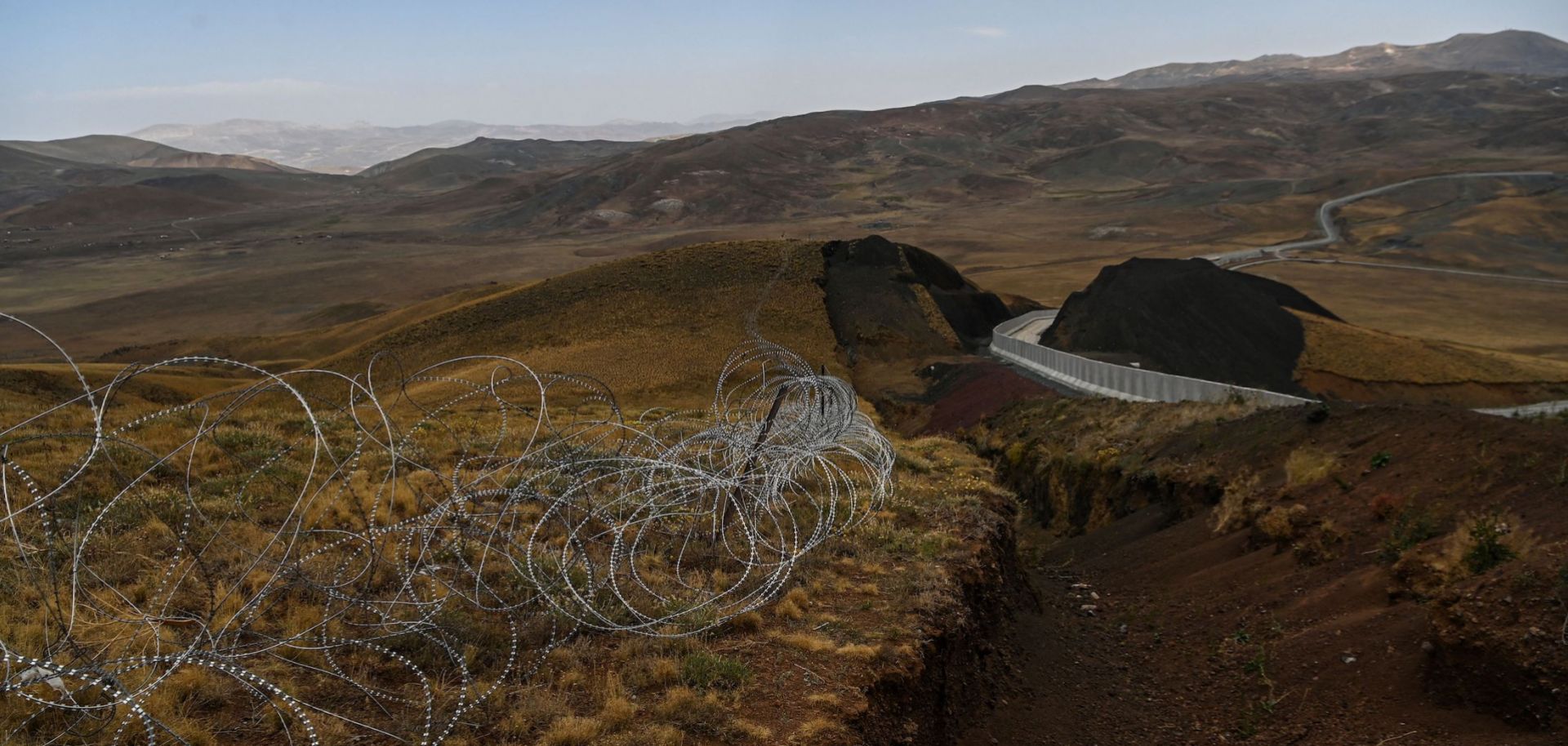
A picture taken on Aug. 16, 2021, shows the landscape of Iran behind a section of the newly completed wall on Turkey’s eastern border in Caldiran.
Amid the coming wave of Afghan migrants, the Turkish government will be forced to choose between exacerbating anti-refugee unrest at home or creating humanitarian crises elsewhere — either of which would threaten the ruling Justice and Development Party (AKP)’s hold on power. Since encountered waves of refugees from Syria and Afghanistan in 2014-15, the AKP has focused on hosting refugees in exchange for EU aid, while also playing up the party’s pan-Islamist ideological credentials by hosting fellow Muslims from war-torn countries. But nativism is on the rise in Turkey, as evidenced by anti-Syrian riots that broke out in Ankara on Aug. 11. And as a result, the AKP is now finding its refugee strategy outdated, and a growing threat to the party’s prospects in the scheduled 2023 national elections.
- Turkey already hosts some 4 million refugees. Most are Syrian, but roughly 120,000 are Afghans.
- Turkey’s refugee population, which is one of the largest in the world, has become an increasingly controversial topic in the country. This has been exacerbated by Turkey’s worsening economic situation in recent years, with native Turks and refugees competing for a limited number of jobs.
The AKP is now scrambling for political solutions to the expected new surge of Afghan refugees caused by the fall of the country’s government to the Taliban. To contain the expected flood of refugees, the government recently approved the construction of a new 150-mile barrier along Turkey’s border with Iran. Ankara is also keeping open options for an updated migrant agreement with Europe.
- Amid the volatility in Afghanistan in recent months, Turkish authorities had already reported an increase in Afghan migrants attempting to enter Turkish territory from Iran. In the wake of the Taliban’s Aug. 15 capture of Kabul, thousands more are expected to flee the country in the coming weeks, spurring new ways of migration across the world.
- On Aug. 16, U.N. Secretary-General Antonio Gutierres urged all countries to receive refugees and refrain from deportations.
Regardless of the AKP’s policy choices, however, the refugee question will increasingly undermine the ruling party’s domestic political support. Turkey may attempt to block new waves of Afghan refugees from entering Turkey, but if it does, Turkish Islamists and other religious Turks will weaken their support for the government, seeing it as Ankara turning its back on fellow Muslims. If Turkey opens the borders to new refugees, however, it will also exacerbate anti-refugee sentiment, especially as it’s not clear that new arrivals will be able to return to Afghanistan and could become a permanent burden on the country’s economy and labor market. Accepting new refugees would also risk triggering more riots like the Aug. 11 one, further undermining security and reducing domestic political support for the AKP. Turkey has less incentive to send refugees on to Europe as well, since doing so would jeopardize its ongoing migrant deal and access to much-needed EU funding, and the European Union might offer more aid money to contain a fresh Afghan refugee wave.
- Recent polls show that opposition parties like the Republican People’s Party (CHP) are already luring voters away from the ruling AKP and its ally, the ultranationalist Nationalist Movement Party (MHP). The ultranationalist Iyi Party also appears to be making inroads with MHP supporters, while the Islamist Felicity Party has historically tried to win over religious Turks to the anti-AKP coalition.
In its scramble to find a political strategy in the face of new Afghan refugees, Turkey might cause a humanitarian crisis as it blocks new refugees, expels them, or both. If Turkey closes its borders and keeps Afghans from entering, they will likely be trapped in Iran, which is facing a severe COVID-19 crisis and already hosts a U.N.-estimated 3.6 million (mostly Afghan) refugees. Under the weight of crushing U.S.-led sanctions, Iran also lacks the Western aid and internal government infrastructure to support a new wave of refugees to the same standard as Turkey. Additionally, as anti-refugee sentiment rises, Turkey might be tempted to resettle some Syrians in Turkish-protected territory in Syria, but will face strong pushback from Syrians who are concerned that the Syrian government will eventually retake these territories.
