
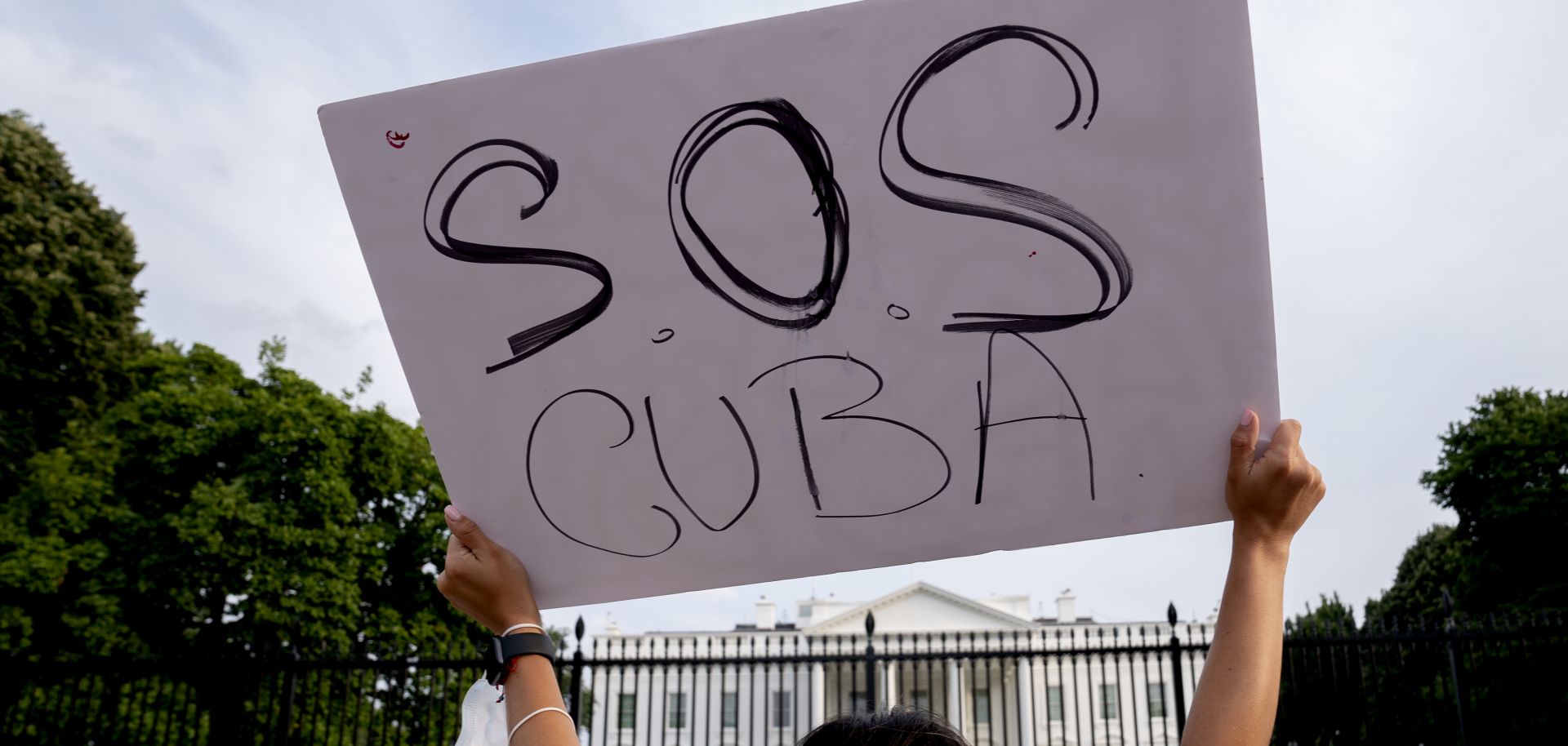
A demonstrator holds up a sign in solidarity with protesters in Cuba outside the White House on July 18, 2021.
New U.S. sanctions indicate President Joe Biden will take a harsher-than-anticipated approach to Cuba, which will hamper Havana’s efforts to attract new private investment. On July 22, the U.S. Treasury Department sanctioned Cuba’s defense minister and entire special forces unit, dubbed the Black Berets, following the violent crackdown on protests that erupted earlier this month. The sanctions were applied under the Global Magnitsky Act, which enables the U.S. government to target perpetrators of serious human rights abuses and corruption around the world. Biden has since warned the measures were “only the beginning” of his administration’s response to the Cuban government’s heavy-handed handling of the unrest, which resulted in mass arrests, collective trials and a social media blackout.
- This is the second time that the United States has sanctioned a Cuban entity under the Global Magnitsky Act since it went into force in 2012. During its final days in office in January, the administration of former U.S. President Donald Trump used the act to impose limited sanctions on the same elite Black Beret forces.
The sanctions are unlikely to deter the Cuban government from using similar heavy-handed tactics to quell future protests — portending further U.S. actions. On July 11, thousands of Cubans took to the streets to protest against food shortages, the high prices of goods and the country's weak health care system. Black Beret forces attempted to quell demonstrations with military tactics, leading to violent clashes between police and protesters. Several journalists were attacked and internet access was shut down for several days in the wake of the unrest. One man died on the outskirts of Havana and several hundred people remain missing after demonstrations calmed on July 12 due to lack of organization. Police forces have since detained over 160 people who participated in the protests. The regime has since carried out mass trials in which activist leaders are tried in small groups at the same time without access to legal defense.
- On July 10, protests began around noon in the municipality of San Antonio de Los Banos, located 26 kilometers (roughly 16 miles) from Havana. Other rallies then began springing up in Havana before ultimately spreading throughout the country as people took to the streets after seeing social media posts.
- The July 10 demonstrations were the largest Cuba has seen since a similar uprising against government policies in 1994.
- The majority of the detained activists were charged with inciting unrest, vandalism or assault, which could carry up to 20-year prison sentences.
The shift in Biden’s Cuba policy will likely deter foreign investment, which will raise the risk of additional episodes of unrest by prolonging the economic issues that triggered the July 11-12 protests. The sanctions mark a significant shift in the White House’s approach to Cuba, as Biden had promised to lift some U.S. sanctions on the island during his 2020 presidential campaign. There was also hope that the Biden administration would end aspects of the trade embargo and restore diplomatic relations with Cuba, which would in turn enable Western investors to fund business endeavors on the island. But as the White House leans on more restrictive sanctions against Cuba, the majority of investors will likely view business opportunities in the country as a liability. This will, in turn, risk impeding Havana’s recent efforts to open its economy by limiting foreign investment to businesses and stakeholders without ties to the United States — namely those in Venezuela and Iran, which traditionally have less readily available access to expendable capital.
- On June 2, Cuba’s Council of Ministers authorized private sector involvement in additional areas of the economy. The reforms allow Cubans to legally own and operate private businesses in more than 2,000 different sectors, expanding a previous list of only 127 sectors.
- Biden has promised some relief for the Cuban people — currently experiencing a humanitarian crisis — in the form of pressuring the Cuban government to release political prisoners and restore internet access. The White House is also reviewing the current remittances policy, which, if reversed, would allow Cubans living in the United States to send money to relatives on the island, who are more likely to be against the government regime.
