
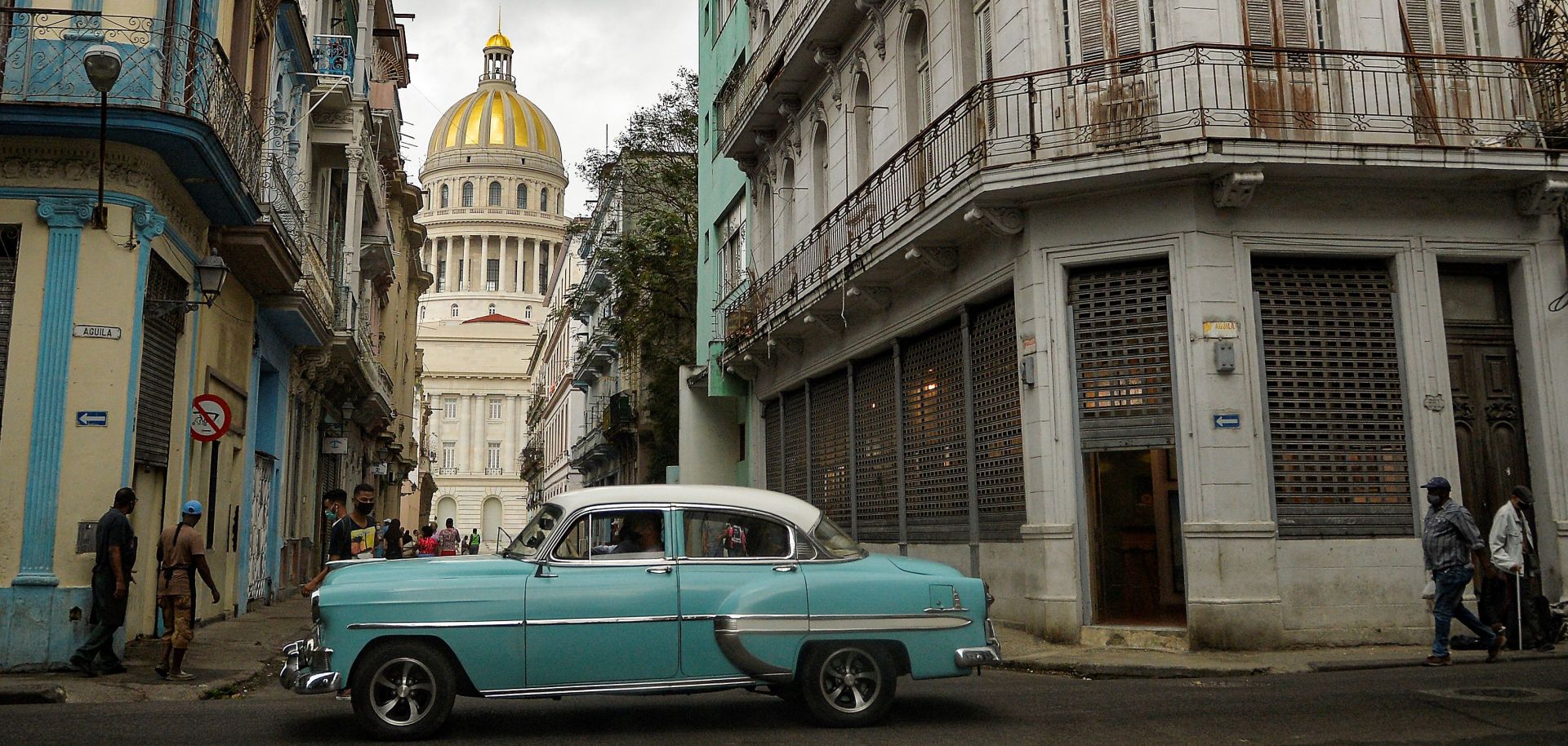
An old American car passes by the capitol building in Havana, Cuba, on May 3, 2021.
Cuba’s decision to allow private sector involvement in additional areas of the economy represents a modest move toward free-market policies that will allow some domestic companies to scale up operations and attract moderate levels of foreign investment, even as crucial sectors of the economy remain excluded from the reform. On June 2, state-owned media reported that Cuba’s Council of Ministers approved a reform that expands the list of economic activities where private ownership is authorized. The reforms, initially announced in February 2021, allow Cubans to legally own and operate private businesses in more than 2,000 different sectors, expanding a previous list of only 127 sectors. However, the 124 economic activities where private sector involvement remains prohibited are in some of the islands’ most lucrative industries, including tourism and tobacco production, as well as pharmaceuticals and health care. Private businesses also remain prohibited in the media and communications sector, which will enable Cuba to continue cracking down on anti-regime rhetoric.
- Since 2010 reforms, Cubans with private sector businesses have been forced to operate in a specified list of 127 sectors. This has resulted in a large black market where many of the unauthorized activities are performed.
- Because of the 2021 reforms, activities such as business consulting and technical services will now be open to the private sector.
- In 2020, only 13% of Cuba’s workforce was employed by privately-owned businesses.
The reform is representative of the island’s shifting political leadership and a practical response to Cuba’s deteriorating economic situation, which the global COVID-19 crisis and harsh U.S. sanctions have exacerbated. Cuba’s GDP shrunk 11% in 2020 as a result of increased U.S. sanctions and lack of tourism due to COVID-19. As a result, prices of goods in the country have skyrocketed over the past year, along with the black market value of the dollar, leading to widespread social unrest. In April, President Miguel Diaz-Canel was appointed head of the Cuban Communist Party, promising a continuation of communist rule seen under the Castro regime. But he also stressed the need to make the country more market-friendly, likely seeking to appease economically motivated protests in the country by creating the conditions for better job opportunities in the private sector. Additionally, the government is seeking to improve state revenue from new business operations, which are taxed at 15% if the firm is domestically owned and 35% if it’s headquartered abroad.
- In late 2020 and early 2021, several artist and activist collectives held prominent protests denouncing poor economic conditions and limits on freedom of expression.
- U.S. President Donald Trump increased sanctions on Cuba in an effort to roll back the normalized relations established under his predecessor, eventually culminating in the Trump administration re-designating Cuba as a state sponsor of terrorism in January.
Cuba’s new policies should moderately contribute to economic growth, due to the possibility of scaling businesses and the increased potential for foreign direct investment. While the ongoing COVID-19 pandemic will likely slow companies’ initial operations, the reforms will likely drive moderate growth and private-sector job creation. Domestic privately-owned businesses will be allowed to grow in ways that were not possible under the Cuban government’s previous restrictions. Small- and mid-sized foreign companies will likely also consider investing in Cuba — especially in sectors such as software programming, engineering and information technology that are now allowed to operate in the country for the first time. However, the threat of triggering sanctions will likely deter companies with ties to the United States to invest in Cuba, limiting the possibilities for foreign direct investment.
- The U.S. embargo on Cuba prevents American businesses and firms with commercial activities in the United States from conducting trade with Cuban interests, among other restrictions.
The Cuban economy’s deeper structural issues, however, will limit the scope of improvement. The legalization of the private sector will not alone be enough to boost economic growth. Diaz-Canel will thus likely continue to pursue other economic reforms, such as permitting wholesale trade and eliminating bureaucratic obstacles. But while such changes provide more room for economic growth, Cuba would need to fix structural issues such as its restrictive central planning system and the state dominance of lucrative sectors to rapidly stimulate business activity and revive its heavily sanctioned economy.
