
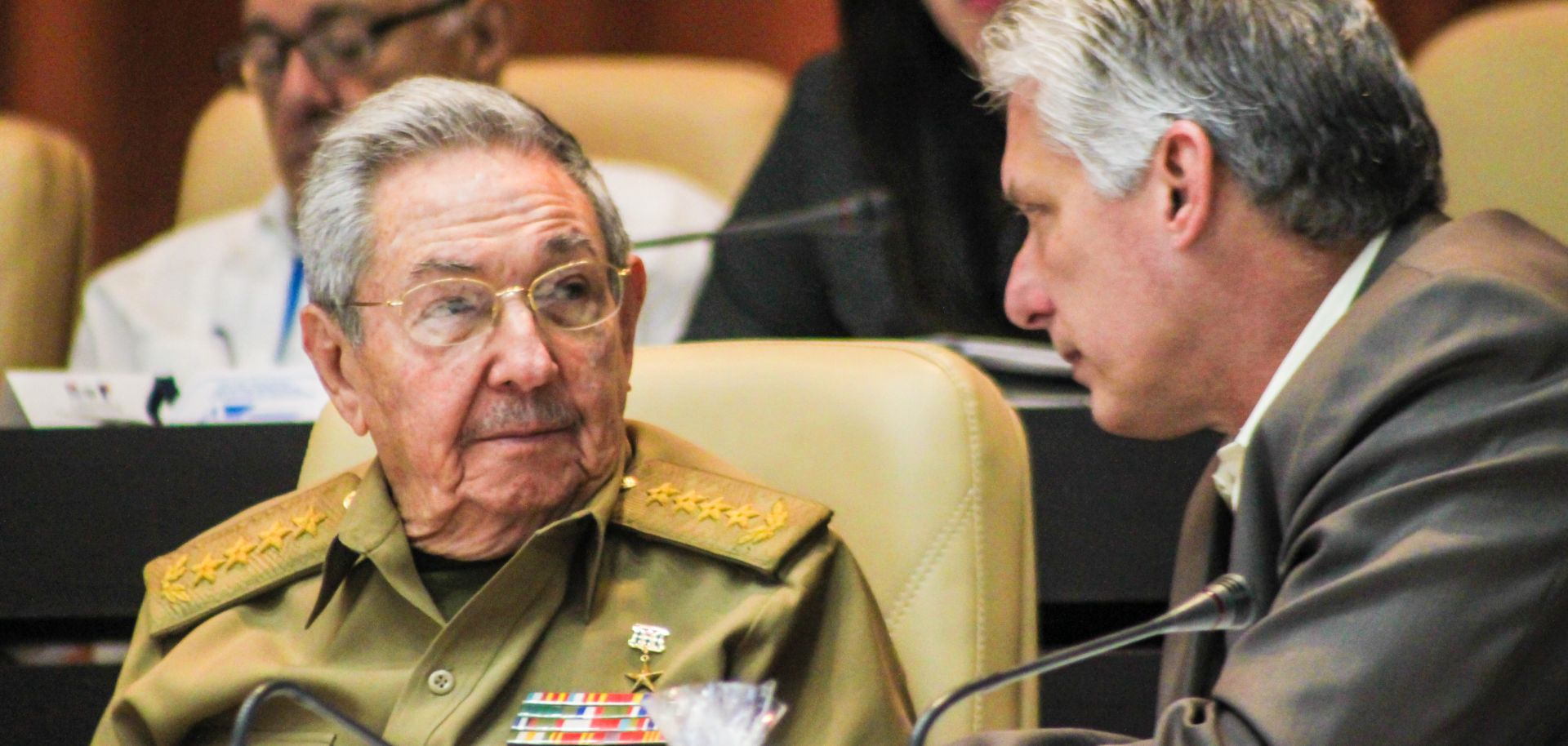
Cuban President Raul Castro (left) talks with first Vice President Miguel Diaz-Canel during the year-end parliamentary session in Havana on Dec. 21, 2017. Castro will step down in April 2018 after elections to choose his successor.
The end of an era is approaching in Cuba. Twelve years after taking the reins of power from his brother Fidel, President Raul Castro will hand over control to a hand-picked successor from the island's Politburo — most likely Vice President Miguel Diaz-Canel — on April 19. But even if Cuba will be without a Castro as leader for the first time since 1959, little is likely to change immediately with Diaz-Canel's accession. Real political power will continue to lie with the country's armed forces, which control most of the major economic conglomerates. Still, some changes will be inescapable, as the government goes in search of more tourist dollars to guarantee it a modicum of economic survival. In the end, economic and potential political changes will corrode the Communist Party's power in the coming years, ushering in political instability that the island has not seen for nearly six decades of socialist rule.
The Economic Mountain to Climb
Over the next few years, Diaz-Canel will govern Cuba in much the same fashion as Castro. The government will maintain absolute control over the country's political system, and the prospective arrest, harassment and surveillance of opposition figures will continue to harm Cuba's political relationship with the United States. Havana will likely implement certain economic reforms, including moves to unify the island's dual currencies to improve efficiency. Cuba maintains a complicated currency system with the Cuban peso and the far more valuable Cuban convertible peso. Pegged to the U.S. dollar, the convertible peso generally funds imports and tourist spending in the country. Unifying the two currencies will challenge the Diaz-Canel government, whose priority will rest in containing inflation from a higher demand for goods.
Of greater concern to the new administration is the country's major financial shortfall. Because of Venezuela's severe economic crisis, Havana will devote significant time and energy to managing Cuba's rising fiscal imbalances. During the rule of Hugo Chavez, Venezuela delivered — at no charge — more than 100,000 barrels of crude oil and fuel daily to Cuba. Aside from shielding Havana's finances from the impact of higher global oil prices, Caracas provided a major source of foreign revenue for Cuba as it paid the state millions of dollars a year for the services of Cuban doctors, among other forms forms of financial assistance. Cuba will attempt to retain its energy relationship with Venezuela, which now totals about 50,000 barrels per day, for as long as possible. But because of the perilous state of Venezuela's economy, Caracas can share little of its diminishing largesse with Havana, meaning austerity is likely to reign during the early years of Diaz-Canel's rule.
A sharp reduction in food and fuel imports in Cuba is unlikely to spur unrest in the short term, but the dearth of such products will eventually create problems for Diaz-Canel — especially because the country is already contending with a bloated public sector, severely depleted foreign currency reserves and a tiny domestic market incapable of driving sustainable economic development. Accordingly, homing in on a reliable source of foreign revenue will be a major priority for the government. Though Cuba can trade with the rest of the world, including key allies such as China and Russia, it has few profitable exports to offer and no private sector capable of stimulating demand for imports. In the absence of a well-developed economy, tourism revenue could provide the most feasible short-term solution to Cuba's financial difficulties.
Trusting in Tourism
The United States is the most logical source of visitors to inject much-needed tourism revenue into the Cuban economy, but Washington's trade embargo against the island will complicate Havana's efforts to develop the industry. Ultimately, Cuba cannot begin to search for a permanent solution to its financial troubles and economic underdevelopment until the United States lifts the embargo. According to current U.S. law, however, Washington will not lift its sanctions until Cuba's government complies with stipulations that would severely weaken its political dominance. Even under a government more amenable to improving relations with Cuba than the administration of President Donald Trump, any negotiations to end the embargo would be politically contentious in the United States. Still, Congress could rescind or replace the legislation underpinning the embargo. Support for such action could even come from the strong Cuban-American lobby in Florida, and many in that group now favor lifting the blockade, according to survey data from 2014 and 2015. Alternatively, Cuba could slowly comply with the U.S. demands for greater political openness in the hopes that Washington would lift sections of the embargo. In the end, the lifting of the sanctions would precipitate a freer flow of tourists between Cuba and the United States.
While cementing closer economic ties with the United States might pad Cuba's budget, such relations are likely to foment political instability on the island in the long run. For Cuba to reap a windfall from greater numbers of visiting U.S. tourists, it may be obliged to loosen political restrictions. With more political openness, more officials in the system would seek a greater slice of the lucrative state-run tourism sector. Ultimately, a rising influx of tourist dollars and growing factionalization in the political system could ignite instability by driving Communist Party officials to compete for prominence and key posts.
Diaz-Canel's administration will pursue domestic and foreign policies that are largely similar to those of the preceding Castro government. Pressure, however, will slowly build on the new leadership to address Cuba's acute financial and economic problems. Acting out of necessity, Havana will take steps to end the U.S. economic embargo against the island. But regardless of the ultimate fate of the embargo, more tourism revenue for the state's empty coffers — along with the possibility of growing factionalization among leading cadres — will serve to rock Cuba's political boat for the first time in decades.
